
Battle of Inverkeithing
Major-general John Lambert found two spent bullets lodged in his coat after the fighting at Inverkeithing. They had not penetrated. The cavalry duel had lasted barely thirty minutes, on the rising ground of Castland Hill just inland from the Ferry Peninsula. When it ended, three Scottish cavalry regiments were broken, the brigade commander John Browne of Fordell was dying of his wounds, and Cromwell's New Model Army held the deep-water port of Burntisland in Fife. Within a fortnight Cromwell had crossed the Firth of Forth with thirteen thousand men, bypassed Stirling, and was marching on Perth. Within six weeks Charles II was a fugitive in England and the Scottish Covenanter government was finished. It all began on the morning of 20 July 1651, on an isthmus half a mile wide.
Why the Forth Mattered
After Cromwell smashed David Leslie's Scots at the Battle of Dunbar in September 1650, the surviving Covenanter government regrouped at Stirling - the choke point that controlled access to north-east Scotland, the source of Scottish food and recruits. Cromwell could not take Stirling by direct attack. For nearly a year he probed, marched, retreated in the weather, and tried every gambit to draw Leslie into open battle. Leslie refused. The breakthrough came not from another assault on Stirling but from the water. Cromwell had quietly ordered fifty flat-bottomed boats built in late 1650. They arrived at Leith in June 1651. On the early morning of 17 July, 1,600 English troops under Colonel Robert Overton boarded them and crossed the Forth at its narrowest point, landing at North Queensferry on the Ferry Peninsula - completely outflanking the Scottish position at Stirling.
The Armies Form
By 20 July the English had ferried over four infantry regiments and three cavalry regiments - approximately 4,000 men - and Major-general John Lambert had taken command on the north shore. The Scots, hastily mobilised from Burntisland, Stirling, and Dunfermline, fielded three infantry regiments under Major-general James Holborne, 500 Highlanders led by Sir Hector Maclean of Duart, and three cavalry regiments under John Browne of Fordell. The historian Austin Woolrych puts their total at over 4,000. Holborne thought he was outnumbered and ordered a withdrawal. Lambert thought he was the stronger and sent cavalry to harass the Scottish rearguard. Holborne turned and formed line on the lower slopes of Castland Hill - 63 metres high, dominating both the road to Inverkeithing and the route north to Dunfermline.
Thirty Minutes
For ninety minutes the armies stared at each other. Neither commander wanted to attack uphill or downhill across that isthmus. The standoff broke when a messenger reached Lambert with news that Scottish reinforcements were coming from Stirling. He had to win quickly. The English advanced. Browne's Scottish cavalry on the right charged the weaker English flank and routed it - briefly. But Browne had committed every horseman to the charge with no reserve. The English reserve cavalry counter-charged the disordered Scots and broke them. Browne was captured; he died of his wounds. On the other flank the same pattern played out: initial Scottish success, then collapse before the English reserve, which Lambert probably led in person. This part of the battle was over in less than thirty minutes. Two of the three Scottish infantry regiments managed to retreat in good order. The third, and Maclean of Duart's 500 Highlanders, were caught and largely destroyed. Duart was killed. Many of his clansmen died with him.
Aftermath: The End of the Scottish War
Lambert marched east and seized Burntisland's deep-water port. Cromwell shipped most of his army across, and by 26 July had 13,000 to 14,000 men in Fife with only eight regiments left south of the Forth. On 31 July he ignored Stirling and marched for Perth, the temporary Scottish capital, which surrendered after two days. With supplies, recruits, and government cut off, Charles II and Leslie made a desperate gambit: they marched south to invade England and try to spark a Royalist rising. Cromwell followed, leaving General George Monck with 6,000 men to mop up Scotland. On 3 September 1651 - one year to the day after Dunbar - Cromwell crushed the Scottish army at the Battle of Worcester. Two days earlier, on 1 September, the last Scottish stronghold of Dundee had been stormed and sacked by Monck's troops, with several hundred civilians killed. Scotland was now under English military rule. It would not have its own government again until the 1660 Restoration; it would not be united formally with England until 1707.
From the Air
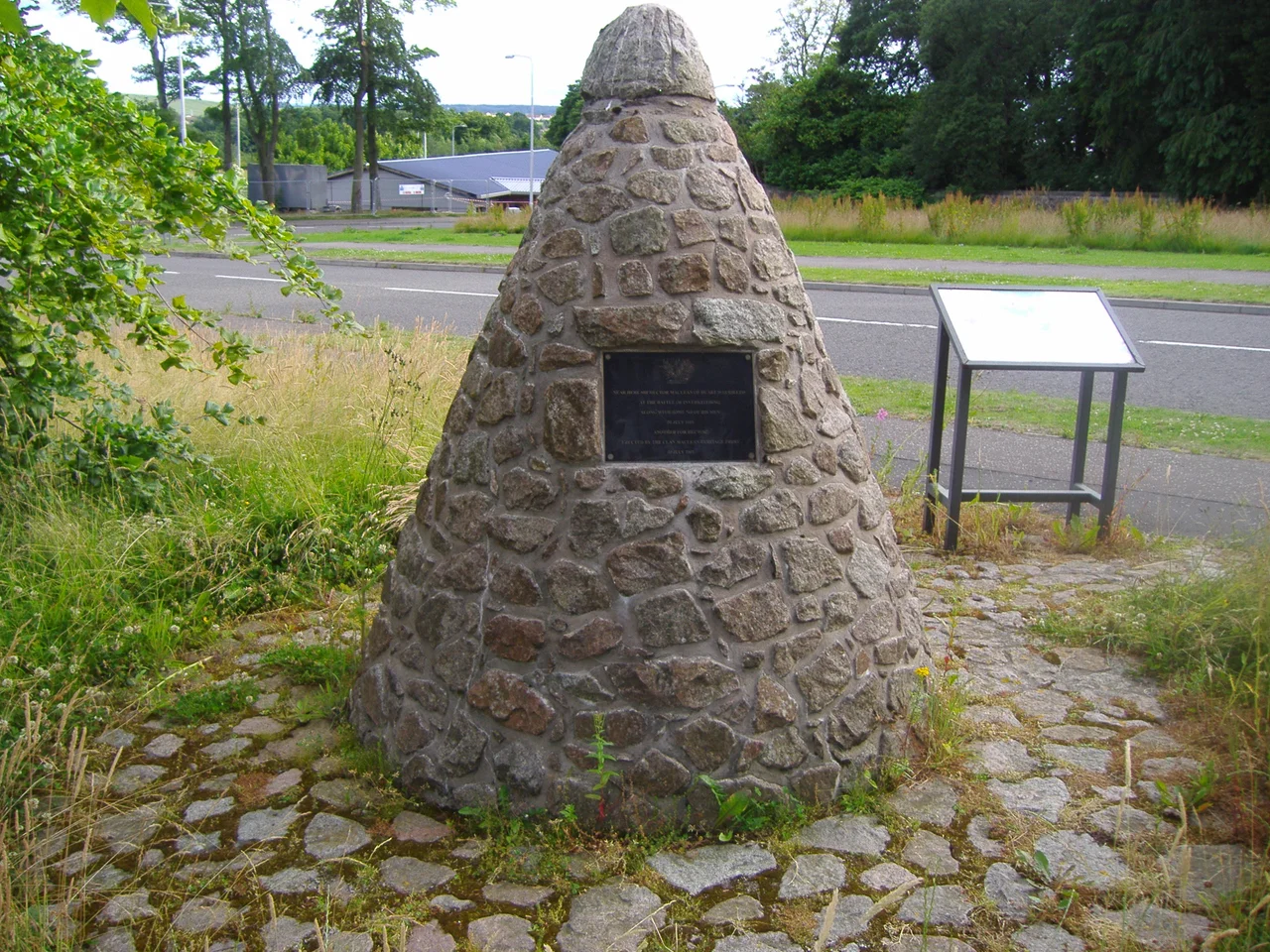
The battlefield lies at 56.048 degrees N, 3.416 degrees W, on the Ferry Hills and Castland Hill just south of Inverkeithing, Fife. Edinburgh Airport (EGPH) is about 5 nautical miles to the south-southeast across the Firth of Forth. From the air, the three Forth Bridges (Forth Bridge, Forth Road Bridge, Queensferry Crossing) are the unmistakable landmark; the battlefield sits immediately north of where the bridges land in Fife, on the rising ground between North Queensferry and Inverkeithing. A commemorative cairn marks the approximate site of the fighting. Best viewed at 2,000-4,000 ft AGL; on a clear day you can see both the battlefield and the Stirling plain Cromwell bypassed.
Nearby Stories
- Ardoch Roman Fort 2.2 km away
- Craignethan Castle 3.1 km away
- Haddington 3.8 km away
- Balvaird Castle 4.3 km away
- Battle of Kilsyth 9.4 km away
- Siege of St Andrews Castle 9.9 km away
- Neidpath Castle 11 km away
- Melrose Abbey 15 km away