
Battle of Kaiapit
Captain Gordon King climbed into a C-47 Dakota at Port Moresby on the morning of 17 September 1943, carrying orders so brisk they read like a telegram. Thirteen transport aircraft lifted off. Two hours later, one blew a tire landing on the rough Leron airstrip, and another tried to touch down on a single wheel before its undercarriage collapsed into a belly landing. The plane was written off. Nobody was hurt, and nobody yet knew that a Japanese force of roughly 500 men was marching through the mountains toward the same village King had been ordered to capture. King had about 300. Two days later, he would attack anyway.
The Valley and the Plan
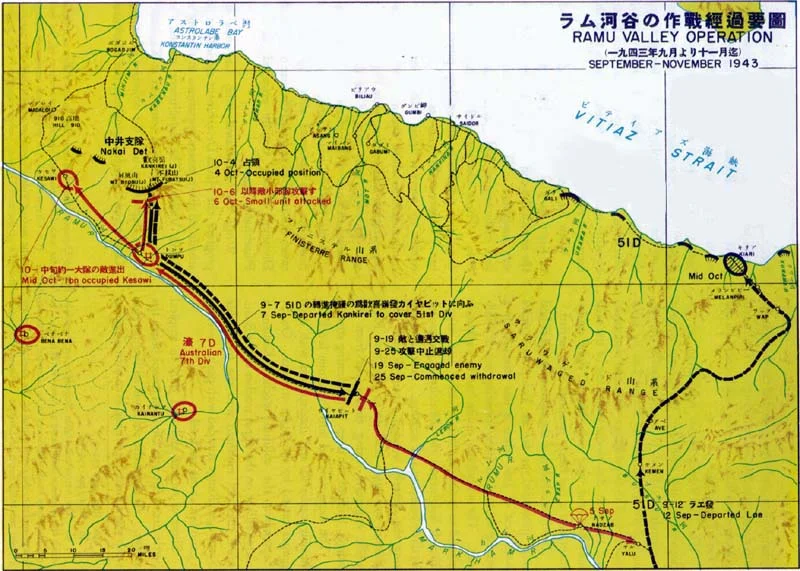
The Markham Valley is a long, flat depression cutting through the mountains of northeast New Guinea. The Markham River runs southeast to the port of Lae; the Ramu River runs northwest toward the coast at Madang. Between them an invisible divide separates the two drainages. In September 1943, with Lae falling to Allied forces, General Sir Thomas Blamey wanted to push up the valley and seize airfield sites that would bring Fifth Air Force fighters within range of the major Japanese base at Wewak. The problem was that the airstrip at Kaiapit, about 130 kilometers up the valley, could only be supplied by air. Fifth Air Force commander Lieutenant General George Kenney gave Colonel David 'Photo' Hutchison a simple brief: get me a forward airdrome. The Australian 7th Division under Major General George Vasey would do the capturing.
The Race for Kaiapit
What neither side knew at first was that both were converging on the village at once. The Japanese commander Major General Masutaro Nakai had ordered Major Yonekura Tsuneo to lead a reinforced force to Kaiapit - two infantry companies of the 78th Regiment, one from the 80th, plus machine gunners, signalers, and engineers - to threaten Nadzab and cover the Japanese garrison escaping from Lae. Yonekura's column left Yokopi on 6 September and slogged through mud and monsoon rain for two weeks, moving by night to avoid Allied aircraft. King's 2/6th Independent Company, meanwhile, had been delayed three days by weather at Port Moresby. The first section under Lieutenant Maxwell was sent ahead to scout. At 14:45 on 19 September, King heard gunfire in the distance and guessed correctly that the scouts had been found.
Two Days at the Village
The 2/6th Independent Company was organized differently from a regular infantry company - smaller in some ways, but with considerably more firepower. Each subsection carried a Bren light machine gun; most other soldiers carried Owen submachine guns rather than rifles. When King's men advanced on Kaiapit through high kunai grass at 15:15, they came under fire from foxholes at the village edge. A 2-inch mortar silenced one Japanese machine gun. Grenades and bayonets cleared the foxholes. The Japanese withdrew, leaving thirty dead. Two Australians were killed and seven wounded, including King. The company dug in for the night. Before dawn, Yonekura's main body arrived after an exhausting forced march and opened fire in the pre-dawn light. King counter-attacked immediately, catching the exhausted Japanese column before it could organize. C Platoon advanced into the ground called Village 3 and was pinned down. A Platoon worked around the right flank toward the high ground on Mission Hill. Lieutenant Bob Balderstone led his section across open ground and took out three machine gun posts with grenades - he later received the Military Cross. Lieutenant Reg Hallion was killed attacking another position, but his section captured it and killed twelve Japanese defenders. By 10 a.m. the battle was over. Yonekura was among 214 Japanese dead counted on the field, with another fifty or more estimated in the grass. The Australians lost fourteen killed and twenty-three wounded.
What the Victory Opened
Lieutenant Frazier landed his Piper Cub on the captured airstrip at 12:30 that afternoon and immediately decided it was unsuitable for Dakotas. A new strip was prepared near Mission Hill, and the next day Hutchison landed a test Dakota there, evacuated the wounded, and brought back rations and ammunition. On 22 September, with good flying weather, the transport pilots made ninety-nine round trips between Nadzab and Kaiapit - an airborne lift operation of the kind the Pacific War was just learning to execute. The 2/16th Infantry Battalion flew in, then the 2/14th, then artillery, then the entire 25th Infantry Brigade. The Japanese threat to Nadzab evaporated. The gate to the Ramu Valley stood open. Engineers eventually decided that Kaiapit itself was too swampy for the big airfields - they built instead at Gusap, further up the valley, where the US 871st, 872nd, and 875th Airborne Aviation Engineer Battalions laid out ten airstrips. A P-40 Kittyhawk squadron flew its first missions from Gusap in November 1943.
Luck and Skill
Vasey later told King that 'we were lucky, we were very lucky.' King bristled: 'If you're inferring that what we did was luck, I don't agree with you sir because I think we weren't lucky, we were just bloody good.' Vasey meant something more honest than King first heard. He had sent a small, unsupported company deep into contested territory, and he confided to Lieutenant General Edmund Herring afterwards that he believed he had made a potentially disastrous mistake. The Japanese account, written by the historian Tanaka Kengoro, acknowledged that Nakai's detachment had failed to hold Kaiapit and had instead handed the Allies a forward base. Three Papua New Guinean civilians were found at Kaiapit, tied to the uprights of a native hut and bayoneted by retreating Japanese - their deaths became part of William Webb's war crimes report submitted to the United Nations in 1944. King received the Distinguished Service Order. He always considered it a unit award, and later regretted not asking for the American Distinguished Unit Citation his men might have deserved.
From the Air
The Battle of Kaiapit occurred near 6.24 degrees south, 146.26 degrees east, in the upper Markham Valley of Morobe Province, Papua New Guinea. The valley is a long flat depression between the Finisterre Range to the north and the Saruwaged Range to the south - excellent for airstrips but hemmed in by high terrain. Nadzab Airport (AYNZ) near Lae is the regional aerodrome built up from WWII. Port Moresby (AYPY) is the major international hub. Expect convective weather in the afternoon and poor visibility in the rainy season.
Nearby Stories
- 1993 Finisterre Earthquakes 11 km away
- Landing at Nadzab 16 km away
- Madang and Morobe 24 km away
- Goroka 25 km away
- Mount Wilhelm 60 km away
- Vitiaz Strait 62 km away
- Morobe Province 75 km away
- Strathallan Estate 145 km away