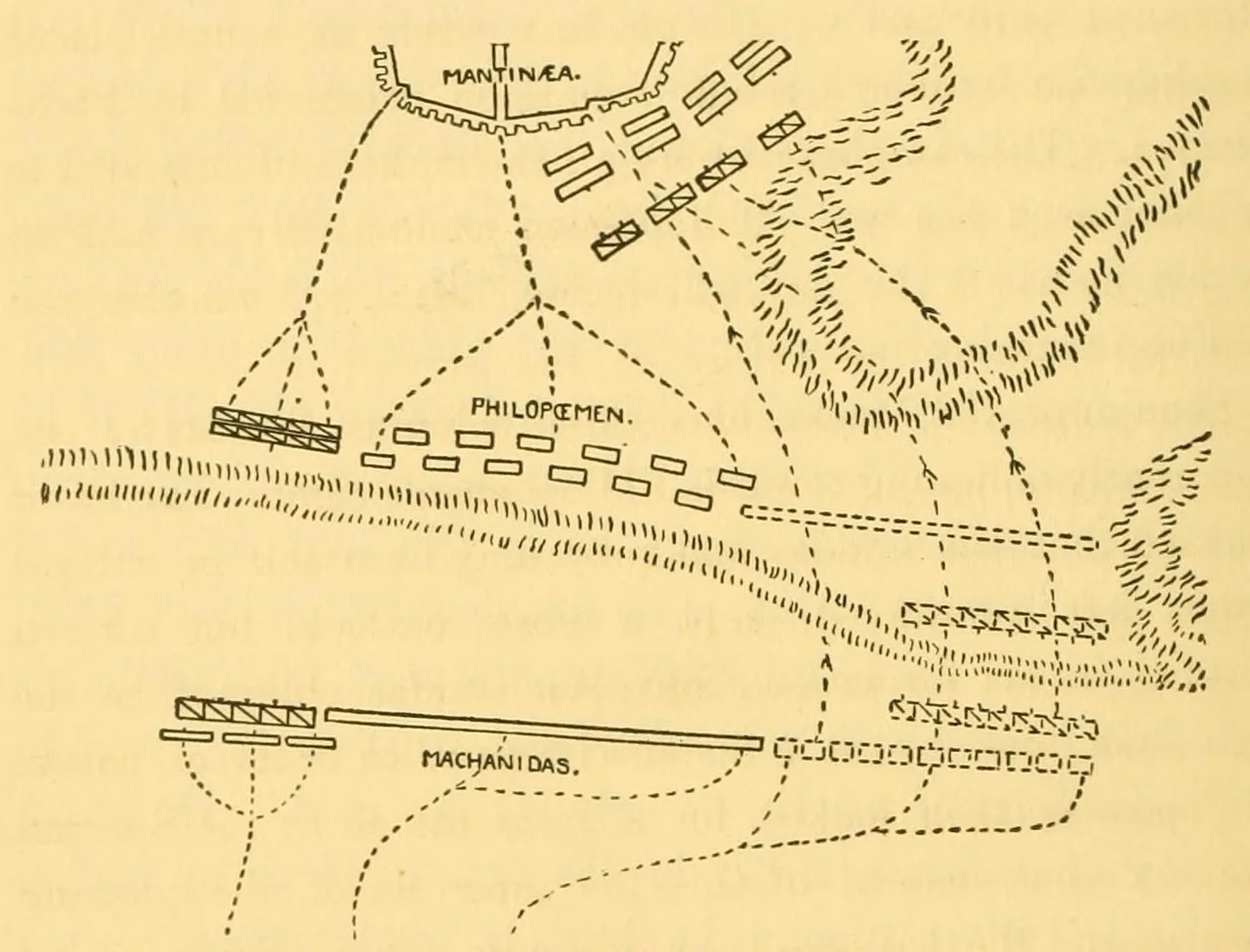

Battle of Mantinea (207 BC)
There were three battles at Mantinea. This is the one that almost no one remembers, which is a pity, because it has the most vivid ending. In 418 BC, the Spartans crushed the Argives and their allies on this same plain. In 362 BC, Epaminondas died here winning a victory that broke the back of Spartan power. And in 207 BC, on the same flat terrain between the mountains, the Achaean general Philopoemen met the Spartan tyrant Machanidas — and killed him in person, at the edge of a ditch, while the armies watched.
The Wider War Behind the Battle
By 207 BC, Greece was entangled in a conflict whose origins lay far to the west. In 216 BC, Hannibal Barca had annihilated a Roman army at the Battle of Cannae in southern Italy, one of the most complete military defeats in ancient history. The Macedonian king Philip V, seeing an opportunity, had concluded an alliance with Carthage, drawing Macedonia into what became the First Macedonian War against Rome. Greece's Greek powers then arrayed around this Macedonian-Carthaginian axis and its Roman-Aetolian opposition. Sparta, under the tyrant Machanidas, aligned with the Aetolian League against Macedonia. The Achaean League, including Arcadia, sided with Macedonia. The confrontation at Mantinea in 207 BC was therefore a local battle in a Mediterranean-wide conflict — one whose outcome mattered both for who controlled the Peloponnese and for the broader question of which bloc would dominate Greece.
The Trap Sprung on the Plain
The two armies met on the Arcadian plain near Mantinea with comparable forces, both supplemented by mercenaries. Machanidas opened aggressively. His mercenaries — likely Tarentine cavalry and light infantry — routed Philopoemen's mercenaries on one wing and chased them from the battlefield. The pursuit was too eager. While Machanidas and his men were running down the fleeing soldiers, the main Spartan infantry, facing the Achaean line without their commander, were defeated. Philopoemen, recognizing what had happened, did not pursue the broken mercenaries but held his position and entrenched the Achaean line behind a water-filled ditch — a prepared defensive position that transformed the returning Spartan cavalry from a victorious strike force into a force trapped on the wrong side of an obstacle. When Machanidas returned to find his infantry defeated and the Achaeans fortified behind the ditch, his options had collapsed.
The Death of Machanidas
What happened at the ditch is recorded in detail by Polybius, the Arcadian-born historian who wrote the definitive Greek account of Rome's rise. Machanidas attempted to lead his men across the ditch — to assault the Achaean line or to escape, the sources do not entirely agree on his intent. As he urged his horse toward the crossing, Philopoemen was there to meet him. The two men fought at the water's edge. Machanidas was unhorsed and killed by Philopoemen in personal combat. Ancient sources, including Plutarch's Life of Philopoemen, make clear that this was not a chance killing in the melee but a direct encounter between the commanders. The Achaeans later commemorated the victory — and Philopoemen's personal role in it — by erecting a bronze statue at Delphi, depicting Philopoemen delivering the killing blow to Machanidas. The statue was a statement about what the battle meant: not just an Achaean victory, but the defeat of Spartan tyranny by Arcadian leadership.
The Last of the Greeks
Philopoemen was born around 253 BC in Megalopolis, the Arcadian city that Epaminondas had founded to check Spartan power. He devoted his career to reforming the Achaean League's military — introducing Macedonian-style phalanx tactics and equipment, drilling his troops personally, and leading from the front in a way that cost him his life in 183 BC when he was captured and executed during a campaign in Messenia. Ancient sources called him 'the last of the Greeks' — a title that acknowledged both his personal virtues and the pathos of his timing. He was the final general of the independent Greek world, fighting to maintain something that Rome's growing shadow was already beginning to make obsolete. The 207 BC Battle of Mantinea was his finest military achievement: a battle he won not by superior numbers but by discipline, tactical awareness, and the willingness to personally finish what the fighting had started.
From the Air
The Battle of Mantinea (207 BC) was fought on the Arcadian plain near Mantinea, at approximately 37.6°N, 22.4°E — just north of modern Tripoli in the central Peloponnese. From the air, the tactical logic of the battle is clearly readable: the flat, open plain where cavalry could maneuver, bounded by mountain ridges that constrained the armies to a defined battlefield. The ancient city of Mantinea's ruins lie a few kilometers north of Tripoli, visible as a faint outline in the agricultural fields. Kalamata International Airport (LGKL) is the nearest major airport, approximately 60 kilometers to the southwest. Athens International (LGAV) serves the region from about 200 kilometers northeast. The terrain has changed remarkably little since 207 BC — the same plain, the same ridge lines, the same narrow corridors that turned Machanidas's overeager pursuit into a fatal mistake.
Nearby Stories
- Araklovon Castle 4.8 km away
- Pellana 6.6 km away
- Arkadiko Bridge 10 km away
- Siege of Corinth (1463) 11 km away
- Leonidio 11 km away
- Kyparissia 11 km away
- Pheneus 14 km away
- Santameri Castle 29 km away