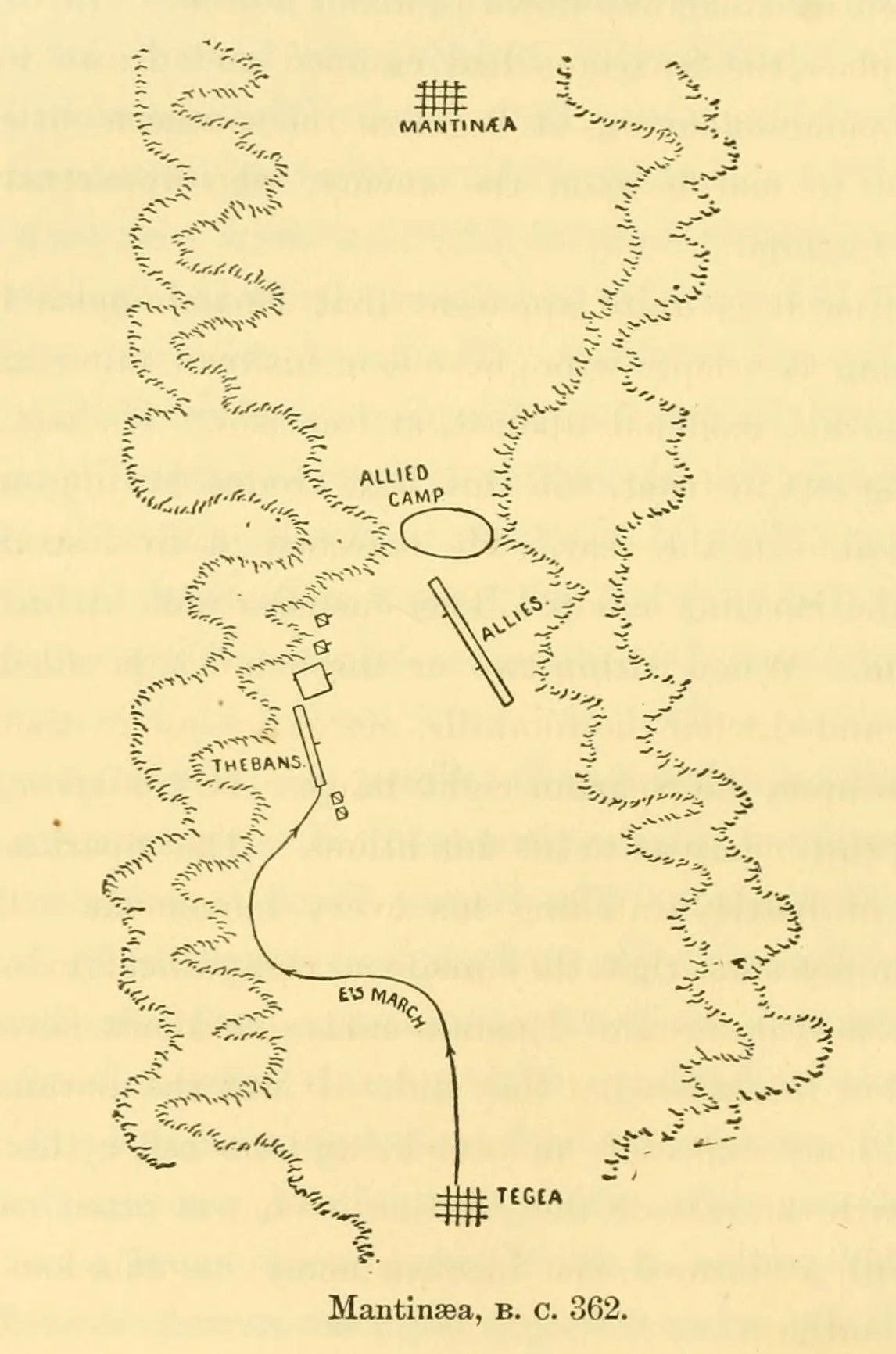

Battle of Mantinea (362 BC)
Epaminondas lay dying on the high ground of Skopi, carried there by the soldiers who had pulled the Spartan javelins from his body. Below him, his army held the field. He had won. His intended successors, Iolaidas and Daiphantus, were also dead. When word came of that, he told the Thebans to make peace. Then he died. It was 4 July 362 BC, and the battle that was supposed to settle the question of who would rule Greece had instead settled nothing — except the fate of the man who might have answered it.
The Road to Mantinea
For nine years before this battle, the Greek world had been rearranging itself around Theban power. Epaminondas — general, statesman, and one of the ancient world's most original military minds — had shattered Spartan dominance at the Battle of Leuctra in 371 BC, stacking his left flank fifty men deep to overwhelm the Spartan right. The reverberations were enormous. Sparta's centuries-old prestige as the unbeatable land power simply collapsed. Epaminondas then marched into Laconia itself while King Agesilaus II watched from behind Sparta's walls, and repopulated Messene — the city whose people Sparta had held as serfs for generations — fortifying it with walls the sources called the finest in Greece.
By 362 BC, a new crisis had fractured the Arcadian League that Thebes had sponsored as a counterweight to Sparta. The city of Mantinea broke with the league and aligned itself with Athens and Sparta. Epaminondas marched south once more. He tried a night raid on Sparta itself — a bold stroke foiled when a Cretan traveler happened to spot the Theban column moving in darkness and warned Agesilaus. Denied that coup, Epaminondas fell back on Tegea and prepared a decisive engagement in the plain near Mantinea.
The Shape of the Battle
The allied forces facing Epaminondas — Spartans, Athenians, Eleans, and Mantineans — fielded roughly 20,000 infantry and 2,000 cavalry. The Athenians contributed about 6,000 men, the Spartans around 1,000 of their dwindling citizen warriors. Epaminondas deployed his Theban-led force with the same oblique-order tactics that had won at Leuctra: his strong left wing, personally led from the front line, would punch through the Spartan right while the weaker right of his own line refused engagement. Xenophon, who was no admirer of the Thebans, described that Theban left wing as "like a trireme, with the spur of the prow out in front."
The Theban cavalry and light troops drove off the enemy horsemen. The Mantinean commander Podares fought hard before he was killed, and his hoplites broke and fled. But as Mantineans streamed back, the Spartans made a desperate final throw: they hurled their javelins at Epaminondas. Several struck him. His men carried him up the slope of Skopi even as the battle below unfolded in Theban favor.
The Cost of Victory
The Thebans held the field. By every military measure, they had won. Yet after Epaminondas died, his left wing simply stopped. The Theban advance froze; the retreating Spartans and Mantineans were not pursued. The moment of potential dominance passed unused.
Among the dead on the Athenian side was Gryllus, the son of Xenophon — killed in an earlier cavalry skirmish when exhausted Athenian horsemen, stopping at Cleonae, were begged by the Mantineans to ride out and engage the Theban cavalry ravaging the countryside. Gryllus died in that bitter preliminary fight. The grief of one father, the historian who wrote down what happened that summer, runs quietly beneath the surviving account.
The total losses are not precisely recorded. The sources dwell more on the political wreckage than the body count. Sparta had suffered another defeat that further eroded its citizen manpower, already badly depleted since Leuctra. Thebes had lost not only Epaminondas but both men he had intended to lead Boeotia after him.
Greater Confusion Than Before
Xenophon ended his history — the Hellenica — with this battle, and with a conclusion that has struck readers ever since: rather than bringing resolution, Mantinea left Greece in greater confusion and disorder than it had known before. No single power emerged to lead the Greek world. Thebes could not hold what Epaminondas had built; without him, the system collapsed. Sparta was too weakened to reassert itself. Athens remained a naval power but not a land hegemon.
The vacuum did not last long. From 368 to 365 BC, a young Macedonian noble named Philip had been held as a hostage in Thebes, where he watched and learned from Epaminondas. He returned to Macedonia in 364 BC. Within a generation, the confusion that Xenophon described had been resolved — by Philip, and then by his son Alexander — but not in any way the Greeks of 362 BC could have imagined or chosen.
The Plain Today
The battlefield lies in the broad agricultural plain near the modern town of Tripoli in Arcadia — the same flat ground, hemmed in by low mountains to east and west, where hoplite armies collided three times across two and a half centuries. Ancient Mantinea's ruins lie a few kilometers north of modern Tripoli. The plain is fertile and quiet now, planted with crops, the mountains ringing it in shades of grey-green. Nothing marks the spot where Epaminondas died on Skopi hill. The place carries its history invisibly, the way most Greek landscape does: a long argument conducted in stone and bone, now stilled to olive groves and afternoon light.
From the Air
The battle site lies at approximately 37.60°N, 22.40°E on the Mantinea plain in Arcadia, roughly 8 km north of modern Tripoli (ancient Tripolitsa). From the air at 5,000–8,000 feet, the flat plain is unmistakable — a broad basin ringed by the mountains of the Arcadian plateau. The ancient city ruins are faintly visible as cropmarks in dry seasons. Nearest major airport: LGKL (Kalamata International), approximately 75 km to the southwest. The Arcadian plateau sits at roughly 650 meters elevation; haze frequently softens the mountain ridgelines in summer months.
Nearby Stories
- Araklovon Castle 4.8 km away
- Pellana 6.6 km away
- Arkadiko Bridge 10 km away
- Siege of Corinth (1463) 11 km away
- Leonidio 11 km away
- Kyparissia 11 km away
- Pheneus 14 km away
- Santameri Castle 29 km away