
Battle of Mantinea (418 BC)
King Agis of Sparta needed a victory badly enough that his own government had placed him under the supervision of ten advisers, required to approve his every military move. He had concluded a campaign the previous year with an unexplained truce, infuriating his allies and earning the threat of a 10,000-drachma fine and the destruction of his house. In the late summer of 418 BC, standing at the edge of the plain near Mantinea with the largest army Thucydides had ever seen assembled in Greece, Agis finally got what he needed.
A Fraying Peace
The Peace of Nicias in 421 BC had ended a decade of the Peloponnesian War, but peace was uneasy. In the Peloponnese, a coalition of democratic city-states — Argos, the Achaeans, the Eleans, and eventually Athens — had formed specifically to challenge Spartan dominance of the peninsula. The threat was existential: Tegea, which controlled the mountain passes from Laconia, was on the verge of defecting to the Argive alliance. If Sparta lost Tegea, its army could be bottled inside Laconia, unable to project power at all.
Agis marched the entire Spartan force, including neodamodes — freed helots who had earned citizen-adjacent status through military service — into Tegea. He summoned northern allies from Corinth, Boeotia, Phocis, and Locris, but they could not reach the battlefield in time. The Eleans, meanwhile, took the opportunity to pursue their own territorial quarrel at Lepreum and pulled their 3,000 hoplites out of the campaign entirely. Agis, needing a fight and facing pressure from every direction, pushed north into Mantinean territory to force one.
River and Ruse
What followed before the main battle was a small lesson in the psychology of ancient warfare. Agis moved his army toward the Argive coalition, which had taken a strong defensive position on "steep and hard to get at" ground. An older Spartan adviser — identified by Diodorus as the symboulos Pharax — counseled Agis, when the two armies had closed to almost a stone's throw, not to correct one error with another. Agis halted and withdrew.
The armies maneuvered for advantage. The Spartans tried to flood the Mantinean plain by diverting the Sarandapotamos River into the bed of the smaller Zanovistas, or by filling the sinkholes through which Zanovistas drained. The Argive hoplites, furious at their own generals for failing to pursue the Spartans and accusing them openly of treason, demanded action. Moving faster than Agis expected, they caught the Spartans emerging from a nearby wood and forced an engagement before the Spartan allies were fully in position.
The Largest Battle
Thucydides, who recorded this engagement in careful detail, estimated roughly 9,000 men on the Spartan side and somewhat fewer on the Argive coalition's — approximately 8,000, by the count of the historian Donald Kagan. The Spartan force included about 3,600 Spartan citizens organized into six morai (regimental units), roughly 2,000 veterans of the late general Brasidas's campaigns plus newly recruited neodamodes, 600 Sciritae (mountain fighters from the Laconian border region), and 3,000 Arcadian allies including 1,500 Tegeans defending their own homeland.
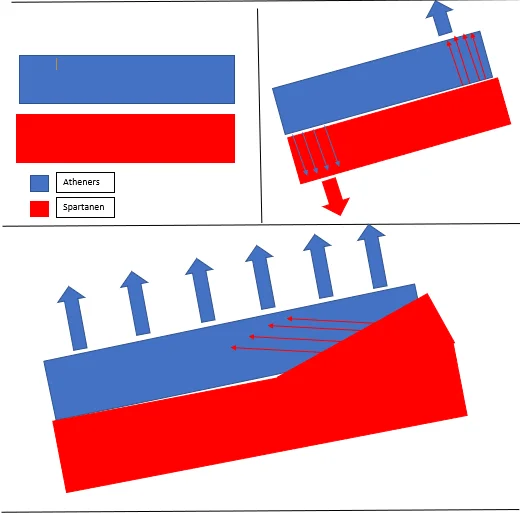
As both phalanxes advanced, they drifted rightward — the natural tendency of hoplites trying to shelter behind the shield of the man beside them. Agis tried to compensate by ordering his left wing to extend and match the Argive right, then ordered two companies from his center to fill the gap that created. The company commanders, Hipponoidas and Aristocles, refused or failed to execute the order in time. A gap opened in the Spartan line, and the elite Argive Thousand — the best fighters Argos fielded — poured through it along with the Mantineans. They shattered the Spartan left and chased the Brasidian veterans and Sciritae far from the field.
In the center and right, however, the regular Spartan army was dominant. The Argive and Arcadian center broke; men were trampled in their hurry to flee before the advancing Spartans reached them. The Athenians on the coalition's left flank were beginning to be encircled when their cavalry screened enough of a retreat to prevent a complete rout.
The Dead and the Aftermath
The Argive coalition lost approximately 1,100 men: about 700 Argives and Arcadians, 200 Athenians, and 200 Mantineans. The Spartan side lost roughly 300. The Spartans, once the battle was won, did not pursue — a deliberate restraint that appears repeatedly in Spartan practice, reflecting both doctrine and the scarcity of their own citizen soldiers.
The political consequences were swift and sweeping. Argos, diplomatically isolated and demoralized, accepted a Spartan-brokered truce, gave up Orchomenus, surrendered its hostages, and joined the Spartans in expelling the Athenians from Epidaurus. The Argive Thousand — whose battlefield performance had been the only Argive success — used that military prestige to stage a coup against Argos's democratic government. The alliance that had threatened Spartan power simply dissolved.
Thucydides had called the Spartan army assembled for this campaign the finest Greece had yet seen. His assessment of the victory was equally direct: after the humiliation at Pylos years before, where Spartans had surrendered to Athenians, the city had been considered cowardly and militarily incompetent. Mantinea, he wrote, reversed that judgment. Sparta's prestige, which Pylos had nearly destroyed, was restored.
The Same Ground, Other Days
Fifty-six years later, two armies would meet again on this same flat plain: Epaminondas of Thebes would win, and die winning, in 362 BC. Fourteen centuries after that, in 1821, Greek revolutionaries and Ottoman forces would contest the same Arcadian landscape during the Greek War of Independence. The plain of Mantinea — ringed by gentle mountains, wide enough for armies to maneuver across, accessible from the north through Orchomenus and from the south through Tegea — pulled armies to it across the centuries as if the ground itself created a logic of conflict. It was simply where important things happened when the Peloponnese needed to settle a question by force.
From the Air
The 418 BC battlefield lies at approximately 37.60°N, 22.40°E, on the broad Mantinea plain in Arcadia — the same ground as the later 362 BC engagement. From the air at 5,000–8,000 feet, the flat basin ringed by mountains is clear. Modern Tripoli (ancient Tripolitsa) lies roughly 8 km to the south. The ruins of ancient Mantinea, including the city walls, are visible north of Tripoli. Nearest major airport: LGKL (Kalamata International), approximately 75 km to the southwest. The Arcadian plateau sits at about 650 meters above sea level.
Nearby Stories
- Araklovon Castle 4.8 km away
- Pellana 6.6 km away
- Arkadiko Bridge 10 km away
- Siege of Corinth (1463) 11 km away
- Leonidio 11 km away
- Kyparissia 11 km away
- Pheneus 14 km away
- Santameri Castle 29 km away