_Battaglia_nel_canal_di_Mitilene_-_Correr_Museum.jpg)
Battle of Mytilene (1690)
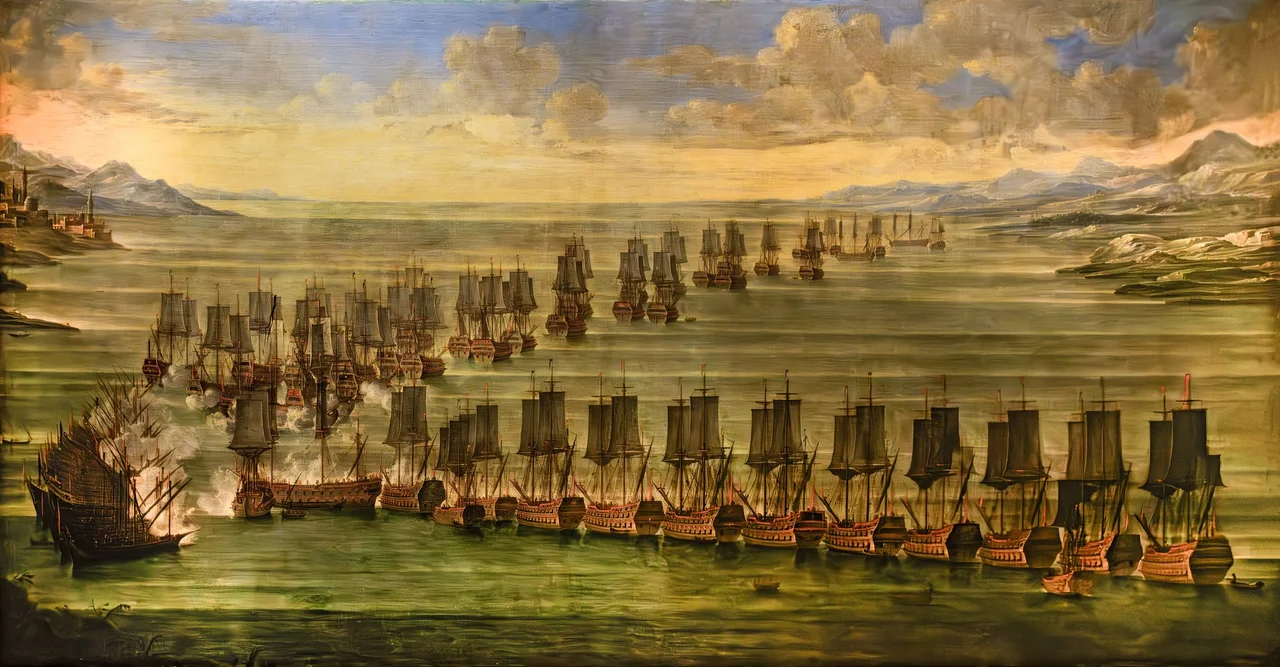
Daniele Dolfin lost his left hand in the smoke off Mytilene. The Venetian commander had sailed into the Aegean with his twelve largest warships, and on 8 September 1690, in the waters off the capital of Lesbos, he ran them into a combined Ottoman and Barbary fleet of thirty-two. The fighting that followed was close and savage, fought at cannon range with the ships pounding one another's hulls and rigging. When it ended, Venice had won, and an angry sultan three hundred miles away in Constantinople would draw a lesson from the wreckage that reshaped his navy.
The Raid Into the Aegean
Dolfin had just taken command at the port of Monemvasia when he led his squadron out, the largest sailing ships of the Venetian fleet, twelve in all. This was the Morean War, one in the long series of conflicts between Venice and the Ottoman Empire, and Dolfin's mission was disruption. He dropped supplies at Tinos, then steered for Euboea, hoping to rattle the Ottoman forces there and keep them from sending troops down to the Isthmus of Corinth. It was the kind of probing, harassing campaign that defined naval war in the Aegean: fleets ranging among the islands, threatening, supplying, drawing the enemy's attention away from where it was needed most. Off Mytilene, the probe met the enemy in force.
Cannon Range
The brunt fell on a single ship. The Redentor took something like a hundred cannon shots through hull and sails and suffered most of the Venetian casualties. Among them was Admiral Giovanni Buggie, struck in the leg by a cannonball; the wound turned to gangrene and he died four days later, on 12 September. Dolfin, the fleet's commander, was wounded too, losing his left hand in the action. The Ottoman and Barbary side fared far worse. Their casualties ran heavier, and three of their thirty-two ships were so badly damaged they never left port to fight, with perhaps two galleys sunk outright. For all the punishment the Redentor absorbed, the day belonged to Venice. These were real men in cramped wooden hulls, hammered by iron and splinters; the leg wound that killed an admiral and the hand a commander left behind in the water were the human cost of a few hours' fighting.
An Angry Sultan
For two more days, 9 and 10 September, the fleets eyed each other across the water without renewing the fight. On the 11th the Muslim fleet withdrew to Foca on the Anatolian coast, and Dolfin turned his battered ships back toward the Morea. The deepest consequences of the battle were felt not at sea but in Constantinople. Sultan Suleiman II was enraged by the defeat, and he placed the blame squarely on the Barbary corsairs, accusing them of cowardice. For generations the Ottoman navy had leaned on these North African privateers for fighting strength at sea. Now the sultan resolved to do without them.
A Navy Remade
Out of that anger came a lasting change. Suleiman II began building sailing warships of the Ottomans' own, determined to end the navy's dependence on the Barbary pirates. He did not live to finish the work, but his successor Ahmed II carried the policy forward, and by 1694, only four years after the battle off Lesbos, the Ottoman fleet counted twenty ships of the line. A single afternoon's defeat in Aegean waters had set in motion the modernization of an empire's navy. It is a reminder of how a small, sharp action, twelve ships against thirty-two off one Greek island, can ripple outward into the strategy of empires long after the gun smoke clears.
From the Air
The battle was fought in the waters off Mytilene, the capital of Lesbos, near 39.10 degrees N, 26.55 degrees E, in the strait between the island's southeastern coast and the Turkish mainland. From the air the sheltered approaches to Mytilene's harbor and the narrow Mytilini Strait are clearly visible, with the Anatolian coast close to the east. Mytilene International Airport (ICAO: LGMT) lies just south of the city. A viewing altitude of 3,000 to 5,000 feet over the strait traces the likely battle waters; the open Aegean stretches west toward Tinos and the Morea, the route Dolfin's fleet sailed.
Nearby Stories
- Eresos 9.6 km away
- Lyrnessus 15 km away
- Battle of the Oinousses Islands 17 km away
- Antandrus 31 km away
- Volissos 41 km away
- St. Helena Church 44 km away
- Akhisar Museum 70 km away
- Battle of Imbros 96 km away