
Battle of Sincouwaan
Martim Afonso de Mello arrived in Chinese waters in July 1522 carrying something unusual for a military commander: instructions to make peace. His fleet held mainly small-caliber cannon and barely any heavy guns. Two-thirds of his crew had already died on the long voyage from Portugal to Malacca. His mission, as King Manuel I had framed it, was commercial and diplomatic — to build a trading post near Guangzhou and open a formal channel between Portugal and the Ming empire. What he found instead was a blockade, a standoff measured in days without fresh water, and a fighting retreat through Chinese cannon fire that left his brother's ship at the bottom of the Pearl River delta.
The Wreckage That Came Before
De Mello sailed into a catastrophe of others' making. For several years before his arrival, Portuguese traders had been conducting themselves along the Chinese coast in ways that had exhausted whatever goodwill the Ming court might have extended. Simão de Andrade had built an unauthorized fort at Tunmen, blocked other foreign traders from competing, and — according to Portuguese chronicler João de Barros — abducted children along the coast to sell into slavery in Portuguese Malacca, seizing them without their parents' knowledge, even from noble families. Some of these children were found years later as far away as Diu, on India's western coast.
The Ming court had received ambassadors from the deposed Sultan of Malacca, whom Portugal had overthrown in 1511, complaining of Portuguese aggression. The diplomat Fernão Pires de Andrade, who had reached Beijing in 1520 to open formal relations, was now in chains in Guangzhou — arrested when news of his brother Simão's activities arrived, promised freedom if the Portuguese would return Malacca to its sultan. He was never released. Against this backdrop, de Mello's mission to trade was, at minimum, optimistic.
Fourteen Days at Anchor
The Ming fleet that met de Mello on the Pearl River delta was commanded by Ke Rong and Wang Ying'en. It fired warning shots but did not immediately press an attack — instead anchoring in formation and waiting. De Mello ordered his men not to return fire. He captured five fishermen one night, paid them, and sent them to deliver a message to the Chinese commanders explaining his peaceful intentions and offering compensation for past Portuguese conduct. No reply came. A second embassy the following night was met with a brief bombardment.
The days accumulated. Duarte Coelho, one of de Mello's captains, sheltered his ship behind a nearby island and refused to join the fleet. Two armed craft sent to escort him could not break through the Chinese blockade. The impasse might have continued longer, but the Portuguese ran short of water. De Mello personally led four armed boats to shore to fill barrels. Ming oarships gave chase and pinned them down for an hour with artillery fire. The Portuguese returned to their ships, in de Mello's own words, with "blood instead of water."
The Run for Open Water
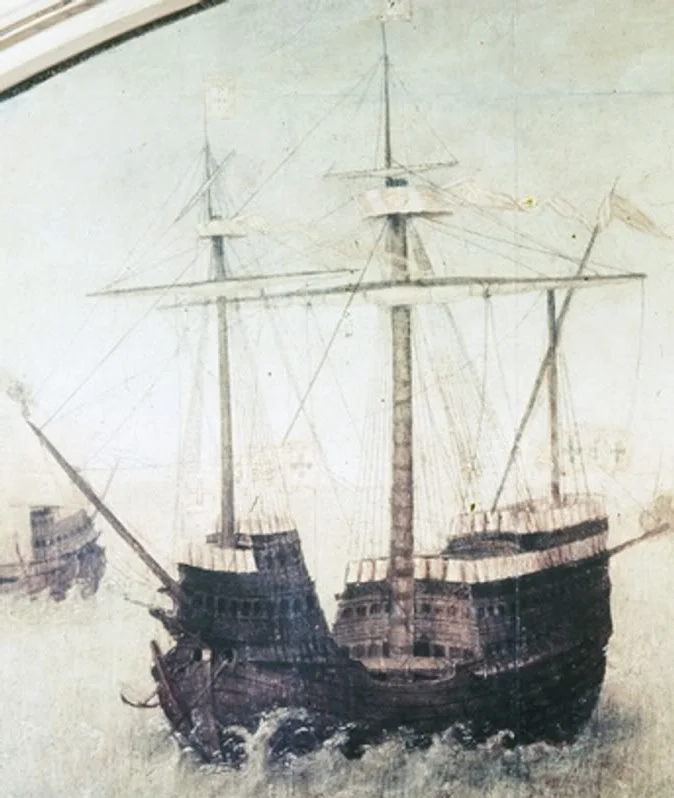
Fourteen days after arriving, de Mello decided to break the blockade. The two heavy carracks at the front of the Portuguese formation pushed through the Ming lines under cannon salvos, matchlock fire, and hurled gunpowder bombs, forcing a path while the Chinese crews fired arrows and guns in return. In the rear, two smaller carracks fell behind.
Diogo de Mello's carrack — the vessel of his brother — took a cannon shot that ignited a powder barrel. Chronicler João de Barros described what followed: "He and the hull went to the bottom together." Martim Afonso wrote afterward that he watched his brother's ship burn and sink, taking with it "fifteen or twenty members of my father's household, and of mine, who had gone with him."
On the other small carrack, Captain Pedro Homem — described by Portuguese sources as one of the largest men in Portugal, armored in European plate, fighting with a heavy two-handed montante sword — held off Chinese boarding parties until a cannon shot finally took him down. The Chinese killed almost everyone on board and stripped the vessel of its cannon, ropes, anchors, and pulleys. A single survivor had climbed to the crow's nest. The remaining Portuguese burned the abandoned carrack to prevent its capture and sailed for Malacca.
What the Battle Changed
The reckoning for those captured was severe. On 6 December 1522, forty-two Portuguese prisoners were displayed in pillories in Guangzhou. On 23 September 1523, twenty-three were executed by slow slicing. The Ming court sent the captured Portuguese breech-loading swivel guns — the Portuguese called them berços — to military engineers, who reverse-engineered them. He Ru completed the first Chinese versions, called folangji (佛郎機, meaning "Frankish"), in 1524. Cannons modeled on Portuguese designs would enter the Chinese military arsenal.
For Portugal, the defeat at Sincouwaan forced a generation of trading along China's Fujian coastline through unofficial, often illegal channels — a decades-long work-around involving Fujianese, Japanese, and Portuguese mariners operating as smugglers and pirates. The formal opening came only in 1554, when merchants Leonel de Sousa and Simão d'Almeida successfully bribed the right official. The Portuguese settled in Macau. The battle off Lantau Island had delayed that outcome by more than thirty years.
From the Air
The Battle of Sincouwaan was fought off the northwestern coast of Lantau Island, at a location now called Sai Tso Wan, near 22.3699°N, 113.976°E. Approaching from Hong Kong International Airport (VHHH), which sits on reclaimed land at the northern tip of Lantau, the northwestern coastline of Lantau is visible immediately to the south and west. The Pearl River estuary opens to the northwest. The waters where the Portuguese carracks anchored and ran their desperate blockade-break are now crossed by the Lantau Link highway and rail bridge. The island of Lingding (Lintin), sometimes proposed as the Portuguese anchorage of Veniaga, is visible to the northwest in the Pearl River.
Nearby Stories
- Chapel of St. Francis Xavier 3.5 km away
- Cuiheng 4.1 km away
- 2015 Shenzhen Landslide 16 km away
- Shunde 31 km away
- Wanshan Archipelago 37 km away
- Nanxiong Formation 96 km away
- Heyuan 149 km away
- Checheng Fu'an Temple 629 km away