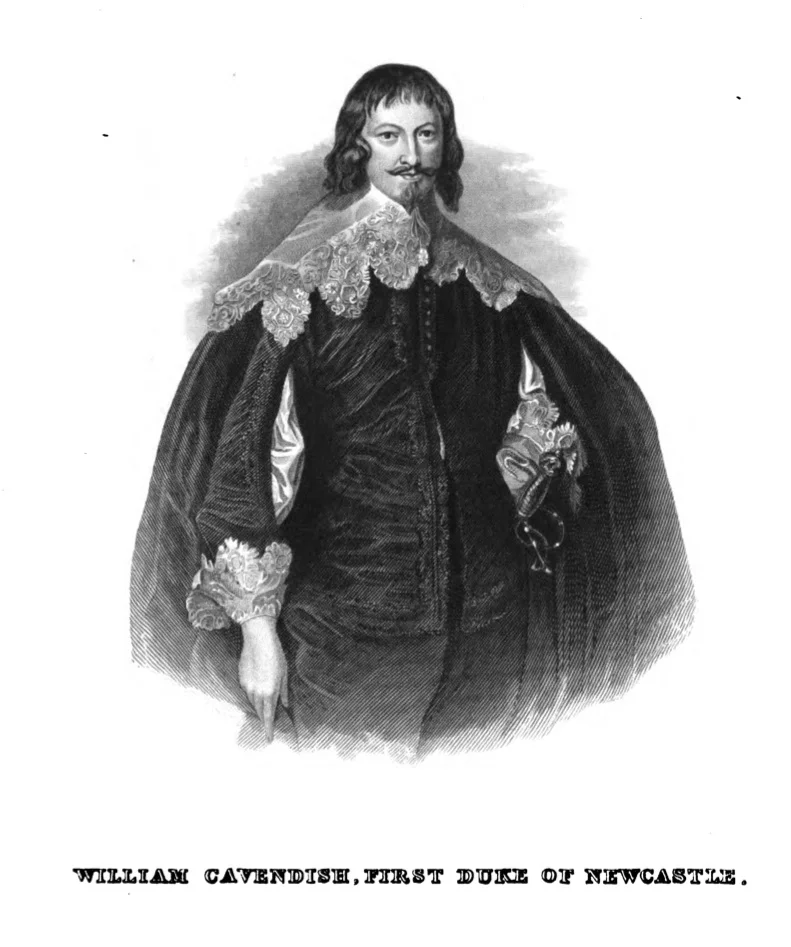

Battle of Tadcaster
Forty thousand musket balls were fired in six hours of fighting. That is the figure the historians settled on for Tadcaster, and it tells you something about what musket combat actually was in 1642 - the slow, smoke-blinded exchange of fire across a few hundred yards while men loaded and reloaded and waited and tried not to think about gunpowder running short. The Parliamentarians had a defensible position - a single stone bridge across the River Wharfe, a redoubt on the high ground, a half-demolished span with planks they could pull up. What they did not have was enough powder to hold for a second day.
Newcastle's March
The English Civil War was four months old when the Earl of Newcastle marched into Yorkshire with around 8,000 men. The county had been contested ground since well before the formal start of fighting - Sir John Hotham had seized Hull for Parliament back in January, the King had set up court in York in March, and Yorkshire gentry had been picking sides ever since. Newcastle's job was to push the Parliamentary forces out of the north. He defeated them at Piercebridge, occupied York on 3 December, and turned his attention to Ferdinando Fairfax's Parliamentarian army, which had pulled back to Tadcaster ten miles south-west. Newcastle saw the chance to destroy Fairfax in detail and moved fast.
The Bridge and the Redoubt
Tadcaster sits mostly on the west bank of the Wharfe. The only crossing was a single stone bridge. Lord Fairfax, with somewhere between 900 and 1,500 men, had thrown up a redoubt on a low hill east of the river to guard the bridge approach. He had also pulled down part of the bridge itself and laid planks across the gap - boards that could be removed quickly when the enemy showed up. On 6 December, with Newcastle's army visible on the road from York, Fairfax held a council of war and decided to evacuate the next morning. He was outnumbered four to one. Withdrawal made sense. The Royalists did not give him the chance.
Six Hours of Smoke
Newcastle's plan was a pincer. He would lead 4,000 foot down the York road and hit Tadcaster from the east, while the Earl of Newport circled north through Wetherby with 1,500 horse and dragoons to cut off retreat. Newport never came. The historian David Cooke thinks it was the winter roads slowing his artillery; the 18th-century historian Francis Drake claimed Captain John Hotham forged a letter to Newport - purporting to be from Newcastle - ordering him to halt. Either way, Newcastle attacked alone. His infantry hit the redoubt and were repulsed. Some pushed into the town and seized houses near the bridge, threatening to cut the redoubt off from its reserves. A counterattack under Major-General Giffard retook the houses and burned them to stop them being reoccupied. After that it settled into musket fire across the river. Hour after hour. The casualty figures Fairfax later reported - seven of his men dead, around twenty wounded - suggest much of those forty thousand balls hit nothing at all.
The Powder Runs Out
Newcastle pulled his men back at dark and bivouacked in the fields, intending to resume in the morning. Inside Tadcaster, Fairfax took stock. The position had held. His casualties were tiny. But the powder was almost gone, and at dawn there would be a fresh attack from a force he could not have stopped even fully supplied. So in the night the Parliamentarians slipped out. They split into two columns - Fairfax leading his men down to Selby, John Hotham riding for Cawood. By morning the town was empty. Newcastle walked into Tadcaster on 8 December, garrisoned Pontefract Castle and the surrounding settlements, and cut Fairfax off from the West Riding wool towns of Leeds, Wakefield and Bradford. Sir William Savile was sent with 2,000 men to take those towns. He picked up Leeds and Wakefield without resistance. Bradford turned him back.
The Bridge Today
Tadcaster's stone bridge still stands - rebuilt and widened many times since 1642, but on the same site where Fairfax's musketeers held off the Royalist infantry. The town sits in the broad Vale of York; the Wharfe is brown and slow here, fringed with willows. The redoubt is gone, ploughed under farmland east of the river. What you can still feel from the old riverside is the shape of the problem: one narrow stone crossing, a town spread across two banks, an army on the high ground to the east with all the time in the world. It was an honourable defence by a small force, undone in the end not by enemy fire but by the simple arithmetic of how many shots a man can take before his powder horn is empty.
From the Air
Battlefield centred on Tadcaster at 53.89N, 1.26W, with the River Wharfe and the stone bridge as the key visual reference. Best viewed at 2,500-3,500 ft AGL. Leeds Bradford (EGNM) is 12 nm to the west, Doncaster Sheffield (EGCN) 25 nm to the south-southeast. York Minster is unmistakable 8 nm to the north-east - the route Newcastle marched down. The A64 follows roughly the line of the old York-Tadcaster road. The Wharfe traces a clear line through the Vale of York; the bridge sits at the obvious bend in the river where the town hugs both banks.
Nearby Stories
- Scampston Hall 3.5 km away
- Salts Mill 4.7 km away
- Newburgh Priory 6 km away
- Brodsworth Hall 6.2 km away
- Coverham Abbey 16 km away
- RAF Leconfield 17 km away
- Macclesfield Canal 27 km away
- RAF Scampton 35 km away