_CKS_2019.jpg)
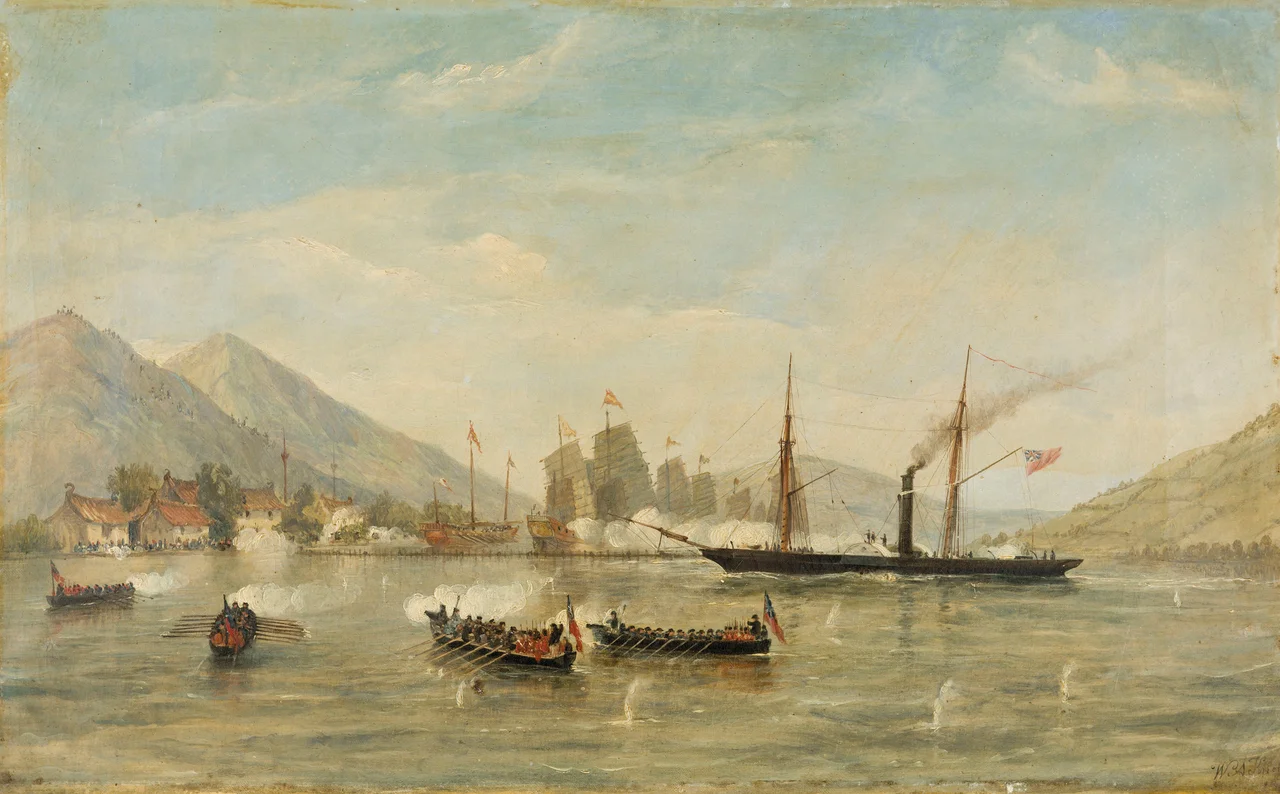
Battle of the Bogue
Admiral Guan Tianpei had held command of Guangdong's naval forces since 1834. On 26 February 1841, at approximately sixty years old, he died at the gate of Weiyuan Fort on Anunghoy Island — meeting the British landing party in hand-to-hand combat rather than retreating. His soldiers died around him. The British forces who killed him later fired a salute of minute-guns when his family came to claim his body, and their officers described him as "a fine specimen of a gallant soldier." The Battle of the Bogue was a military catastrophe for Qing China, and Guan Tianpei's death became one of its most enduring human markers — a man defending an impossible position, to the last.
The War That Opium Built
To understand the Battle of the Bogue, it is necessary to understand what had brought two nations to armed conflict at a narrow strait in the Pearl River Delta. Britain ran a chronic trade deficit with China: Chinese tea, silk, and porcelain were in high demand across the British Empire, but China's Qing court accepted only silver in payment and refused to buy British manufactured goods. The solution developed by British and East India Company merchants was the systematic smuggling of opium — grown in British India — into China, with silver flowing back in payment. By the late 1830s, opium revenues were financing Britain's entire China tea trade, and China had accumulated millions of people suffering from addiction. The Daoguang Emperor dispatched Imperial Commissioner Lin Zexu to Guangdong in 1839 to end the trade. Lin seized and destroyed more than 19,000 chests of British merchants' opium at Humen. Britain's response was to send a military expedition. The stated reason was free trade; the practical goal was forcing open Chinese markets on British terms.
The Bogue and Its Forts
The Humen strait — known to Western traders as the Bogue, from a corruption of the Portuguese *Boca do Tigre*, meaning Tiger's Mouth — was China's chokepoint. It was the only maritime approach to Canton, the sole port through which foreign trade with China was officially permitted. The Qing dynasty had fortified it accordingly: stone forts on the islands of Anunghoy (also called Weiyuan) and North Wangtong, bristling with guns, were meant to deny the Pearl River to any hostile fleet. The forts mounted more than 200 cannon across their various positions. What the Qing commanders defending them did not have was an answer to British iron-hulled steamships — particularly HMS *Nemesis*, which could maneuver against wind and tide, closing within devastating range of fortifications designed for an era of sail. The technological gulf between the two forces was enormous, and the defenders knew it.
The Three Days
British forces under Commodore Gordon Bremer and Major General Hugh Gough launched the assault on 23 February 1841. The battle unfolded over three days. HMS *Blenheim*, *Melville*, *Wellesley*, and *Nemesis* led the naval bombardment. On 26 February, the decisive assault came at Anunghoy: roughly 300 Royal Marines and sailors landed under covering fire and stormed Weiyuan Fort. It was there that Guan Tianpei died, having refused evacuation. North Wangtong fell the same day; the entire British landing force of more than a thousand soldiers came ashore and the fort's resistance collapsed within minutes. The cost to British forces was stark in its disparity: no British soldiers were killed; approximately five were wounded. Chinese losses were staggering — estimates put the dead and wounded at more than 500, with approximately 1,300 captured. More than 506 guns were seized. The disparity was not a matter of courage. It was a matter of firepower, technology, and the particular cruelty of a war that China's military was not equipped to fight.
After the Guns Fell Silent
With the Bogue forts in British hands, the Pearl River lay open. Bremer's fleet proceeded upriver and captured Canton the following month. The Imperial Commissioner Qishan, who had negotiated inconclusively with British envoy Charles Elliot in the weeks before the battle, was arrested on the same day the forts fell, his properties confiscated, and he faced a death sentence for treason — later commuted to exile — for having offered Hong Kong Island to Britain without imperial authorization. Guan Tianpei received a different legacy. His death in defense of the Humen forts was commemorated by Qing authorities, and his name has remained attached to this stretch of the Pearl River ever since. The battle, and the broader First Opium War, ended with the Treaty of Nanking in 1842: Hong Kong was ceded to Britain; five treaty ports were opened; an indemnity of 21 million silver dollars was paid. The Qing dynasty never recovered its former confidence in the face of Western imperial pressure.
The Strait Today
The islands where British and Chinese forces fought in 1841 are now connected to the mainland and to each other by the Humen Pearl River Bridge, which has spanned the strait since 1997. The Weiyuan Fort where Guan Tianpei died still stands on what was Anunghoy Island, preserved as a historical monument. The Opium War Museum in nearby Humen Town holds the material record of these events — cannon, documents, artifacts of the destruction of the opium at Lin Zexu's Smoke Pond. The strait itself remains what it always was: a narrow passage of blue-brown water where the Pearl River pushes toward the South China Sea, flanked by hills that once held the guns of an empire trying to hold its borders against a force it could not stop.
From the Air
The Battle of the Bogue took place at the Humen strait, centered at approximately 22.80°N, 113.62°E in the Pearl River Delta, Guangdong Province. Flying southbound over the delta at cruising altitude, the strait is visible as a narrowing of the Pearl River where it meets the broader Lingdingyang estuary — the Humen Pearl River Bridge crossing it is a clear visual landmark. Anunghoy Island (Weiyuan), where the decisive assault took place and where Guan Tianpei died, lies on the eastern shore. The nearest major airport is Guangzhou Baiyun International (ICAO: ZGGG), approximately 60 km to the northwest. Shenzhen Bao'an International (ICAO: ZGSZ) lies roughly 30 km southeast. At lower altitudes the historic Weiyuan Fort is visible on the eastern bank, its battlements marking the place where the Qing dynasty's defense of the Pearl River came to its end.
Nearby Stories
- South China Mall 1.5 km away
- Sham Chung 7.1 km away
- Fengjian Village 7.4 km away
- Foshan Wong Fei-hung Memorial Hall 9 km away
- Nei Lingding Island 12 km away
- West Lake (Huizhou) 16 km away
- Horizontal Skyscraper – Vanke Center 19 km away
- Yamen, Guangdong 27 km away