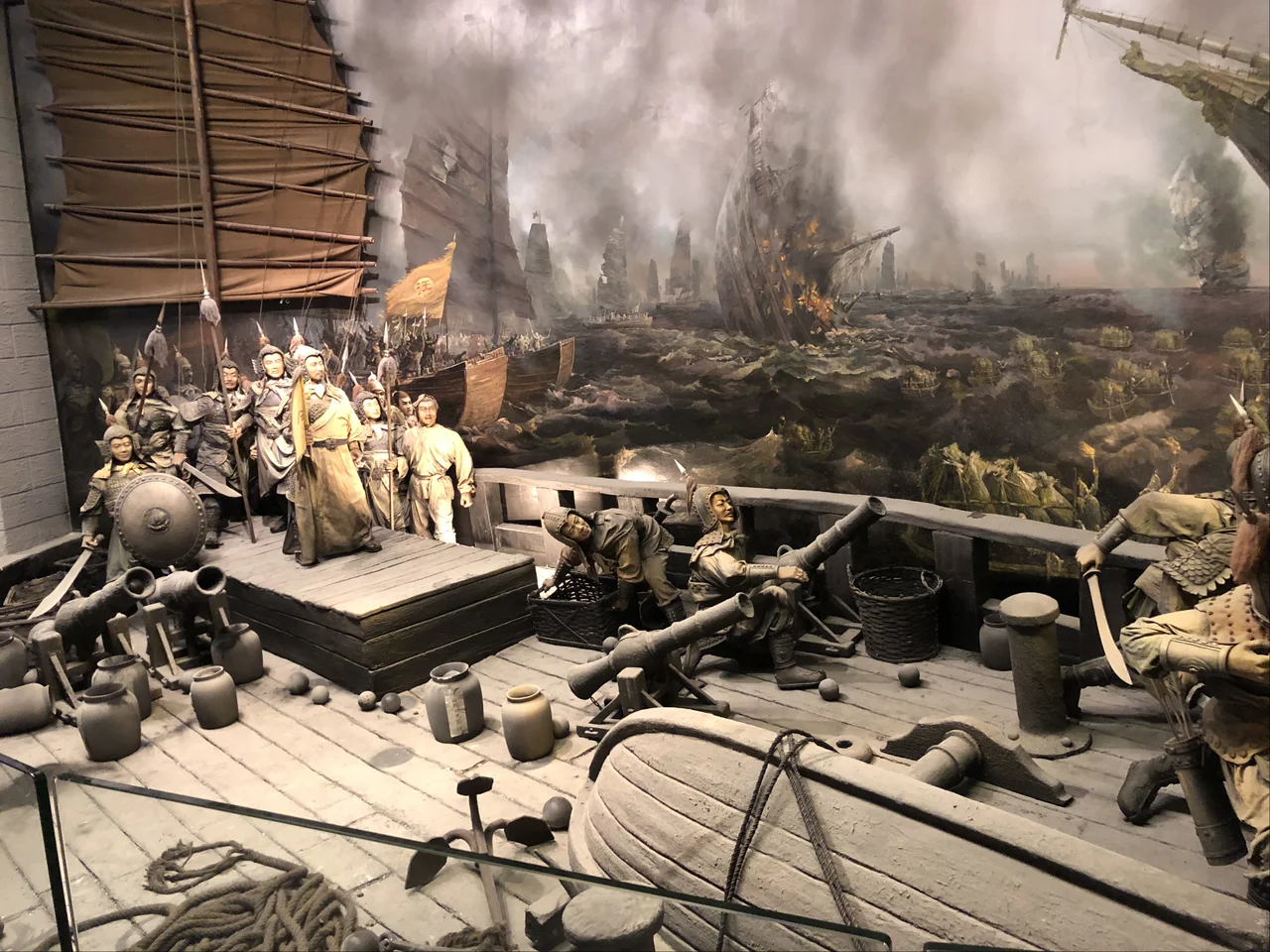

Battle of Tunmen
Portuguese diplomat Fernão Pires de Andrade fired a cannon salute as his ships entered the Pearl River in 1517 — a friendly gesture, by the customs of the harbors he knew. The Chinese onshore heard it as an act of aggression. The confusion was not merely cultural. It pointed to something deeper: two empires with entirely different assumptions about trade, sovereignty, and the sea had come into direct contact, and neither had the tools to understand the other. Within four years, they were at war in these waters, and the war would define the shape of European access to China for the next half-century.
First Contact on the Pearl River
When Fernão Pires de Andrade arrived at the mouth of the Pearl River in June 1517, Portuguese expansion in Asia was less than twenty years old, yet already immense. Portugal had rounded Africa, established the Estado da India, seized Goa, and — most consequentially for what followed — captured the Malacca Sultanate in 1511, displacing a polity that had been a Ming tributary for decades. The sultan's ambassadors had already reached Beijing with their grievances.
Andrade waited a month for permission to proceed upriver and then simply sailed to Guangzhou anyway. His ships fired a cannon salute on arrival. Despite the alarm this caused, the encounter recovered: officials from Guangzhou received the Portuguese with ceremony, and Tomé Pires — the embassy's diplomat — was allowed to proceed to the imperial capital. Trade commenced. The Portuguese sold their goods for silk and porcelain. A Portuguese record noted that they had made a good impression. It would not last.
Simão's Damage
Fernão's brother Simão de Andrade arrived at Tunmen in August 1519 with three ships, and within weeks had undone everything the first Portuguese contact had built. He executed a Portuguese citizen publicly. He built an unauthorized fort at Tunmen — after his formal request for the location had been denied — and blocked other foreign traders from the harbor. When a Ming official arrived to inquire about the fort, Simão knocked off his hat.
Then he began purchasing children along the coast to sell as enslaved people in Portuguese Malacca. João de Barros, the Portuguese chronicler, concluded that the children had been taken without their parents' knowledge, including children from prosperous families. Some were found years later at Diu, on India's western coast, thousands of miles from home. Rumors spread across China that the Portuguese were cannibalizing children. Whether or not that claim was believed, it captured something real about the terror Simão's presence had created among coastal communities.
None of this was what Fernão Pires de Andrade, now in Nanjing, had intended. But news of his brother's conduct reached Beijing before he did, along with ambassadors from the exiled Malaccan sultan. The Zhengde Emperor died on 20 April 1521. The new Grand Secretary, Yang Tinghe, rejected the Portuguese embassy the following day.
Fifty Ships and Fire Boats
Commander Wang Hong assembled a squadron of fifty ships and imposed a blockade on the Portuguese at Tunmen, including the Siamese and Patani junks the Portuguese had requisitioned. The Portuguese, refusing to comply with eviction orders from Beijing, found themselves penned in a location that the enclosed terrain of Tunmen made difficult to defend.
The battle, which occurred in April or May 1521, began with Ming boarding attempts, but Portuguese guns outranged the Chinese fleet and kept the attackers at bay. Wang Hong then deployed fire ships — vessels set alight and sent downwind toward the Portuguese — to force a confrontation. The Portuguese evaded the fire attack but could not evade the subsequent boarding actions, which took a steady toll on their manpower. Eventually they no longer had enough men to crew all five of their ships. They abandoned two of them and their requisitioned junks, and began sailing south.
A strong wind arose at the critical moment, scattering the pursuing Ming fleet. The Portuguese made Malacca in October.
A Location That History Lost
The precise location of Tunmen — and therefore of the battle — has never been established, and historians still debate it. The Portuguese called their settlement Tamão, understood as a corruption of Tunmen, which was the Tang-dynasty name for the western Hong Kong and Shenzhen region. Chinese sources place the Portuguese settlement around the Tunmen Inlet, but the inlet's current location is unknown.
In present-day Cantonese, Tunmen reads as Tuen Mun — the name of a new town in the New Territories of Hong Kong, which leads some researchers to connect the Ming-era harbor to Castle Peak Bay or Deep Bay nearby. Others point to Lintin Island, in the Pearl River estuary west of Tuen Mun, as the more likely candidate, since Portuguese sources describe Tamão as an island. The much larger Lantau Island has also been proposed.
What is not in dispute is the battle's consequence. The Portuguese defeat at Tunmen — followed a year later by the similar expulsion at Sincouwaan — drove European trade away from Guangdong for a generation. The route to Macau, which finally opened in 1554 through bribery rather than force, wound through years of illegal commerce and two lost battles in the waters that now fall within Hong Kong's territory.
From the Air
The Battle of Tunmen was fought in waters near the present-day Tuen Mun district and the Pearl River estuary, centered around 22.3713°N, 113.9782°E. From Hong Kong International Airport (VHHH), fly northwest over the northern coast of Lantau Island. The Pearl River opens to the west; Tuen Mun and its new town are visible ahead on the mainland coast of the New Territories. Lintin Island — the Lingding Island of modern maps — appears as a small landmass in the estuary to the northwest and is one of the leading candidates for the Portuguese anchorage of Tamão. Castle Peak (Tsing Shan) rises behind Tuen Mun as a distinctive 583-meter peak and navigational landmark.
Nearby Stories
- Chapel of St. Francis Xavier 3.5 km away
- Cuiheng 4.1 km away
- 2015 Shenzhen Landslide 16 km away
- Shunde 31 km away
- Wanshan Archipelago 37 km away
- Nanxiong Formation 96 km away
- Heyuan 149 km away
- Checheng Fu'an Temple 629 km away