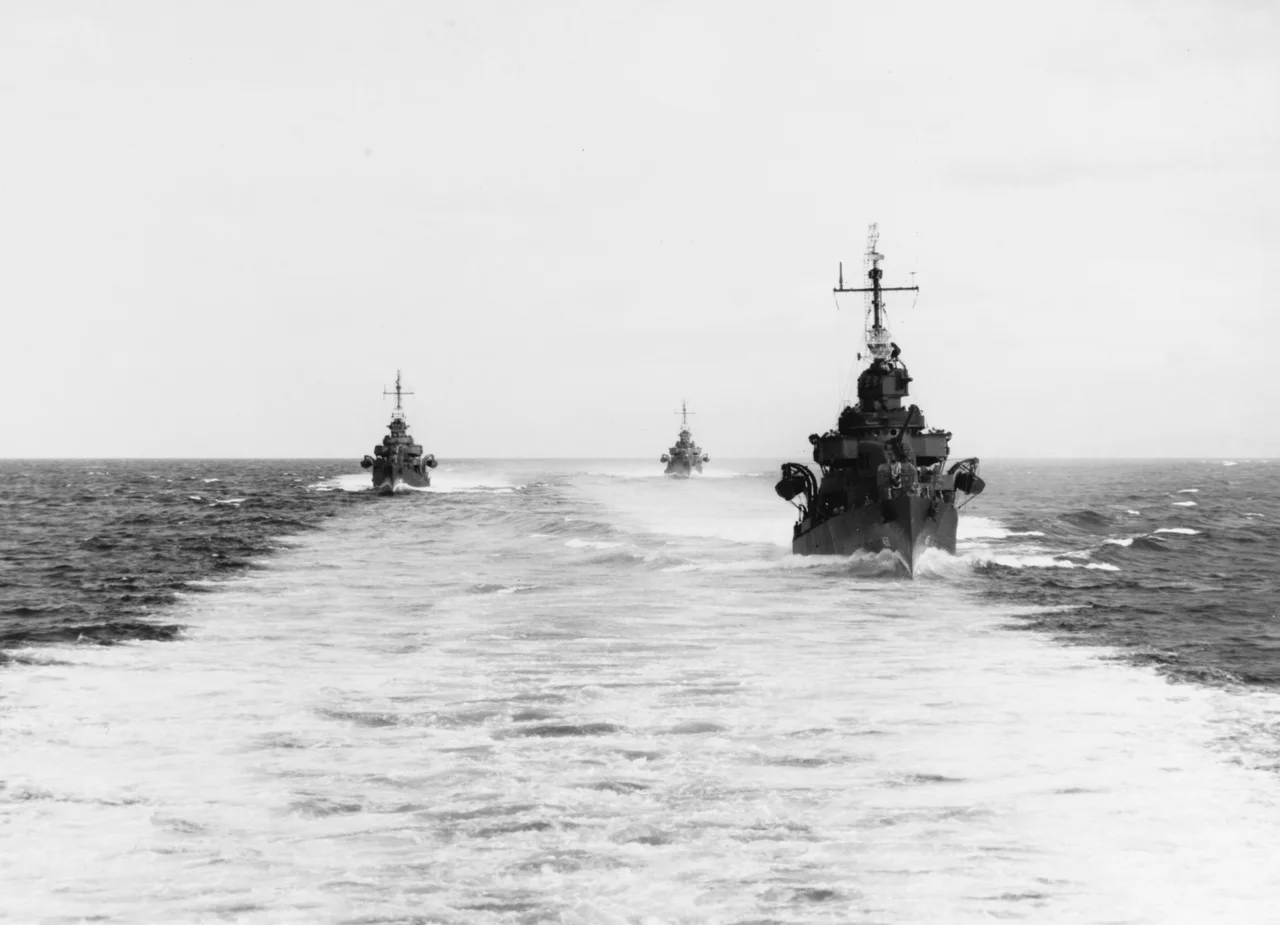
,_USS_Chevalier_(DD-451)_and_USS_Taylor_(DD-468)_underway_at_sea_on_15_August_1943_(80-G-58800).jpg)
Battle of Vella Lavella (land)
Admiral William Halsey looked at his maps and decided not to fight. Kolombangara held 10,000 to 12,000 Japanese troops, well dug in under Major General Noboru Sasaki. An assault would have cost thousands of American lives. So Halsey did something his predecessors in the Solomons rarely had the latitude to do: he left the enemy alone. Instead, he aimed his landing force at a smaller island to the northwest, an island with better terrain for an airstrip and a Japanese garrison that could almost be counted on one hand. On the morning of 15 August 1943, about 4,600 US troops came ashore at Barakoma on the southeastern tip of Vella Lavella, and the New Georgia campaign began its final chapter.
The Week the Scouts Roamed Free
Before any troops landed, a handful of men walked the island for seven days. The reconnaissance party was an unlikely mix - American scouts, an Australian coastwatcher who had been quietly reporting Japanese movements, a New Zealand missionary who knew the coast, and local Solomon Islanders who knew everything else. They landed in late July 1943, linked up with their contacts, and spent a full week exploring the southeast coast, mapping beaches, counting patrols, and never once making contact with the Japanese. On 31 July they slipped back to Guadalcanal carrying the most valuable thing any invasion force ever gets: accurate intelligence. The village of Barakoma near the island's southeastern tip was chosen for the landing, and on 12 August an advanced party of troops from the 103rd Infantry Regiment was sent ahead by torpedo boat to mark the beach. Japanese aircraft attacked the boats en route, but the mission continued, the beach was marked, and seven Japanese soldiers were captured before the main force even arrived.
Landing Under a Sky Full of Zeros
The main landing on 15 August looked like what the Pacific War had become by late 1943: a methodical, overwhelming force. Brigadier General Robert B. McClure commanded the assault troops, drawn from the 35th Regimental Combat Team of the 25th Infantry Division under J. Lawton Collins. Rear Admiral Theodore S. Wilkinson's Task Force 31 carried them - seven destroyer-transports, three LSTs, submarine chasers, a swarm of landing craft, all screened by twelve destroyers with P-40 and Corsair fighters flying top cover. The Japanese responded with Zeros and Val dive-bombers. They attacked the LSTs at noon, were driven off by anti-aircraft fire, came back later in the day, and were driven off again. Torpedo aircraft tried at dusk. Seaplanes tried at midnight. Of all those attacks, two American planes went down. Japanese losses ran between 17 and 44 aircraft. Twelve Americans were killed in the landing, 50 wounded. By evening, a beachhead was secure, and the Seabees of the 58th Naval Construction Battalion were already unloading bulldozers to carve roads into the jungle.
The New Zealanders Take Over
In mid-September, the 3rd New Zealand Division relieved the Americans - about 3,700 men of the 14th Brigade under Brigadier Leslie Potter, from Major General Harold Barrowclough's command. Their task was to squeeze the remaining Japanese garrison, now concentrated along the north coast between Paraso Bay and Mundi Mundi. The 35th and 37th Infantry Battalions moved in pincer fashion - one up the western coast, the other up the east - each with landing craft that let them bound from bay to bay. It was a slow, miserable campaign. Torrential rain turned tracks to mud. Armour could not be used. Artillery had to be dragged ashore from landing craft and hauled into position by hand. Patrols were ambushed in tangled jungle so dense that cut-off platoons sometimes had to fight their way out and be rescued by barge. By 5 October the 37th Battalion had cleared Warambari Bay, and the two battalions were closing on the Japanese pocket at Marziana Point. A heavy artillery barrage was planned for that night - but Japanese aircraft appeared overhead, the guns went silent to avoid giving away their positions, and under cover of darkness the garrison slipped away.
The Airfield That Changed the Pacific
What the campaign built was more important than what it captured. The Seabees worked while being bombed. The 58th Naval Construction Battalion landed on 15 August and started pushing roads inland before the ground had cooled. Nine miles of road in August alone. An underground radio room. An underground sick bay. A 4,000-foot airstrip surveyed and cleared before September ended, its first landing on 24 September. The 77th Naval Construction Battalion arrived in the middle of an air raid on 25 September and was bombed 47 times during its tour, losing ten men. Its job was hospital wards - a thousand beds for the Bougainville campaign coming next. The Barakoma airfield became home to VMF-214, the Black Sheep Squadron under Major Gregory Pappy Boyington. From those runways, Allied aircraft reached north toward Rabaul, the great Japanese base that had menaced the Solomons since the war began. Rabaul fell - not by assault, but by being cut off, surrounded, rendered irrelevant. The decision to bypass Kolombangara had proven itself. On the night of 6-7 October 1943, Rear Admiral Matsuji Ijuin's destroyer transports evacuated 589 Japanese troops from Marquana Bay. A naval battle erupted to the north as six American destroyers engaged Ijuin's covering force. In the jungle behind them, 150 American and New Zealand dead had paid for the island.
What the Jungle Kept
The airstrip at Barakoma was abandoned on 15 June 1944, its job done. The last construction battalion sailed for Emirau Island on 12 July. The avgas tanks came down. The sawmills were dismantled. The hospital wards emptied. Today the island is jungle again, its volcanic cones softened by rainforest. Overhead satellite images still show faint rectangles where the runways were, geometry that lowland forest has not quite managed to erase. The evacuated Japanese who reached Buin on Bougainville fought on through 1945. The Americans and New Zealanders who survived the campaign moved up the chain toward Bougainville themselves. Vella Lavella ended the New Georgia campaign and opened the road to Rabaul - a stepping stone used hard, then left where it lay.
From the Air
Battle of Vella Lavella (land) centered at 7.73 degrees south, 156.63 degrees east, off the Barakoma area on the island's southeastern coast. Recommended viewing altitude 3,000 to 5,000 feet to follow the historical advance from Barakoma up the coasts to Marquana Bay on the north. Nearest modern airstrip is Barakoma itself (AGOK), a grass strip on the old WWII site. Munda Airport (AGGM) on New Georgia lies 35 nautical miles southeast. Honiara International (AGGH) on Guadalcanal is about 200 nautical miles southeast. Weather is typically tropical with afternoon convective buildups and frequent rain showers.
Nearby Stories
- USS Helena (CL-50) 14 km away
- Gizo, Solomon Islands 33 km away
- Munda Airport 48 km away
- Raid on Choiseul 56 km away
- Shortland Islands 57 km away
- Battle of the Treasury Islands 66 km away
- Woodlark Island 390 km away
- 1737 Kamchatka Earthquake 6662 km away