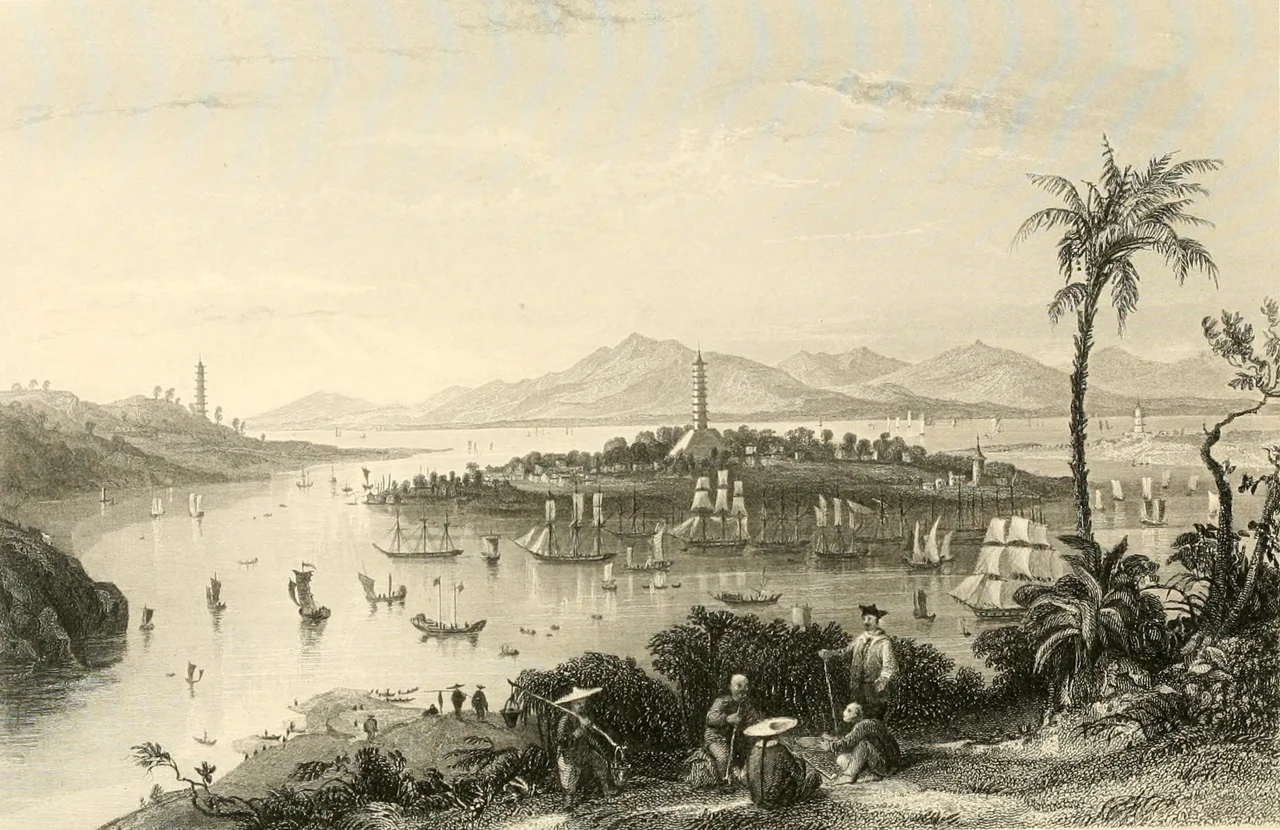

Battle of Whampoa
Five days after the clash at First Bar, the guns were firing again. On 2 March 1841, British reconnaissance boats approached the northeast end of Whampoa Island — today known as Pazhou Island — on the Pearl River near Canton. Hidden among thick tree branches was a battery of approximately 25 Chinese guns. The battery opened fire without warning, and for a few concentrated minutes, men on both sides of the river were in mortal danger. The Battle of Whampoa was smaller than First Bar, shorter, and less documented. But the men who died there were just as real, and the ground they fought over carried a weight of history that neither side fully understood at the time.
The Anchorage and Its Significance
The Whampoa anchorage — the stretch of Pearl River around modern Pazhou Island — had been one of the most internationally trafficked waterways in Asia for more than a century before the First Opium War. Under the Canton System, foreign trading ships were required to anchor here before offloading cargo into smaller boats for transfer to the foreign factories at Canton. Danish crews had used nearby Changzhou Island for repairs and burials during the Canton trade era; the whole district was layered with the residue of international commerce.
By 1841, that commercial history had curdled into military conflict. Britain was pressing the Qing dynasty to open China's ports to free trade — and to allow the importation of opium, which the Qing government had banned. The British fleet had already broken through the Bocca Tigris forts and fought at First Bar. Whampoa, the historic anchorage that had once welcomed foreign merchants, was now a military objective.
The Hidden Battery
Commodore Gordon Bremer, commander-in-chief of British forces, sent Captain Edward Belcher of HMS Sulphur to reconnoitre the Junk River near Whampoa on 2 March. Three boats from HMS Wellesley, commanded by Lieutenant Richard Symonds, were towing the Sulphur when the battery opened fire.
The guns had been concealed behind tree branches — a deliberate attempt at concealment that almost worked. Symonds immediately cut the tow line. The boats turned toward shore and the crews landed. The battery was manned by around 250 Manchu Bannermen, elite imperial troops, but they were dislodged from their position when artillery from the Sulphur found its range. After the British took the forts, the guns were destroyed and the ammunition magazines blown up.
Bremer reported 15 to 20 Manchu soldiers killed. One British seaman from HMS Wellesley died of wounds after being shot through the lungs with grapeshot — a weapon designed to tear through concentrations of men at close range. He did not survive.
Transfer of Command
Following the action at Whampoa, Commodore Bremer transferred command of the land forces to Major General Hugh Gough, who came aboard HMS Cruizer to take up his new role. Gough would go on to lead British land forces through the rest of the First Opium War, commanding at several larger engagements before the conflict ended with the Treaty of Nanking in August 1842.
The handover was a practical recognition that the campaign had moved beyond naval operations into something larger. The Pearl River had been forced open, step by step — Bocca Tigris, First Bar, Whampoa — and now the question was Canton itself. What followed over the next year and a half would reshape trade, sovereignty, and the relationship between China and the Western world.
Pazhou Today
Pazhou Island — the modern name for what the British called Whampoa Island — is today one of the busiest commercial districts in Guangzhou. The Canton Fair Complex, one of the world's largest trade fair venues, occupies a large portion of the island, filling the same Pearl River waterfront where the battery once fired on British boats with exhibition halls hosting tens of thousands of international buyers twice a year.
The contrast is not ironic so much as instructive. The trade that Britain went to war to force open now flows through Pazhou in volumes that would have been inconceivable in 1841. The island's transformation from a military position in a colonial war to a hub of global commerce tracks something essential about Guangzhou's history: this is a city that has always been defined by trade, even when trade was the reason for conflict.
From the Air
Pazhou Island (historic Whampoa Island) sits at approximately 23.10°N, 113.40°E in the Pearl River, just south of central Guangzhou. From the air at 2,000–4,000 feet, the island is clearly visible as a distinct landmass in the river, with the large Canton Fair Complex buildings visible on its southern and western shores. The nearest major airport is ZGGG (Guangzhou Baiyun International), approximately 30 km to the north. The Pearl River curves prominently through the cityscape, making Pazhou an easy landmark to identify from altitude.
Nearby Stories
- Shunde 12 km away
- 2015 Shenzhen Landslide 15 km away
- Mount Luofu 23 km away
- Qingyuan Maglev Tourist Line 32 km away
- Kaiping 56 km away
- Heyuan 90 km away
- Chikan, Kaiping 92 km away
- Erlitou Site Museum of the Xia Capital 1257 km away