
Battle of York (867)
The Roman walls around Eoferwic were already old when the Vikings came over them. Built almost eight centuries earlier, they had been maintained badly under the Anglo-Saxons and by the spring of 867 they were crumbling - not much of a defence against the men of the Great Heathen Army. Inside those walls, on 21 March 867, the kings Aelle and Osberht of Northumbria put aside the civil war they had been fighting over the crown and rushed together at the city they had lost five months before. They broke through. They were inside. And then the streets, narrow and confused and full of Viking warriors who knew the ground better than they did, swallowed them both.
Two Kings, One Throne
Northumbria had been tearing itself apart. Aelle had driven out the previous king, Osberht, by force. Then a Viking army landed in East Anglia in 865 - the chroniclers call it the Great Heathen Army, the largest Scandinavian force yet seen in Britain - and on 1 November 866 it took York. The chroniclers say Ivar, who later became known as Ivar the Boneless, was avenging the death of his father Ragnar Lodbrok. The Vikings had little trouble with the city. The Anglo-Saxon civil war was their gift. They took Eoferwic; they failed to take Aelle. Through the winter the two rival Northumbrian kings did something rare in any era: they put aside the war over the crown and joined forces to take their capital back.
Inside the Walls
What happened on 21 March 867 reads in the chronicles as a battle in two acts. The Northumbrians attacked and at first they made progress, breaking through the Roman defences and pushing into the streets. Then the Viking experience told. The chronicles say the narrow streets nullified any advantage of numbers - and the geography of medieval York would have been a maze of timber buildings, alleys, market squares and dead ends, every one of them held by warriors who had spent the winter learning the ground. A different account holds that the Vikings were briefly trapped between the Northumbrian attackers outside the walls and the Northumbrian garrison inside, before rallying. Either way, the rally happened. The Anglo-Saxon Chronicle puts it bluntly: "Both kings were slain on the spot."
The Blood Eagle
Norse tradition gave the death of Aelle its own particular horror. Sagas written centuries later say Ivar and Ubba, fighting as brothers, captured Aelle alive and put him to the blood eagle - a ritual execution in which the ribs are cut from the spine and pulled outward to form the shape of wings, the lungs drawn out to flap as the victim died. Whether this actually happened is one of the long-running debates of early medieval scholarship. The blood eagle appears only in late Norse sources and may be poetic invention, a literary revenge for Ragnar Lodbrok rather than a historical execution. The Anglo-Saxon Chronicle, much closer in time, says only that both kings were killed in the fighting. The truth is buried somewhere in the streets of Jorvik.
The Birth of Jorvik
What followed was less dramatic but more consequential. The Vikings set up a puppet king named Ecgberht, an Anglo-Saxon willing to take orders. He lasted until 872, when a revolt sent him into exile in Mercia. Halfdan Ragnarsson - another son of Ragnar - ended the rising in 876, occupied southern Northumbria directly, and divided the land among his followers. Out of this grew the Kingdom of Jorvik, the Scandinavian York that would dominate the region under varying degrees of Viking control until 954. By that point the language of York was already mixing Norse and English in ways still audible in Yorkshire speech a thousand years later - the place-name endings in -by and -thorpe, the street-names in -gate from Old Norse gata. Coppergate. Stonegate. Micklegate.
Beneath the Modern City
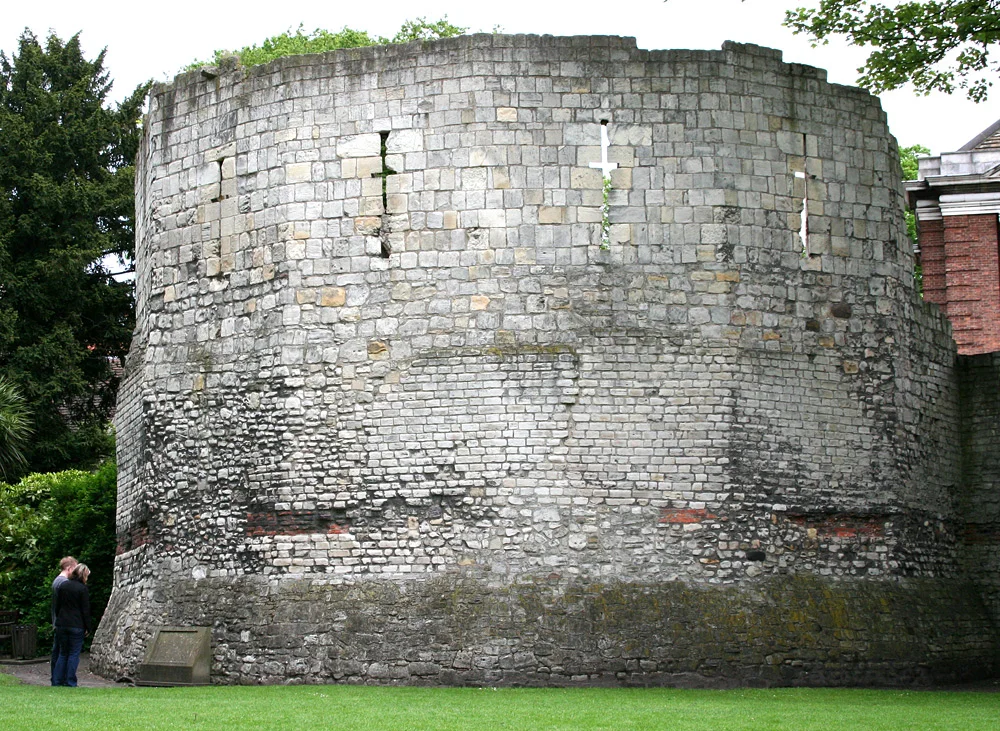
Stand in central York now and almost every layer of this story is under your feet. The Roman walls still survive in stretches - the Multangular Tower in the Museum Gardens is the same Roman masonry the Northumbrians and Vikings climbed over. The medieval city walls were built on top. The Viking workshops and houses excavated at Coppergate between 1976 and 1981 are reproduced inside the Jorvik Viking Centre, where you can ride past them in a small car and smell, more or less, what a Viking street smelled like in the autumn of 975. The streets that confused Aelle's men in 867 are still the streets you walk on. York buries nothing properly. It just builds the next thing on top.
From the Air
York city centre at 53.96N, 1.08W. Best viewed at 2,500-4,000 ft AGL. York Minster's central tower is the unmistakable landmark - the largest Gothic cathedral north of the Alps, visible from 20+ nm in clear weather. Leeds Bradford (EGNM) lies 20 nm to the south-west, Doncaster Sheffield (EGCN) 28 nm to the south. The River Ouse loops through the city in a wide S-bend; the Roman and medieval walls trace a partial oval around the historic centre. The flat Vale of York spreads out in every direction; the Yorkshire Wolds rise gently to the east, the Pennines as a high wall 25 nm to the west.
Nearby Stories
- Scampston Hall 3.5 km away
- Salts Mill 4.7 km away
- Newburgh Priory 6 km away
- Brodsworth Hall 6.2 km away
- Coverham Abbey 16 km away
- RAF Leconfield 17 km away
- Macclesfield Canal 27 km away
- RAF Scampton 35 km away