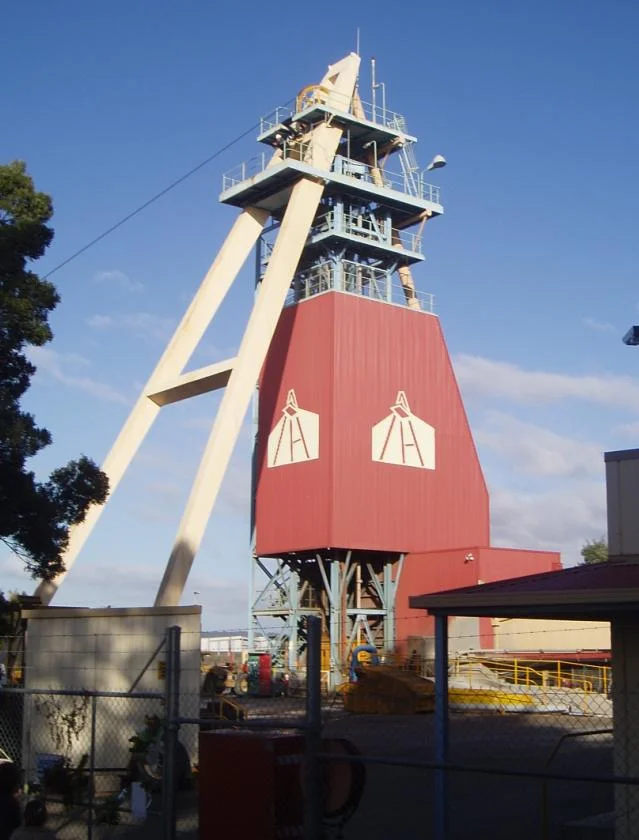

Beaconsfield Mine Collapse
It was Anzac Day, the night Australia pauses to remember its dead, when the ground gave way beneath Beaconsfield. At 9:26 in the evening on 25 April 2006, a small earthquake, magnitude 2.3, shuddered through the quartz nearly a kilometre below this quiet town in northern Tasmania. Rock that had stood for hundreds of millions of years came down in seconds. Fourteen miners scrambled clear. Three did not. One of them, Larry Knight, was killed where he worked. The other two, Brant Webb and Todd Russell, were alive, sealed in a steel cage at the end of a loader's arm, in the dark, with the weight of a mountain pressing down on them.
The Richest Hole in Tasmania
Gold built Beaconsfield. In 1877 two brothers, William and David Dally, found a payable reef on the slope of Cabbage Tree Hill, and within two years the Grubb Shaft was being sunk into the hill. For decades this was the richest gold town in the state, drawing hundreds of men underground and lifting some twenty-six tonnes of gold to the surface before flooding forced the workings to close in 1914. The mine slept until 1999, when modern pumps and methods coaxed it back to life. By 2006 the crews were working a stope nearly 925 metres down, applying steel mesh against the rock, doing the dangerous, ordinary work that the town had done for well over a century. None of them knew the ground was about to fail.
Two Men in a Cage
Webb and Russell had been standing in a basket, meshing a wall, when the rockfall buried them. Webb was knocked unconscious; Russell's legs were pinned under rubble. When Webb came to, the two cut themselves free of clothing and boots fused into the rock with utility knives, then waited, because there was nowhere to go. The "ceiling" they survived under was not, as first reported, a single protective slab. It was thousands of loose stones held in a fragile, deadly balance. When rescuers blasted a new tunnel toward them, rock shook loose inside the cage faster than the men could clear it. They begged the crews not to cut the wire mesh of their cage to reach them, certain the whole thing would come down. So the rescue had to come from below, through rock five times harder than concrete, drilled at less than half a metre an hour.
A Town, a Nation, a Foo Fighter
Beaconsfield turned its grief and hope into small acts of care. Down a narrow pipe went fresh water and food, then dry clothes, letters from home, and iPods loaded with the music the men asked for, including the Foo Fighters. When Dave Grohl heard, he sent word by fax: two tickets to any show, anywhere, and two cold beers waiting. "My heart is with you both," he wrote. The band later recorded an instrumental, "Ballad of the Beaconsfield Miners." Russell, ever himself, wrote to his wife from a kilometre underground: "It's not much of a room we have up here." The whole country watched. Prime Minister John Howard's message was four words long: "Everybody is with you, mate."
I Can See Your Light
After fourteen nights, in the small hours of 9 May, rescuers Glenn Burns, Donovan Lightfoot and Royce Gill broke through the last barrier of stone. One of them shouted, "I can see your light." The miners called back, "I can see your light too." Webb was freed at 4:47 a.m., Russell minutes later. They rode the decline up, climbed out of their wheelchairs before reaching the surface so they could walk into the daylight, and were taken to hospital in Launceston with damaged knees and vertebrae. The joy was real, but it was never whole. Less than six hours after his rescue, Todd Russell stood among more than a thousand mourners at Larry Knight's funeral, which had been postponed so the survivors could attend. A union review afterward found miners untrained in safety, supports removed, and mesh known to be ineffective. The mine finally closed for good in 2012; the town keeps its memory in a museum at the old Grubb Shaft.
From the Air
The site sits at 41.20 degrees south, 146.82 degrees east, in the lower Tamar Valley of northern Tasmania, roughly 40 km northwest of Launceston. From the air, look for the broad, mirror-flat Tamar River estuary running northwest to Bass Strait; Beaconsfield lies on its western bank, the old mine headframe a small landmark amid farmland. The closest major airport is Launceston (YMLT/LST), about 25 nm to the southeast; George Town and the Bell Bay industrial area lie a short hop north along the river. Mornings here are famously fog-prone in the valley, so clear midday light gives the best view of the estuary and the patchwork of paddocks around the town.
Nearby Stories
- Overland Track 30 km away
- Van Diemen's Land 60 km away
- Mount Bischoff 65 km away
- Stanley (Tasmania) 83 km away
- Bay of Fires 85 km away
- Freycinet National Park 103 km away
- Wybalenna Aboriginal Establishment 118 km away
- Bass Strait 125 km away