
Beecroft Art Gallery
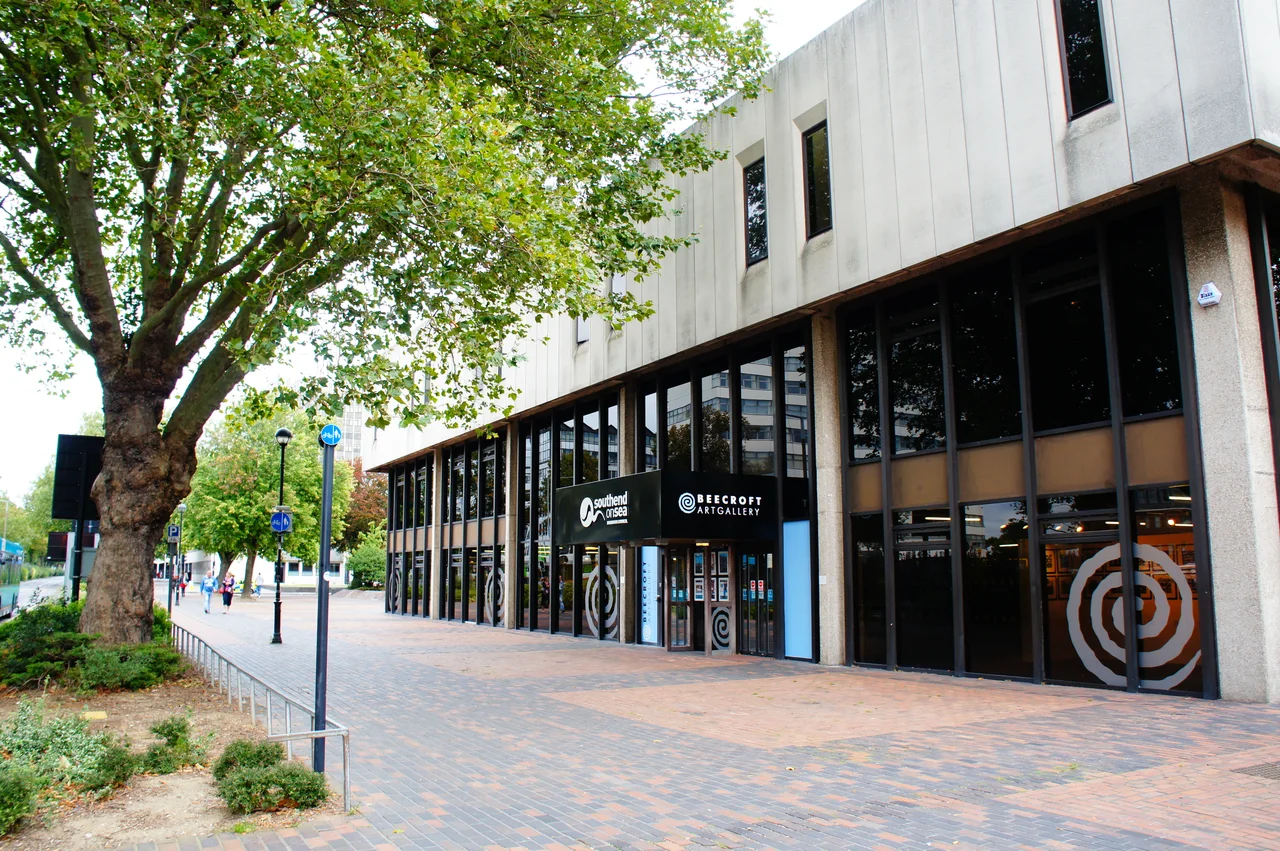
On the outside wall of the gallery, embedded into the Brutalist concrete, runs a frieze of cast ceramic tiles in browns and ochres. Look closely and the abstract pattern resolves itself: book spines, stacked. The German ceramicist Fritz Steller designed it around 1973, when the building was about to open as Southend's central library. He cast the tiles using an experimental mixture of clay, resin and sand that produced surfaces no two of which are quite alike. The library is gone now - moved up the road in 2014 - but the gallery that replaced it kept Steller's wall. It also kept Constable, Rossetti, Edward Lear, the largest collection of swimwear in the United Kingdom, and a Henry Selmer trumpet designed in 1933 in collaboration with Louis Armstrong.
A Solicitor with a Habit
Walter Beecroft (1885-1961) was a Leigh-on-Sea solicitor with two passions outside his practice: local politics and collecting art. In 1928 he persuaded the Southend public libraries committee to create an Art Gallery Sub-Committee. In 1947, deep into a long career of civic service, he offered to endow an entire building to house his collection of paintings - Dutch Old Masters, English Romantics, contemporary British work, all gathered over four decades of London auction-room visits. The Beecroft Art Gallery opened in 1952 in an Edwardian villa on Station Road in Westcliff-on-Sea, opposite the Cliffs Pavilion. Beecroft also funded the Beecroft Bequest - a permanent art purchase fund administered by the Museums Association, which still buys works for British municipal galleries today. He died in 1961, twenty-five years after the project he had launched. His gallery has now outlived him by more than six decades.
From Edwardian Villa to Brutalist Library
By the early 21st century the original Station Road building was subsiding. The Southend council had been planning a new museum on the Cliffs but the costs kept rising; in 2014 they moved the gallery, as a temporary measure, into the Central Library on Victoria Avenue, which had just been vacated when the library moved to the new Forum building. The library had been designed in 1974 by the council's architect Patrick R. Burrough as part of the Southend Civic Centre - a 1970s complex of council offices, courthouse, college and police station built in the muscular Brutalist concrete idiom of its era. The Cliffs museum plan was finally dropped in 2018, making the move permanent. The collection is now spread across three floors: temporary exhibitions on the ground, the permanent collection and fashion on the first, and in the basement an entirely independent institution - The Jazz Centre UK.
Two Thousand Works, From Bissolo to Now
The permanent collection runs to more than two thousand pieces. There are 17th-century Dutch paintings by Jan Miense Molenaer, Jacob van Ruisdael and Nicolaes Berchem, and a Venetian Madonna by Francesco Bissolo. The 19th century is represented by works attributed to Dante Gabriel Rossetti, John Constable and the nonsense poet and watercolourist Edward Lear. There are paintings by Carel Weight and members of the Great Bardfield Group - the artists' colony that gathered around Eric Ravilious and Edward Bawden in north Essex in the 1930s and 1940s. A small bronze by Jacob Epstein. The local artist Alan Sorrell is represented by his Drawings of Nubia series, made during a visit to Egypt in the early 1960s, just before the rising waters of the new Aswan Dam drowned the landscapes he had been sketching. The Thorpe Smith Collection of local views begins with a Southend watercolour from 1803.
Koudelka's Southend
In 1972 the Arts Council of Great Britain commissioned the Magnum photographer Josef Koudelka - then in exile from Czechoslovakia, having documented the 1968 Soviet invasion - and the British photographer Ron McCormick to spend the summer working in Southend. The brief was simple and slightly extraordinary: come and look at this English seaside town with outsider eyes, and tell its people what you see. Koudelka and McCormick walked the beach and the High Street and the pier. They photographed day-trippers eating ice cream, kids paddling in the surf, fairground crowds, kissing couples. The resulting prints were exhibited at the old Beecroft Art Gallery between March and April 1973, then toured local schools and community centres, then entered the gallery's permanent photographic collection. Koudelka is now regarded as one of the great documentary photographers of the twentieth century. The Southend pictures are an early example of his eye finding a vernacular subject and rendering it strange.
Hardy Amies and Mavis Plume
Since the 1970s Southend Museums has built one of the most unusual fashion collections in the British provinces. Its strengths are the decades from the 1920s to the 1970s, but it also holds a rare 17th-century slap-sole shoe and the Gloria Levin collection of Hardy Amies couture, designed by the Queen's dressmaker. Dame Vera Lynn donated a collection of her 1970s stage costumes. In 2009 the private collector Mavis Plume donated 500 bathing suits - which, combined with the museum's earlier holdings, gives Southend the largest swimwear collection in the United Kingdom, running from around 1900 to the present. Once a year the gallery turns over its first floor to a fashion exhibition. In the basement, the Jazz Centre UK - founded in 2016 by trumpeter Digby Fairweather from overstock of the National Jazz Archive - holds Sir John Dankworth's first piano, Humphrey Lyttelton's complete archive, and the 1933 Selmer balanced-action trumpet that Louis Armstrong helped design. The Essex Open Exhibition, founded by Beecroft himself in 1957, still runs annually and remains the cornerstone of the gallery's local programme - a Royal Academy Summer Exhibition in miniature, drawing entries from across historic Essex including the East London boroughs that were part of the county before 1965.
From the Air
Beecroft Art Gallery is at 51.54°N, 0.71°E on Victoria Avenue in central Southend-on-Sea, Essex, about three quarters of a mile inland from the seafront. Recommended viewing altitude is 1,500-2,500 feet. The building forms part of the Southend Civic Centre - a recognisable cluster of low Brutalist concrete blocks. From the air look for the long pier extending into the Thames Estuary as the visual anchor; the Civic Centre is northwest of the pier base, the gallery on the southeast corner of the complex. Nearest airport: London Southend (EGMC) about 2 nm north - the gallery is within the Southend control zone.
Nearby Stories
- Port of Ramsgate 0.7 km away
- Faversham Munitions Explosion Memorial 2.6 km away
- St John's Abbey, Colchester 3.7 km away
- Brentwood Cathedral 4.4 km away
- Maunsell Forts 6.7 km away
- Tilty Abbey 6.9 km away
- Shipbourne 9.9 km away
- Broadstairs 26 km away