
Beigang, Yunlin
Every year, more than a million pilgrims walk, ride, and prostrate their way to a town of fewer than 40,000 people in the agricultural heart of Yunlin County. They come for Mazu — the sea goddess worshipped across the Chinese-speaking world — even though Beigang sits far from any coast. What draws them is not geography but history: the Chaotian Temple here is among the most revered Mazu shrines in Taiwan, and the rituals that unfold around her birthday on the 23rd day of the third lunar month are among the island's largest and most visceral acts of collective devotion.
A Port Town Without a Port
The name Beigang means "north port," and once it made perfect sense. In 1621, a man named Pedro Yan Shiqi arrived from Zhangzhou in Fujian province with his forces and occupied the settlement then known as Ponkan — an important coastal castle during the era of Dutch Formosa. Yan Shiqi and his people developed the surrounding region, and what grew from that foothold eventually became the capital of Tsulo County by 1704.
Then the river moved. A catastrophic flood in 1750 sent the Beigang River cutting directly through the settlement, splitting the original Bengang community in two. The northern half became Beigang — "north port" — and the southern half became Nangang, the south port. Subsequent floods accelerated the drift, and as the river continued its southward shift, so did the population. The old port town reinvented itself as an inland agricultural market, trading maritime commerce for rice paddies and peanut fields.
The Temple That Defines the Town
Beigang's identity today is inseparable from the Chaotian Temple. Its architecture is magnificent enough to appear in tourism literature across Taiwan — layered rooflines, dragon-carved pillars, clouds of incense smoke rising through the red-gold interior. But what makes the temple extraordinary is not its appearance. It is the scale of devotion it generates.
More than a million visitors arrive each year, concentrated especially around Mazu's birthday. Processions wind through the streets with palanquins, firecrackers, and lion dances that continue for hours. The Baishatun Mazu Pilgrimage, one of Taiwan's most famous, draws thousands of walkers who follow a statue of Mazu on a multi-day journey across the island's western plains — a journey that treats Beigang as one of its key spiritual destinations. The smell of incense saturates the streets for days. This is not tourism that happens to involve a temple; this is pilgrimage that a town has grown up around.
Life Beyond the Incense Smoke
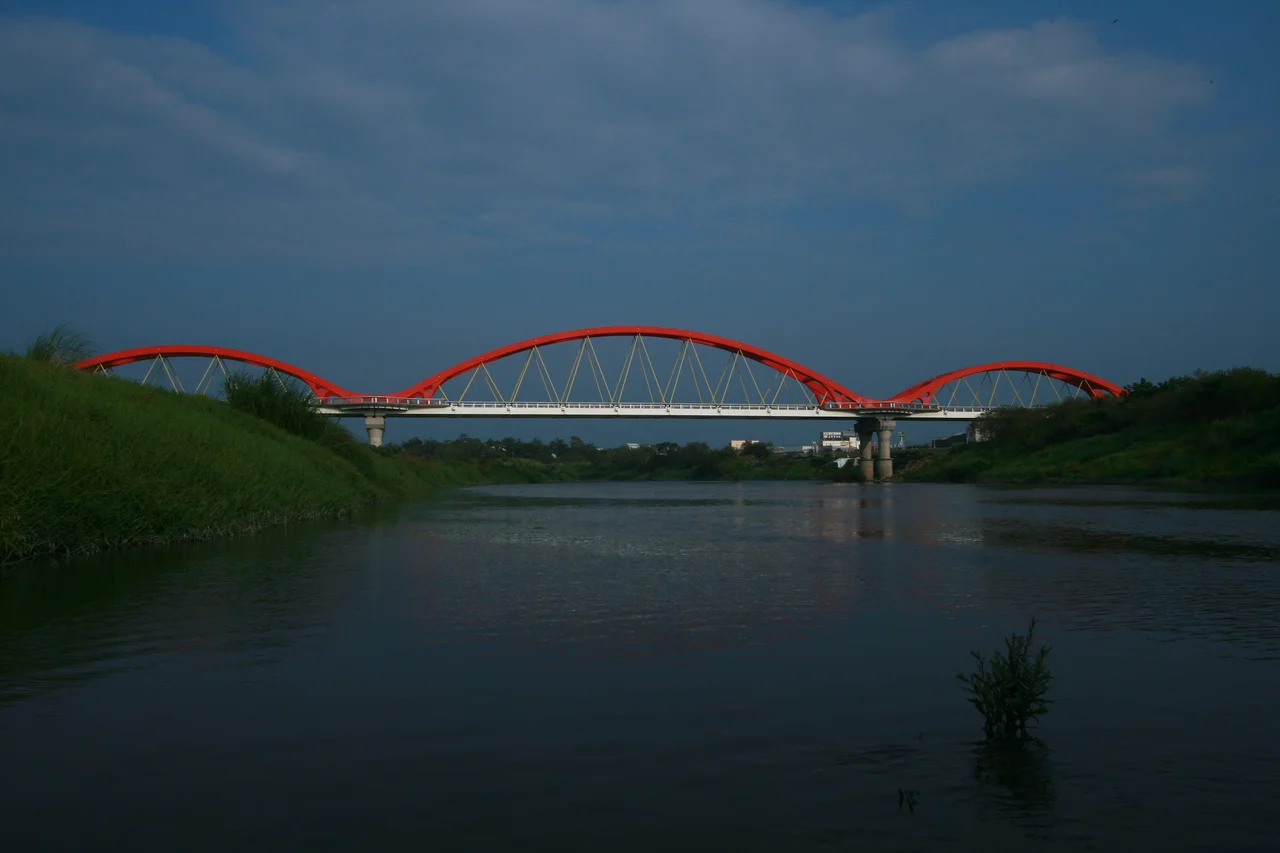
Beigang has the texture of a place that knows exactly what it is. The 450-meter Beigang Tourist Bridge, whose three arches are said to echo the form of a dragon, spans the river and announces the town's sense of its own character. The Beigang Water Tower, a legacy of Japanese-era infrastructure, stands as a reminder of a different kind of civic ambition.
Local specialties anchor the food culture. Beigang wedding cakes — both salty and sweet, in a range of traditional flavors — are carried home by visitors as souvenirs, purchased by couples preparing for ceremonies and by ordinary tourists who simply want something that tastes of the place. Peanuts and broad beans grown on the Yunlin plain fill bags at roadside stalls. The China Medical University maintains a branch here, and National Chung Cheng University, one of Taiwan's leading research institutions, lies about fifteen minutes away by car. The town sustains its own rhythms alongside the annual surge of pilgrims.
Sound and Festival
The Beigang International Music Festival brings a different kind of gathering to town — concerts and performances that draw audiences from across Taiwan and occasionally from abroad, layering a contemporary cultural identity onto the ancient ritual calendar. It is the kind of thing that happens when a community is confident enough in its heritage to add new chapters without anxiety.
The pilgrimage season, the music festival, the agricultural markets, the school sports days, the ordinary Tuesday afternoons of a Yunlin township — all of it coexists in Beigang with a naturalness that speaks to how settled the place feels in its own skin. The goddess is here all year, watching from inside the Chaotian Temple, and the town proceeds accordingly.
From the Air
Beigang sits at approximately 23.57°N, 120.30°E in Yunlin County on Taiwan's western coastal plain. From the air at 5,000–8,000 feet in clear conditions, the town is identifiable by the dense concentration of temple rooflines in its center. The flat Chianan Plain stretches in all directions; the foothills of the Central Mountain Range rise to the east. Nearest airport is RCKU (Chiayi Airport), approximately 20 km to the south-southeast.
Nearby Stories
- Puli 7.3 km away
- Guanzihling 11 km away
- Fangyuan Lighthouse 11 km away
- Yakou Mountain Pass 13 km away
- 1999 Jiji Earthquake 15 km away
- China Airlines Flight 611 23 km away
- TransAsia Airways Flight 222 26 km away
- Dongji Island 26 km away