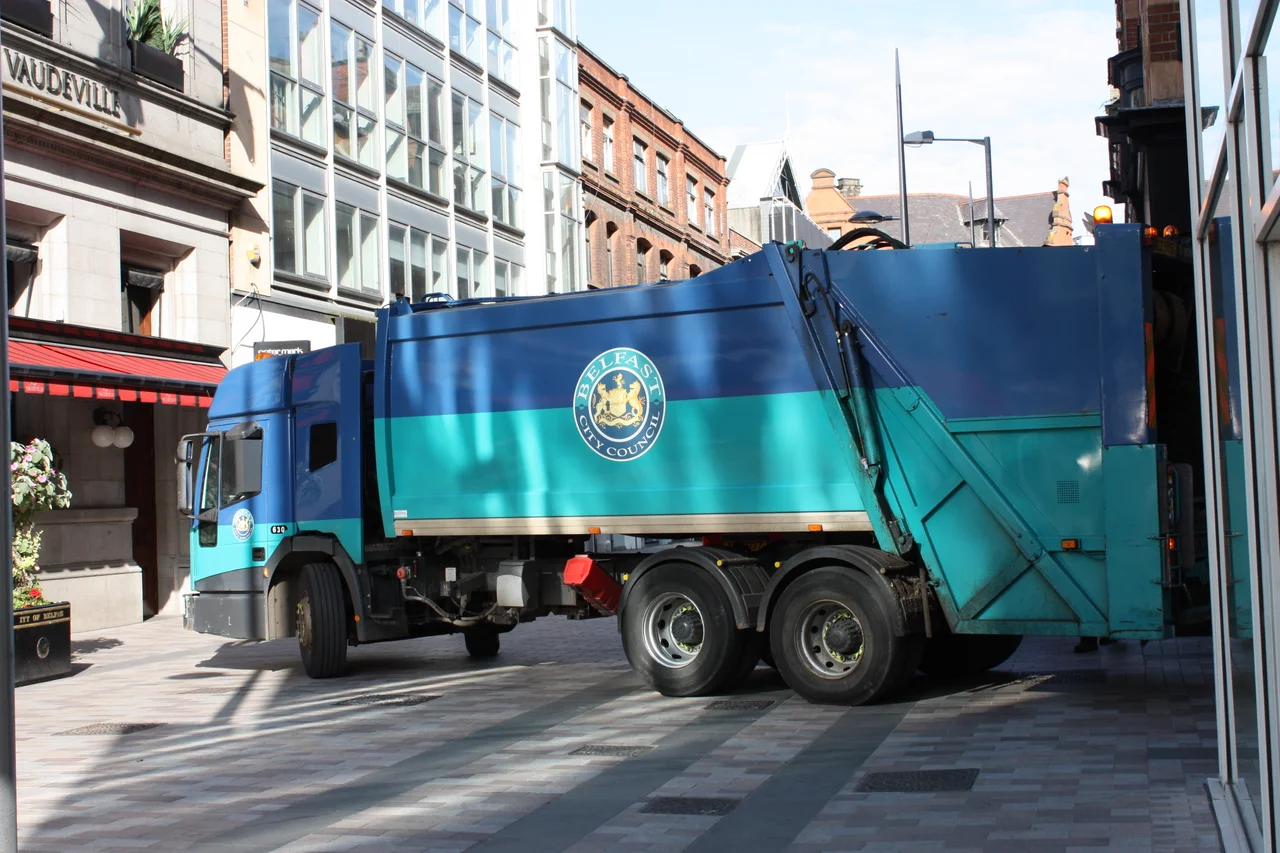
,_October_2009.JPG)
Belfast City Council
In return for so much, what shall we give back? That is the most generous translation of the Latin phrase Pro tanto quid retribuamus carved into Belfast's civic crest. The motto comes from Psalm 116, verse 12 in the Vulgate Bible, and it has anchored the city's identity since King James I granted the town status back in 1613. The coat of arms shows a silver bell beside a ship in full sail, supported by a chained wolf and a sea-horse. Belfast City Council meets beneath that crest in the green-domed City Hall on Donegall Square, a baroque-revival monument completed in 1906 to mark a city that, by 1901, was the largest in Ireland.
The Plantation and the Industrial Boom
Belfast's modern history begins with the seventeenth-century Plantation of Ulster, when Protestant Scottish and English settlers were resettled on lands cleared of the Gaelic Irish chieftains. The town grew slowly through the eighteenth century, then surged in the nineteenth as linen mills and shipyards transformed it. The Belfast Corporation handled local government from the 1840s. Queen Victoria granted city status in 1888. Within thirteen years, by the 1901 census, Belfast was the largest urban centre on the island of Ireland - larger than Dublin - and the lavish City Hall completed in 1906 served as the architectural proof. The body now known as Belfast City Council was created in its current form following the local elections of May 1973, replacing the old Corporation.
The Lord Mayor's Long Chain
The position now called Lord Mayor began in 1613 as the Sovereign of Belfast, set out in the original Royal Charter. It became Mayor of Belfast in 1842 and Lord Mayor when city status was granted in 1892 - making Belfast one of only three cities on the island of Ireland with a Lord Mayor, alongside Cork and Dublin. In 1929 it became one of only six Lord Mayoralties in the United Kingdom styled the Right Honourable. The Lord Mayor's role is mostly ceremonial, but during natural disasters they may direct police, fire, and ambulance services. The position rotated for decades almost exclusively among Ulster Unionists - they held it for 61 of the 67 years between 1921 and 1997. David Cook of the Alliance Party broke that pattern in 1978 as the first non-unionist Lord Mayor since partition. Alban Maginness became the first Irish nationalist Lord Mayor in 1997. The first Sinn Féin Lord Mayor was elected in 2002. The post is now allocated by the D'Hondt system - mathematical proportionality rather than majority rule.
1997 and the End of the Majority
From its 1973 inception until 1997, Belfast City Council was dominated by unionists. They lost overall control for the first time in council history that year, with the Alliance Party of Northern Ireland holding the balance of power between Irish nationalists and unionists. The position was confirmed in three subsequent elections. The 2011 council election saw Irish nationalist councillors outnumber unionist councillors for the first time, 24 to 21, with Sinn Féin becoming the largest party and Alliance still holding the balance with six seats. The 2011 census findings confirmed the demographic shift behind the political one: 48.58 percent of Belfast City Council area residents were Catholic or brought up Catholic, against 42.30 percent Protestant - the first census in which Catholic backgrounds outnumbered Protestant ones. In national identity, 43.16 percent considered themselves British, 34.77 percent Irish, and 26.82 percent Northern Irish.
Sixty Wards, Ten Districts
The 2014/2015 local government reform expanded Belfast's city council area to include 53,000 additional residents in 21,000 households, drawn from former Castlereagh, Lisburn, and North Down districts. The number of councillors grew from 51 to 60, distributed across ten district electoral areas - Balmoral, Black Mountain, Botanic, Castle, Collin, Court, Lisnasharragh, Oldpark, Ormiston, and Titanic - electing between five and seven members each. The first elections to the expanded council were held on 22 May 2014, and the new body came into its powers on 1 April 2015. The new ward of Titanic took its name from the Harland and Wolff shipyards where the great White Star liners were built. The new ward of Black Mountain took its name from the basaltic ridge rising west of the city. Belfast is still seen as straddling County Antrim and County Down with the River Lagan as the demarcation.
The City Hall and the Cecil Ward Building
Council meetings still take place at Belfast City Hall in Donegall Square, the green-domed Edwardian Baroque pile completed in 1906 to a design by Sir Alfred Brumwell Thomas. Administrative offices have spread to nearby buildings - the Cecil Ward Building at 4-10 Linenhall Street, completed in 1990 and named after a former Town Clerk, and an adjoining structure at 9-21 Adelaide Street completed in 2016. The council has eight committees, each with twenty councillors, working through Strategic Policy and Resources, People and Communities, City Growth and Regeneration, Licensing, Planning, Standards and Business, Climate and City Resilience, and Waterfront and Ulster Hall. Tracy Kelly took office as Lord Mayor on 2 June 2025 - the latest in a rotation that the D'Hondt system now ensures will cycle through the city's political parties. The motto endures. In return for so much, what shall we give back?
From the Air
Belfast City Hall sits at 54.594N, 5.929W at the centre of Belfast, with its distinctive green copper dome visible from significant distances - a useful navigation reference for VFR transit. Best viewed at 2,000 to 3,500 feet, with the dome at the city's centre and the River Lagan curving past to the east. Belfast City Airport (EGAC) lies 2 nm east, immediately accessible and with controlled airspace; Belfast International (EGAA) is 12 nm northwest. The Harland and Wolff yellow gantries are 1.5 nm east at the Titanic Quarter.
Nearby Stories
- Larne 1.2 km away
- Ahoghill 3.5 km away
- Castleskreen 4.9 km away
- Lough Neagh 6.1 km away
- Kingsmill Massacre 14 km away
- Pasages (steam trawler) 23 km away
- Ballantrae Lifeboat Station 34 km away
- St Patrick's Isle 39 km away