.jpg)
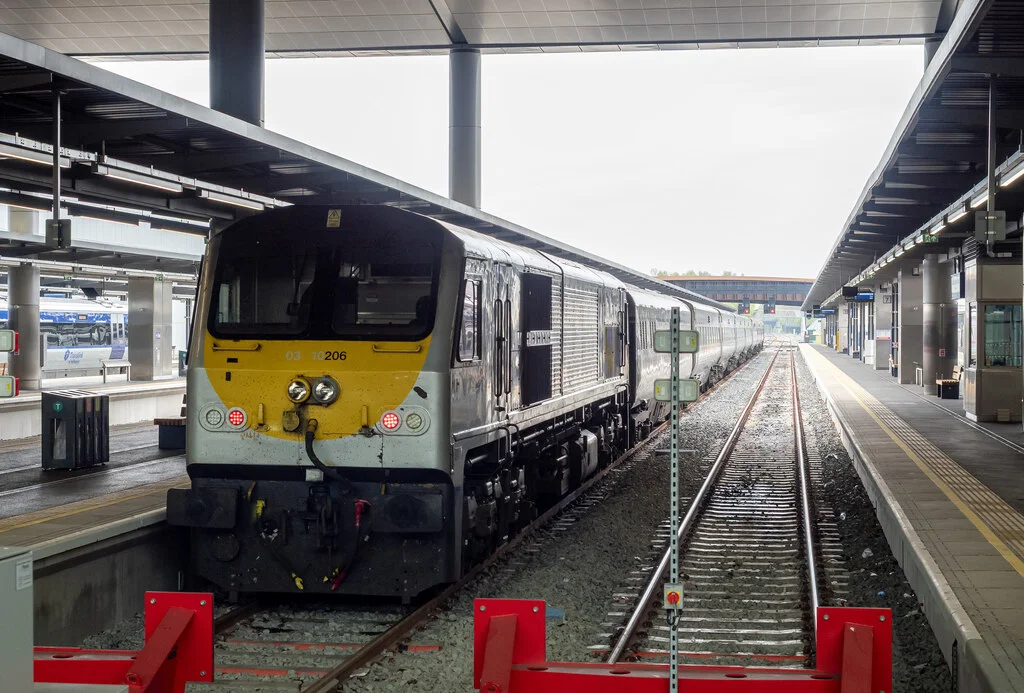
Belfast Grand Central station
On Sunday 8 September 2024 at five in the morning, an X1 Goldliner bus pulled out of a brand-new station in central Belfast bound for Dublin Busáras. It was the first scheduled service from Belfast Grand Central - a building that had been called the Belfast Transport Hub all through its planning and construction. The trains did not start running for another five weeks. When they did, on 13 October 2024, the Minister for Infrastructure was on the first arrival from Portadown. The first 2,000 passengers received commemorative tickets. The eight-hectare site is now the largest integrated transport facility on the island of Ireland - a Translink-owned interchange built between two of Belfast's earlier stations, both of which it has replaced.
From Great Victoria Street to Grand Central
The first railway station in Ulster opened in 1839 on the site of the former Great Victoria Street station, terminus of the original Ulster Railway. In 1947 it became the northern terminus of the GNR's non-stop Dublin-Belfast express. In 1962 the railway operators removed Platform 5 to make room for a bus station - giving Belfast its first integrated bus-rail interchange. Then in 1976, NIR closed the railway section altogether. The original buildings came down. The Europa Hotel and Great Northern Mall took their place. Rail services resumed in 1995 with a rebuilt Great Victoria Street station integrated with the new Europa Buscentre. That arrangement lasted nearly thirty years. When the time came to replace it, the planners had room on an adjacent eight-hectare site to do something much bigger - to combine an expanded bus station with a railway hub serving every active line in Northern Ireland.
Eight Platforms, Twenty-Six Stands
Grand Central operates eight railway platforms. Platforms 1 to 4 are 154 metres long, accommodating trains up to six cars; platforms 5 to 8 are 224 metres, taking trains up to nine cars. Trains for Derry, Larne, and Bangor typically use platforms 1 to 4. Trains for Dublin via Portadown and Newry use platforms 5 to 8. The Portadown-to-Bangor traffic, which had operated through Great Victoria Street as a single line, is now divided into two separate lines. The Enterprise express service to Dublin was relocated from Lanyon Place as part of the project. On the bus side, the station has 26 stands - eight more than Europa Buscentre had. Amenities include ATMs, vending machines, automated ticket machines, a help desk, a water refill station, a sensory pod for neurodivergent travellers, accessible restrooms, and Changing Places facilities.
Weaver's Cross and the Lost Bridge
The area surrounding Grand Central is being rebranded as Weaver's Cross - a 100,000 square metre site planned for leisure, residential, and commercial development. Combined with rejuvenated Glengall Street, Hope Street, and Durham Street, the area is intended to become Station Quarter, Belfast's ninth cultural quarter. Not everyone has welcomed the change. The 2019 planning permission included removal of the Boyne Bridge, originally built in 1863 to span the railway leading into Great Victoria Street with the current bridge dating to 1936. The Sandy Row end contains remnants of a bridge built in 1642 - originally the Great Bridge, later the Saltwater Bridge - believed to have been crossed by King William of Orange on his way to the Battle of the Boyne in 1690. Residents of Sandy Row, heritage campaigners, and architectural critics opposed the demolition. The bridge is being replaced by a four-lane road and a new plaza called Saltwater Square.
Irish Signs and the Judicial Review
The station opened without Irish language signage, drawing protests from An Dream Dearg and other language rights groups. Ciarán Mac Giolla Bhéin told reporters that the station serves people from across the entire island and should reflect the city's identity. In March 2025, Infrastructure Minister Liz Kimmins announced that bilingual signage including Irish would be installed later that year at an estimated cost of £150,000. The decision was welcomed by Irish language advocates and criticised by some unionists, including TUV MLA Timothy Gaston who called the move culturally divisive in what he described as a predominantly Loyalist area of Belfast. In April 2025 loyalist activist Jamie Bryson sought judicial review, arguing that Kimmins had breached the ministerial code by not referring the decision to the full Stormont Executive. A High Court hearing on 9 May 2025 ruled the procurement process alone would take six months, effectively pausing the signage installation until at least October 2025. Bryson was granted leave for a full judicial review. The hearing was listed for September.
Trains to Five Lines
Grand Central serves as terminus for every active railway line in Northern Ireland except the Coleraine-Portrush branch. The Bangor Line runs half-hourly to Bangor on weekdays and Saturdays. The Derry-Londonderry Line runs hourly, with services alternating between Derry and Coleraine on Sundays. The Enterprise to Dublin Connolly runs hourly Monday to Saturday, with stops at Portadown, Newry, Dundalk Clarke, and Drogheda MacBride. The Larne Line runs half-hourly with alternating terminus patterns. The Portadown-Newry Line runs half-hourly Monday to Saturday with peak express services. Designed by John McAslan + Partners with Arup Group and Juno, built by a joint venture of Farrans Construction and Sacyr with rail systems by Babcock - Grand Central is the largest public transport project in Northern Ireland's history. The Europa Buscentre has been converted into a corridor connecting the new station to the old Great Victoria Street site. Belfast has been waiting for an integrated transport hub on this scale since the 1962 attempt at Great Victoria Street. It now has one.
From the Air
Belfast Grand Central station sits at 54.594N, 5.940W just south of Belfast city centre, with the green dome of Belfast City Hall as the closest navigation reference. Best viewed at 2,000 to 3,500 feet on a westerly track, with the station's broad rectangular form visible immediately southwest of the city centre. Belfast City (EGAC) is 2 nm east-northeast - the station sits inside the Belfast control zone, requiring airspace coordination. Belfast International (EGAA) is 12 nm northwest. The Lagan runs east of the city centre. The railway lines fan out south, west, and east from the station.
Nearby Stories
- Larne 1.2 km away
- Ahoghill 3.5 km away
- Castleskreen 4.9 km away
- Lough Neagh 6.1 km away
- Kingsmill Massacre 14 km away
- Pasages (steam trawler) 23 km away
- Ballantrae Lifeboat Station 34 km away
- St Patrick's Isle 39 km away