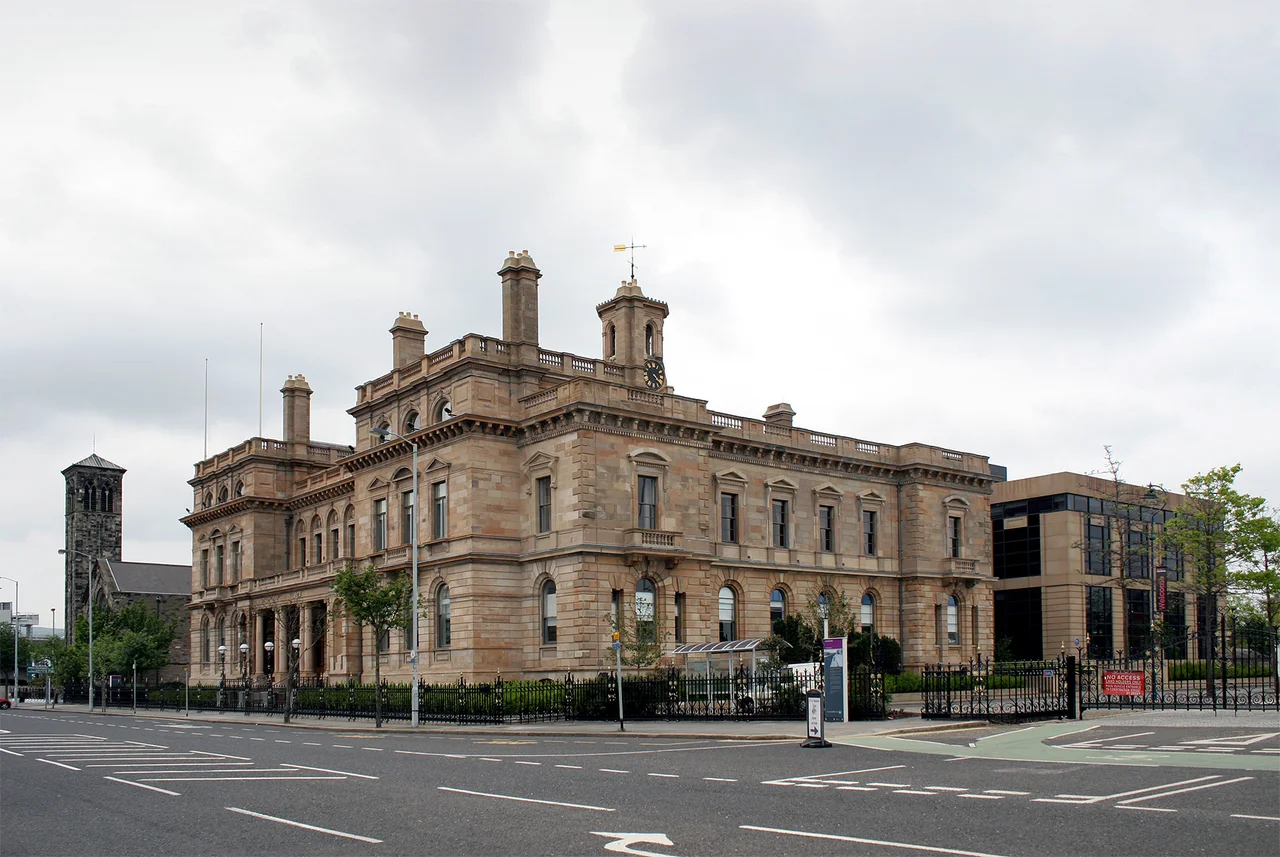

Belfast Harbour
Two rivers met here once, the Lagan and the smaller Farset, and on the muddy confluence between them King James I signed a charter in 1613 that asked for a wharf. The Farset is gone now, buried beneath High Street, but the wharf grew. It became docks. The docks became channels. The channels became an estate of nearly two thousand acres carved from reclaimed mud, and from those reclaimed acres came the largest ship in the world. Belfast Harbour is what happens when a river crossing decides to become a city's engine.
The River That Wasn't Deep Enough
For most of its first two centuries as a port, Belfast had a problem: the lough was too shallow and the channel curved too much. Ships arriving from the Irish Sea couldn't reach the quays fully loaded. They had to anchor downstream at a place called Garmoyle and lighten their cargo into smaller boats - paying twice for unloading, paying again for Customs supervision, losing time on every tide. By 1785 the trade was busy enough that Parliament constituted a Ballast Board to fix things, but the real change came under the Victorians. Engineers began straightening the river in 1839, slicing through bends, dredging a deep cut they would call the Victoria Channel. It opened in 1849, and suddenly Belfast had what Belfast had always needed: water deep enough for the world.
Where the Titanic Got Built
The reclaimed land that emerged from all that dredging became Queen's Island, and on Queen's Island a shipyard called Harland and Wolff laid the keel for a vessel they numbered 401. She would be launched in 1911 and christened RMS Titanic. The yard built her sister Olympic alongside her, and her younger sister Britannic after, under the world's largest gantry crane. Today the gantries Samson and Goliath still loom over the same slipways, painted yellow, visible from the city centre and from passenger jets descending into George Best Belfast City Airport, which now occupies a strip of the same harbour estate. The Titanic story sank in the North Atlantic, but the dock she was fitted out in - a basin so vast it can hold modern oil tankers - is still there, water still in it, walls still vertical, the largest dry dock in the world when it was new.
The Working Port
Most ports become museums of themselves. Belfast did not. The harbour today moves around 24 million tonnes of cargo a year, handles roughly two-thirds of Northern Ireland's seaborne trade, and is one of only two ports on the island that takes every type of freight: containers, dry bulk, liquid bulk, break-bulk, rolling freight, passenger ferries, cruise ships. Stena Line's super-ferries to Cairnryan and Birkenhead carry over a million passengers a year and well over half a million trucks. Eight remote-controlled gantry cranes, delivered in late 2019, lift containers off feeder ships from Rotterdam and Antwerp. Over 700 firms employing 23,000 people work within the harbour estate. It is the kind of place where the past is not curated; it just keeps operating alongside the present.
HMS Caroline and the Quiet Cruisers
Tucked into Alexandra Dock, painted in dazzle camouflage, sits a small grey ship called HMS Caroline. She is a light cruiser built in 1914, and she fought at the Battle of Jutland - the largest naval engagement of the First World War. After the war she became a training ship, then headquarters of the Ulster Division of the Royal Naval Reserve, and stayed on as a working naval vessel until 2011, almost a century after her launch. Restored and reopened as a museum in 2016, she sits a short walk from where Titanic sailed. During the Second World War the entire port served as a base for Atlantic convoy escorts, and German bombers came looking for it during the Belfast Blitz of April and May 1941. The shipyard was hit. The convoys kept sailing.
The Titanic Quarter
When Harland and Wolff began closing slipways in the 1980s, the harbour found itself with hundreds of acres of disused industrial land - all of it just across the water from Belfast city centre. The result, two decades later, is the Titanic Quarter: apartments where rivet shops used to be, a film studio where Game of Thrones was shot, the Catalyst Inc innovation campus, and the Titanic Belfast museum, which opened in 2012 on the hundredth anniversary of the disaster and looks from the outside like four iceberg-shaped prows pointing at the sky. The harbour still owns and develops the land, still describes itself as a trust port - independent of government, obliged to operate commercially, accountable to a board appointed through open public advertisement. It is a hybrid arrangement, neither private nor state, that has somehow allowed a Victorian dock to keep reinventing itself for two hundred years.
From the Air
Located at 54.63°N, 5.89°W on the southern shore of Belfast Lough, where the River Lagan empties into the sea. From a window seat, look for the two enormous yellow gantry cranes - Samson and Goliath - rising 96 metres above the former Harland and Wolff shipyard; they are visible from miles offshore and from cruising altitude on clear days. The harbour estate sprawls across the lough's eastern shore, threaded by the Victoria Channel. George Best Belfast City Airport (EGAC) sits on harbour land itself, with its runway running along the south side of the docks - approaches are right over the cranes. Belfast International (EGAA) is 14 nautical miles west-northwest. Recommended viewing altitude: 2,000-5,000 feet for the yellow cranes and dock geometry; the lough opens north-eastward toward Carrickfergus and the Irish Sea.
Nearby Stories
- Larne 1.2 km away
- Ahoghill 3.5 km away
- Castleskreen 4.9 km away
- Lough Neagh 6.1 km away
- Kingsmill Massacre 14 km away
- Pasages (steam trawler) 23 km away
- Ballantrae Lifeboat Station 34 km away
- St Patrick's Isle 39 km away