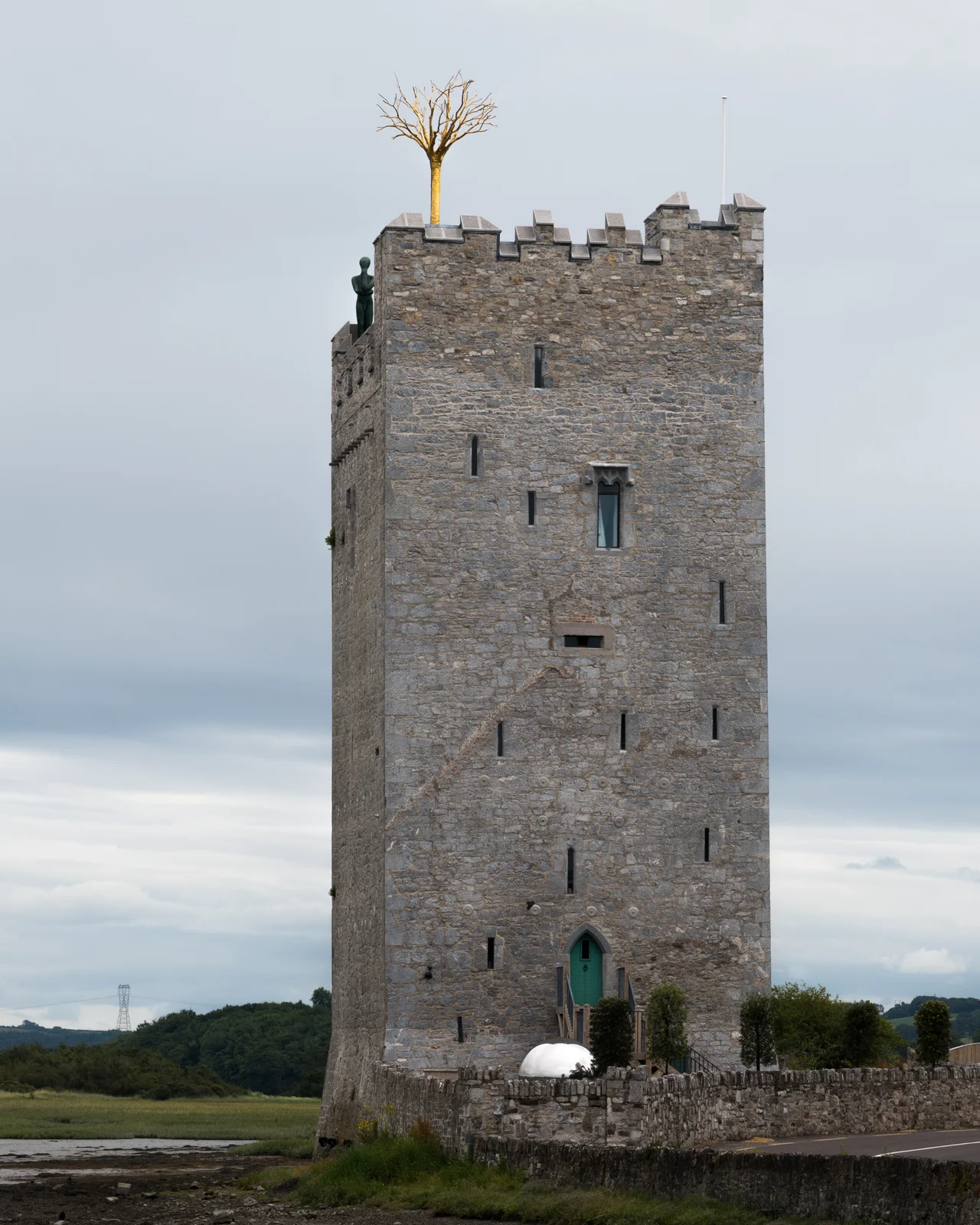

Belvelly Castle
During the First World War, Cork coachmen made good money driving American and British sailors out to a small grey tower house overlooking a bridge, telling them - and possibly half-believing it themselves - that they had arrived at Blarney Castle. The sailors kissed the wrong stones. They had been taken to Belvelly, not Blarney. The trick speaks to how easily one Irish castle can be sold as another, but it also tells you something about Belvelly's location: right beside the only road bridge connecting Fota Island to Great Island, impossible to miss, and convenient for a coachman with a story to tell.
A Hodnett Fortification
Belvelly was built in the 14th or 15th century by the Anglo-Norman Hodnett family, one of the smaller settler clans who took up positions around Cork Harbour after the conquest. The Hodnetts later leased the lands back, an arrangement that became common as Norman families intermarried with their Gaelic neighbours and the old hard distinctions softened. The tower house is the standard Irish design of its century: a tall stone block with thick walls, narrow windows, a single defensible entrance, and rooms stacked vertically. You built up because building wide cost more and defended less.
Raleigh, Cromwell, and the Long 17th Century
Some sources place Walter Raleigh at Belvelly in the 16th century - the same Raleigh who tormented the Barrys at Barryscourt during the Desmond Rebellions. The castle later passed back to the De Barra family, the Norman dynasty that dominated this part of East Cork. During the Irish Confederate Wars of the mid-17th century, Roger Boyle, 1st Earl of Orrery - one of the Protestant strongmen who anchored Cromwell's settlement of Ireland - used Belvelly to garrison troops. The castle, like most of its peers, was less a residence by then than a strongpoint in a country at war with itself.
The Sailors Who Kissed the Wrong Stone
By the 19th century Belvelly was a ruin, mossy and forgotten. Then came the First World War, and Queenstown - now Cobh - became a major Allied naval port. The harbour filled with American destroyers, British cruisers, and exhausted sailors with shore leave. Local coachmen spotted opportunity. The famous Blarney Stone was a long drive inland. Belvelly was right here, beside the bridge, with a perfectly castle-shaped silhouette. Some coachmen probably knew exactly what they were doing. Others may have got caught up in the illusion themselves. Either way, sailors kissed stones at Belvelly believing they were getting the Blarney gift of eloquence. The deception is gentle as historical lies go - nobody was harmed, and the sailors went home with stories.
From Emergency Outpost to Restoration
During the Emergency - Ireland's name for the Second World War, which it spent officially neutral - the Irish Army occupied and modified Belvelly. The castle slipped back into disuse afterwards. By the early 21st century it was again a ruin, and in 2016 planning permission was granted for a restoration as a private dwelling. The work cost roughly five million euro and finished in late 2018. The new owners commissioned additional sculptures placed on the roof, a deliberately contemporary flourish on a 15th-century silhouette. They also became sponsors of Cobh Ramblers FC, the local football club - a quiet way of tying the restored castle back to the community it has watched over the bridge for six centuries.
From the Air
Located at 51.89°N, 8.30°W at the north-west corner of Great Island, immediately beside the Belvelly Bridge that connects Fota Island to Great Island. The tower house is visible from low altitudes as a tall grey block beside the bridge crossing the narrow channel. Cobh and the deep-water harbour lie about 5 km east; Cork Airport (EICK) is roughly 14 km south-west. Best viewed at lower cruising altitudes when bridges and channels of Cork Harbour are clearly visible.
Nearby Stories
- St. Declan's Monastery 0.8 km away
- Aghavrin House 2.4 km away
- Mitchelstown Castle 7.4 km away
- Clonakilty 9.5 km away
- Inislounaght Abbey 16 km away
- Walter Siepmann 23 km away
- Newcastle West 33 km away
- SM U-27 110 km away