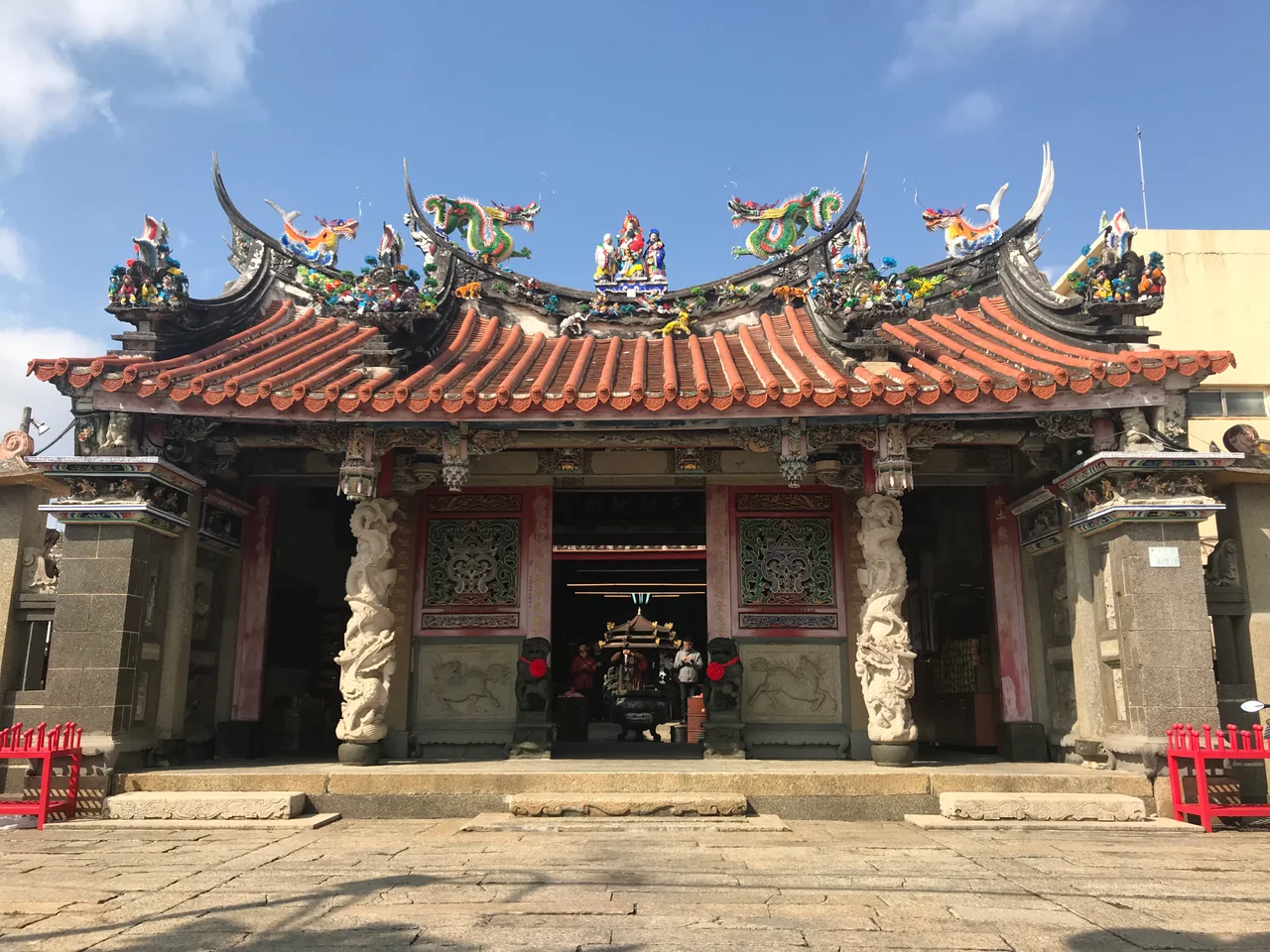

Bengang Shuixian Temple
The five figures in the main hall are a strange and magnificent assembly: Yu the Great, the legendary flood-tamer of Chinese antiquity; Xiang Yu, the doomed warrior-king; Wu Zixu, the loyal minister whose story ended in death by betrayal; Qu Yuan, the poet who walked into a river; and Lu Ban, the divine patron of craftsmen. Together they are the Shuixian Zunwang — the Water Immortal Kings — and the temple built to house them on the south bank of the Beigang River carries the weight of all their stories, plus three centuries of its own.
Bengang: The Port That the River Erased
In 1621, when Pedro Yan Shiqi arrived from Fujian and began developing the settlement of Ponkan along the Beigang River, he was establishing what would become one of the most important trading and administrative centers on Taiwan's western coast. By the early eighteenth century, the place called Bengang — its name meant something like "clumsy port" in the local dialect, a designation that belied its real importance — had become both a trade hub and, reputedly, a pirate haven. Boatsmen moved goods along the river constantly, and in 1739, the community built Shuixian Temple so those mariners could pray for safe passage.
The temple served its purpose for eleven years. Then, in 1750, the Beigang River flooded catastrophically, altering its own course to run directly through the city. Bengang split into two settlements: Beigang to the north and Nangang to the south. Shuixian Temple survived this first catastrophe, though much of the surrounding city did not.
Flood, Ruin, and Rebuilding
The second blow came in 1803. Another major flood destroyed Shuixian Temple entirely, along with most of Bengang's other significant structures. This time the river's course shifted so far southward that the center of gravity of the surviving population moved north to Beigang. Nangang — where the temple had stood — became the smaller, quieter settlement. Most people had left.
But the temple was rebuilt anyway. In 1814, construction crews raised Shuixian Temple again on its original site in Nangang. The final significant addition came in 1848, when the four rows of halls that define the current structure were completed. That rebuilding in a depopulated settlement, in the old location rather than the more convenient northern one, was itself a statement: the site mattered. The water gods demanded it.
The Hall of Immortals and Its Artifacts
Walking into the main hall today means entering a space where the five Water Immortal Kings are arranged in hierarchy, Yu the Great at the center. He belongs here — his legendary achievement was taming China's ancient floods, working without rest until the waters submitted to engineering and order. The front hall is dedicated to Mazu, the sea goddess whose worship saturates the surrounding region; the rear hall to Guan Yu, the deified general revered across Chinese religious practice.
In that rear hall hang artifacts that predate the current building by decades. A plaque inscribed with the characters 日月爭光 — roughly, "competing with the radiance of sun and moon" — dates to the reign of the Jiaqing Emperor, meaning it was carved sometime between 1796 and 1820. Alongside it stand a pair of dragon pillars from the same era. The menshen — the door gods — and many of the interior paintings were executed by Chen Yufeng, a famed Taiwanese painter who lived from 1900 to 1964 and whose work appears in significant temples across southern Taiwan.
A Monument to the Margin
In 1985, Taiwan's government designated Shuixian Temple a level-two national monument — recognizing both its architectural significance and the depth of its Qing dynasty artifact collection. The designation acknowledges something easy to overlook: the temple's survival and repeated rebuilding in the quieter, less-populated Nangang rather than the busier Beigang makes it an unusually intact record of the original Bengang settlement. Most of the historical fabric of the original port city is gone, erased by floods and demographic drift. Shuixian Temple, rebuilt twice, holding pillars from the early 1800s and paintings from the mid-twentieth century, carries more of that memory than almost anything else that remains.
From the Air
Bengang Shuixian Temple sits at approximately 23.5618°N, 120.3087°E in Nangang Village, Xingang Township, Chiayi County, on the south shore of the Beigang River. From the air at 3,000–6,000 feet, the river itself is a useful navigation landmark, with the temple compound visible as a dense cluster of traditional rooflines on the southern bank. The nearest airport is RCKU (Chiayi Airport), approximately 18 km to the southeast.
Nearby Stories
- Puli 7.3 km away
- Guanzihling 11 km away
- Fangyuan Lighthouse 11 km away
- Yakou Mountain Pass 13 km away
- 1999 Jiji Earthquake 15 km away
- China Airlines Flight 611 23 km away
- TransAsia Airways Flight 222 26 km away
- Dongji Island 26 km away