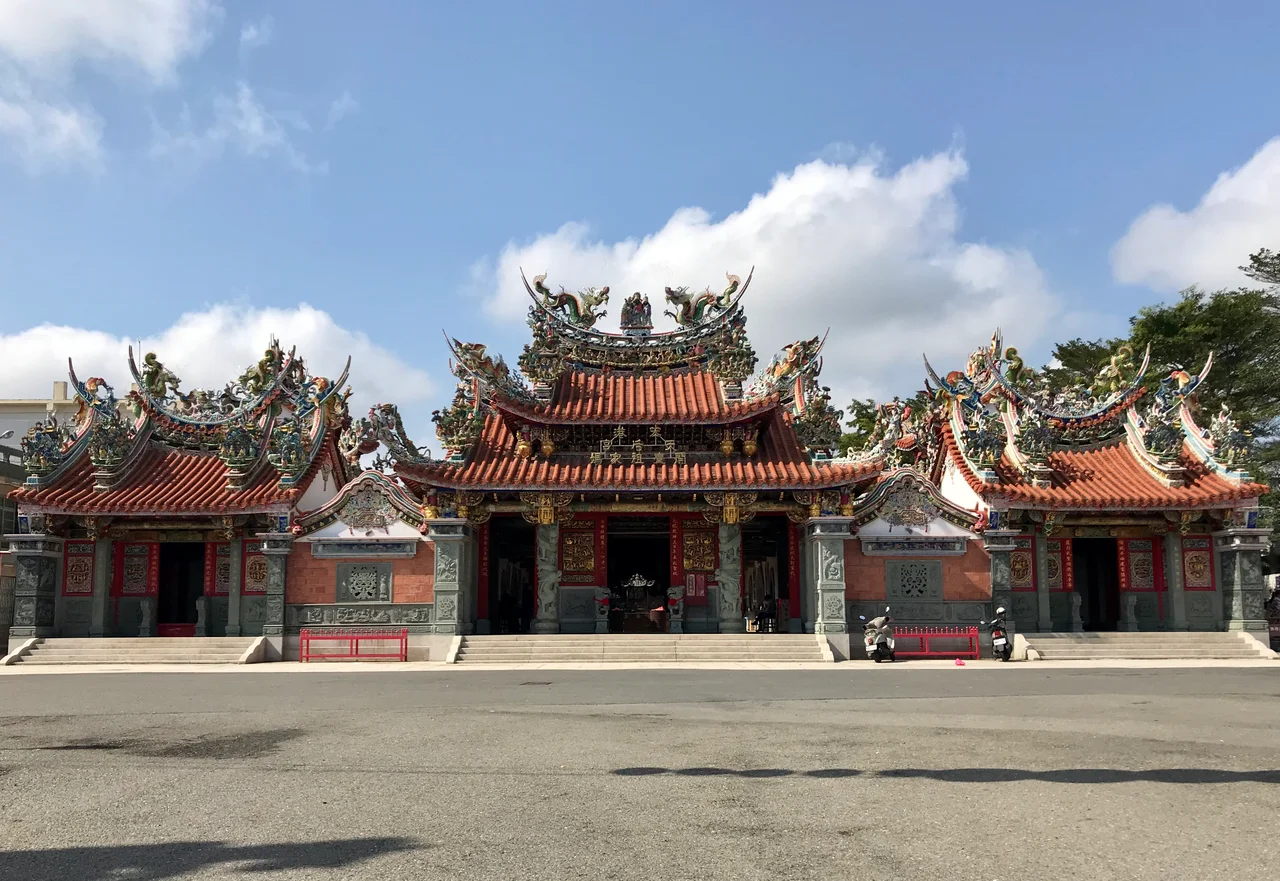

Bengang Tianhou Temple
The statue came home by a long road. Its journey began with a potter named Yang Qian, who left Bengang for Changhua sometime in the eighteenth century and, according to tradition, carried an incense bag for spiritual protection. The bag began to glow — or so the people of Changhua believed — and they took this as a sign that Mazu herself had arrived among them. A temple was built in her honor in 1738. Decades later, Yang Qian returned to Bengang, and the thread of obligation that his migration had created kept pulling the two communities together, visit by visit, generation by generation, long after the man himself was gone.
The Original Temple and the Wandering Potter
In 1713, a temple known simply as Mazu Temple stood in Bengang — the historical port city along the Beigang River that eventually split into today's Beigang in Yunlin and Nangang in Chiayi County. It was east of where the current temple stands. Yang Qian worshipped there before his departure for Changhua, taking with him only the small incense bag that Taiwanese folk practice holds should travel with the faithful.
When the incense bag glowed — the legend does not specify when, only that it did — the people of Changhua interpreted it as Mazu revealing herself. They built Nanyao Temple in 1738. Yang Qian later moved back to Bengang, settling near Shuixian Temple. In 1815, Nanyao Temple formalized its spiritual debt by beginning a pilgrimage to the Yang family residence, paying tribute to the origins of their Mazu devotion. This relationship between a Changhua temple and a Bengang family — sustained through annual pilgrimages — would define the Mazu statue's story for the next two centuries.
The Statue That Kept Moving
Yang Qian's descendants eventually found the arrangement of a deity visiting a mortal household unsettling, and they asked Nanyao Temple to provide a proper statue. Nanyao Temple had one sculpted and installed it in the old Mazu Temple, which had by then been renamed Tianhou Temple — a name that translates roughly as Queen of Heaven Palace, one of Mazu's honorific titles. The arrangement continued: each year, Nanyao Temple's pilgrims arrived, the Yang family hosted, and the statue received new ceremonial clothing from the pilgrims when the family's fortunes were thin.
Then the earth moved. The 1906 Meishan earthquake destroyed Tianhou Temple — an event that also leveled much of Chiayi City and left thousands dead across the region. The statue was carried to the Yang residence for safekeeping, and there it remained for decades, with the annual pilgrimage continuing in the domestic setting as if nothing extraordinary had happened. The tradition was more important than the building.
The Temple Rebuilt and Consecrated Again
Nearly a century passed before a permanent home was found. In 1998, worshippers pooled resources to purchase a plot of land directly adjacent to Shuixian Temple in Nangang Village — the same neighborhood where the original Mazu Temple had stood and where the water-god temple that had sheltered the statue stood. Construction of the new Tianhou Temple took five years. The finished building measured 420 ping, a traditional Taiwanese unit of area — roughly 1,390 square meters — substantial enough to serve the community it had been waiting to serve for over ninety years.
On 10 October 2002, a formal ceremony moved the Mazu statue from Shuixian Temple, where it had rested during construction, into the newly completed Tianhou Temple. Future pilgrimages from Nanyao Temple in Changhua would now end here, at this building, rather than at a family home or a temporary arrangement. The thread that Yang Qian's migration had pulled taut in the eighteenth century was finally anchored to permanent ground.
A Neighborhood of Sacred Ground
The proximity of Bengang Tianhou Temple to Shuixian Temple is not coincidental. These two temples occupy what was once the spiritual and commercial center of the original Bengang settlement — the port city founded in 1621 and twice transformed by floods. Together they preserve a density of religious continuity that is unusual even for a region as temple-rich as southwestern Taiwan.
Pilgrimages from Nanyao Temple now converge on Tianhou Temple, bringing the Chang-Nan connection alive each spring in processions, ceremony, and the ritual changing of the statue's garments. It is an act of memory as much as worship: a reminder that Mazu's presence in this corner of Taiwan was carried here by one man's journey, sustained by a glowing incense bag and the faith of two communities that refused to let the connection lapse.
From the Air
Bengang Tianhou Temple is located at approximately 23.5616°N, 120.3081°E in Nangang Village, Xingang Township, Chiayi County, adjacent to Bengang Shuixian Temple on the south shore of the Beigang River. From the air at 3,000–6,000 feet in clear conditions, the two temple complexes are visible as a dense grouping of traditional-style rooflines on the southern riverbank. Nearest airport is RCKU (Chiayi Airport), approximately 18 km to the southeast.
Nearby Stories
- Puli 7.3 km away
- Guanzihling 11 km away
- Fangyuan Lighthouse 11 km away
- Yakou Mountain Pass 13 km away
- 1999 Jiji Earthquake 15 km away
- China Airlines Flight 611 23 km away
- TransAsia Airways Flight 222 26 km away
- Dongji Island 26 km away