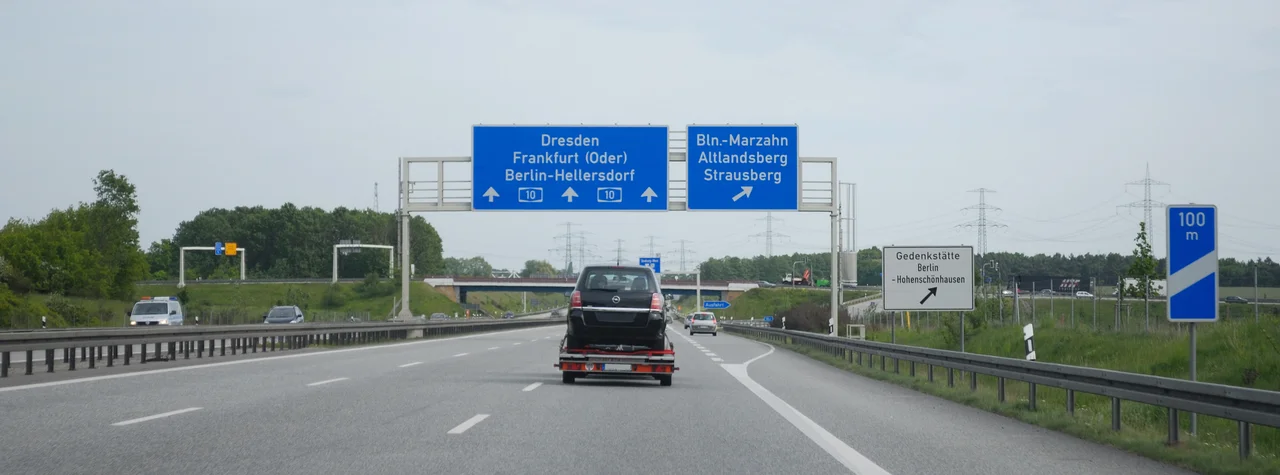

Berlin-Hohenschönhausen Memorial
The journey in was designed to tell you nothing. Prisoners arrived at Hohenschönhausen in the back of a Barkas B1000, a small East German delivery van painted up as a bread or produce round, with windowless steel compartments welded into the load space — one person to a compartment, no light, no sound but the engine. The driver took a long looping route through the city. The van pulled into an enclosed garage before anyone opened the doors. A man arrested that morning in his own neighbourhood could climb out an hour later with no idea which part of Berlin he was standing in, or whether he was still in Berlin at all. Disorientation was not a side effect of the arrest. It was the first thing the Ministry for State Security took from him.
Special Camp No. 3
The oldest building on the site was never meant for this. A red-brick factory finished in 1939, it produced supplies for the soup kitchens of the Nazi welfare organisation until the war ended. In June 1945 the Soviet NKVD took over the compound and made it a detention and transit camp — Special Camp No. 3 — through which more than twenty thousand Germans passed on their way deeper into the Soviet penal system. Among them was the actor Heinrich George, sent on to Sachsenhausen in 1946, where he died soon afterwards. Conditions in the camp killed people quickly. Official figures record 886 deaths between July 1945 and October 1946, from malnutrition, illness and cold; independent estimates run as high as three thousand. The dead were tipped into bomb craters in the surrounding wasteland. Berlin was full of bomb craters that year, and nobody was counting.
The U-Boat
In the cellar the Soviets built a row of cells that prisoners named das U-Boot — the submarine. They were damp, windowless and cold, lit when they were lit at all by a single bulb, and a prisoner put in one could lose the distinction between day and night within a week. When the East German Ministry for State Security reopened the prison as its central remand facility in 1951, it inherited the cellar and used it. Through the 1950s the treatment was physical: beatings, cells flooded with water, interrogations that ran for days without sleep. Around eleven thousand people were held here between 1951 and 1989. They were pastors and poets, would-be escapees, people caught passing letters west, people denounced by a colleague, people who had applied to emigrate and were made to understand that the application itself was the offence.
When the Method Changed
From the 1960s onward the Stasi grew more careful. Visible injuries created problems abroad and martyrs at home, so the pressure moved inward. Prisoners were kept in near-total isolation, sometimes for months, forbidden to speak to anyone but their interrogator and unable to learn what had happened to their families. Cellmates were sometimes informants placed there to draw out a confession over weeks of apparent friendship. Interrogators alternated warmth and threat, and the uncertainty — nobody knew the charge, the sentence, or the date — did work that a truncheon could not. The prison had a hospital wing, expanded in 1972, with up to twenty-eight beds inside cells, an X-ray ward, operating rooms and a morgue, staffed at the end by twenty-eight full-time Stasi employees under a doctor named Herbert Vogel. Its exercise yards were roofless concrete boxes with wire lids and a guard walking above. Prisoners called them tiger cages.
An Address That Was Not on the Map
None of this was secret from the people it happened to. It was secret from everyone else. The prison sat inside a large restricted zone in Lichtenberg, ringed by a settlement built for Stasi staff and their families, and for most of its working life it was simply omitted from city maps — a blank rectangle in a district that otherwise had streets and tram stops like anywhere else. That omission had a consequence nobody planned. When the Wall opened in November 1989 and crowds occupied the Stasi headquarters on Normannenstraße, no one came to Hohenschönhausen, because there was no publicly known place to come to. Officials used the time to destroy their records. The prison stayed in operation until 3 October 1990, the day Germany reunified. Much of what is known about how it worked comes not from its own paperwork but from the memories of the people held in it, cross-checked against files kept elsewhere in the East German state.
The Prisoners Who Made It a Museum
Former inmates founded the memorial themselves in the early 1990s, pushed the site onto the historic register in 1992, and opened it to visitors in 1994. It is funded in equal parts by the German federal government and the state of Berlin, and it is run today by the historian Helge Heidemeyer, who took over in 2019 after his predecessor Hubertus Knabe was dismissed in a dispute over his deputy's conduct. You can only go round in a group, with a guide, and that is deliberate — many of the guides are people who were once locked in these corridors. Mario Röllig has been leading tours since 1999. In June 1987 he was picked up by Hungarian border police while trying to reach Yugoslavia, spent a week in a Budapest cell, was handed back to the Stasi and brought here for three months on a charge of attempting to cross the border illegally. He walks visitors past the doors and explains what happened behind them in an even, unhurried voice. It is the most persuasive exhibit in the building, and it is not behind glass.
From the Air
The memorial occupies a walled compound at 52.542°N, 13.501°E on Genslerstraße in Alt-Hohenschönhausen, roughly 9 km northeast of central Berlin. Berlin Brandenburg (EDDB) is 24 km south-southwest. From 2,000–4,000 ft the site shows as a rectangle of low red-brick and grey blocks with an open yard, set apart from the surrounding grid of GDR-era Plattenbau slabs that run in long parallel rows to the north and east. The Fernsehturm bears southwest at about 8 km and makes the easiest visual fix. The prison's old exclusion zone is still legible from above as an area of oddly discontinuous streets.
Nearby Stories
- E11 hiking trail 3.4 km away
- Bogensee 4.3 km away
- Maybach I and II 4.9 km away
- Treuenbrietzen 15 km away
- Battle of Fehrbellin 18 km away
- Falkenhagen Bunker 20 km away
- St. Mary's Church, Chojna 35 km away
- Eisenhüttenstadt 39 km away