.jpg)
Big Ben
On 31 December 2024, just before midnight, the Great Bell at the north end of the Palace of Westminster struck the new year within about five-thousandths of a second of the correct time. This is the strange precision of Big Ben. The clock is hand-wound three times a week, takes about ninety minutes to wind, and is corrected — when it runs even a fraction fast — by adding or removing pre-decimal pennies from the top of the pendulum. Each penny shifts the rate by 0.4 seconds per day. The most accurate four-faced public clock in the world, when it was finished in 1859, is still running on Victorian mechanics, a stack of old copper coins, and the careful attention of a small team of horologists who are on call twenty-four hours a day.
What the Name Means
The name belongs first to the bell. "Big Ben" is the nickname of the Great Bell of the Great Clock of Westminster, cast at the Whitechapel Bell Foundry on 10 April 1858 and weighing 13.5 long tons. By association, the name has crept outward — onto the clock face, onto the tower itself, and onto the entire idea of the place. The tower has had three official names. It was simply the Clock Tower until 2012, when on the occasion of Queen Elizabeth II's Diamond Jubilee the House of Commons voted to rename it Elizabeth Tower, mirroring the renaming of the western tower (Victoria Tower) for Queen Victoria's Diamond Jubilee. Journalists during Victoria's reign called it St Stephen's Tower. In Welsh political reporting, anything to do with the Commons is still "San Steffan." The bell, though, has always been Big Ben.
The Bell That Cracked Twice
The original 16-ton bell was cast on 6 August 1856 in Stockton-on-Tees by John Warner & Sons. The tower was not yet finished, so the bell was hung temporarily in New Palace Yard for testing. It cracked beyond repair. The replacement, the bell that hangs today, was cast at Whitechapel and pulled by sixteen horses across London to the tower, where it took eighteen hours to raise the 200 feet to the belfry. It first chimed on 11 July 1859. Two months later, in September, it too cracked under its hammer. According to the foundry manager George Mears, Edmund Beckett Denison, the lawyer and amateur horologist who had designed the clock, was using a hammer more than twice the maximum weight specified. Rather than recast the bell a third time, the engineers turned it a quarter turn so the hammer fell on an undamaged section, and fitted a smaller striker. The crack is still there. So is the slightly mournful E-natural note it produces.
Pugin and the Tower
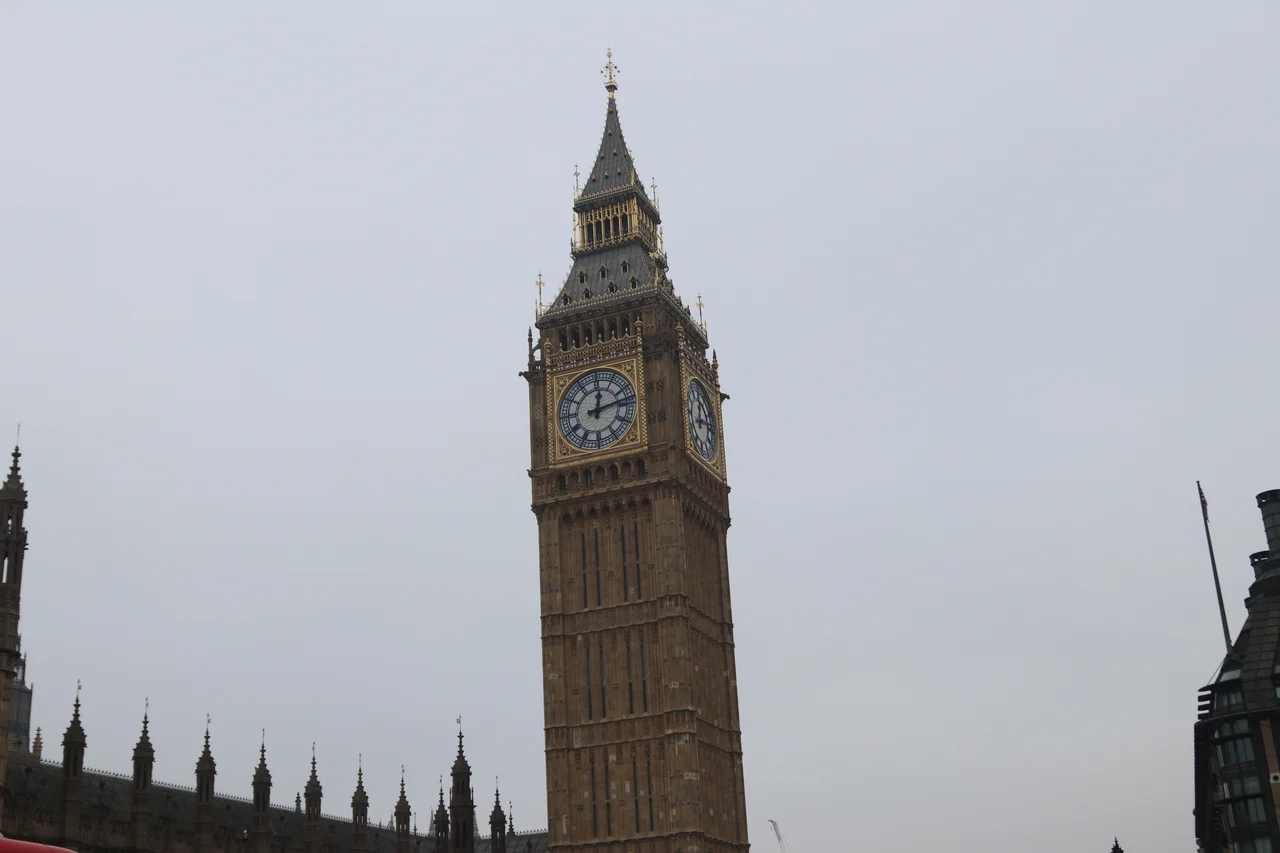
The old Palace of Westminster burned on 16 October 1834 in an accidental fire that took most of the medieval complex with it. Charles Barry won the competition to rebuild and turned to Augustus Pugin for the Gothic detail. Pugin designed the Clock Tower in 1843, drawing on his earlier work at Scarisbrick Hall in Lancashire. It would be his last design before the breakdown and death that followed in 1852. "I never worked so hard in my life," Pugin wrote, finishing his drawings for Barry's last visit. "It is beautiful." Construction began on 28 September 1843; the tower was completed in 1859. It stands 316 feet tall, with a 22.5-foot dial on each of its four faces, each dial made of 324 pieces of opalescent glass. The dial frames were originally Prussian blue, painted black in the 1930s to hide soot from London's coal fires, and restored to their original blue during the 2017–2021 conservation works.
How the Clock Stays Accurate
Denison's most lasting contribution was an invention he never patented: the double three-legged gravity escapement, which isolates the pendulum from the effects of wind pressure on the giant clock hands. The pendulum itself is two metres long and beats every two seconds. On top of it sits a small stack of pre-decimal pennies. Adding a penny minutely lifts the pendulum's centre of mass, shortens its effective length, and speeds it up by exactly 0.4 seconds per day. In 2009, three of the pennies were replaced with a £5 coin commemorating the 2012 London Olympics, an aesthetic choice that does not appear to have offended the clock. The Keeper of the Clock and a team of horologists maintain the mechanism, along with about three hundred other clocks scattered throughout the Palace of Westminster. Big Ben keeps time to within a few seconds per week.
The Tower That Leans
Big Ben leans. Not by much — about 500 millimetres at the finial, after thousands of tons of concrete were pumped into the ground beneath it during the construction of the Jubilee line in the 1990s. Engineers think the lean will not be a problem for another four to ten thousand years. It rests on London Clay over a gravel base, and the May 1941 Luftwaffe raid that destroyed the adjoining Commons chamber turned out, when restoration crews opened up the masonry in February 2020, to have damaged the tower more than anyone had realised. The 2017–2021 restoration peeled back six different colour schemes from the dial frames, removed and refurbished 2,567 cast-iron roof tiles, installed the first lift in the tower's history, and replaced 1,296 pieces of clock-face glass. The work cost nearly £80 million. In December 2021, the scaffolding came down and the bells rang in the New Year, on time, as they have done — almost without exception — since the practice began at midnight on 31 December 1923.
From the Air
Big Ben rises at 51.50N, 0.12W on the north bank of the Thames at Westminster, where the river bends sharply from south-flowing to east-flowing. The 316-foot tower is unmistakable from the air, set among the Gothic spires of the Palace of Westminster and directly across from Westminster Bridge. London City Airport (EGLC) lies six miles east; London Heathrow (EGLL) fifteen miles west. Best viewed from 1,500 to 3,000 feet on a clear day, using the Thames bend and St James's Park as references.
Nearby Stories
- Battle of Britain, Northfleet 1.1 km away
- Bayham Old Abbey 5.4 km away
- Catharine Macaulay 6.4 km away
- Hatfield rail crash 8.8 km away
- Chequers 8.9 km away
- Chelmsford Cathedral 10 km away
- Queen Victoria Hospital 13 km away
- Fishbourne Roman Palace 36 km away