
Birmingham Canal Navigations
Birmingham has more miles of canal than Venice. Locals love saying it, and it is true. The Birmingham Canal Navigations, abbreviated BCN, at their peak spanned around 174 miles of inland water across the city and the Black Country -- more than Venice's grand and minor canals combined. About 100 miles of the network are still navigable. The figure misleads slightly, because Birmingham's waterways look nothing like Venice's: these are working-engineer's canals, cut for cargo, lined with brick warehouses and lock cottages, hidden behind ring roads and under bridges. But the comparison sticks for a reason. No other British city industrialised so completely around a man-made water network, and no other city kept so much of that network in working order.
Brindley's Cut
On 14 September 1772, James Brindley's Birmingham Canal opened for business. Authorised four years earlier by Act of Parliament (8 Geo. 3 c. 38), the cut ran from the then-edge of Birmingham -- with termini at Newhall Wharf and Paradise Wharf, near what is now Gas Street Basin -- north-west to meet the Staffordshire and Worcestershire Canal at Aldersley Junction, north of Wolverhampton. The route wandered. Brindley, the great pioneer of contour canals, refused to fight terrain when he could go around it, so his line snaked through the landscape following the natural levels. Coal arriving from the Black Country pits could now move into central Birmingham at a fraction of the road-haulage price. The toll dropped, and the price of energy for forges and factories dropped with it. The Industrial Revolution in Birmingham had its delivery system.
Three Levels and a Pumping Engine
The BCN is built on three main levels, each with its own reservoir. The Birmingham Level sits at 453 feet above Ordnance Datum; the Wolverhampton Level at 473 feet; the Walsall Level at 408. The Titford Canal climbs higher again, to 511 feet. Locks link the levels at various points. At Smethwick Summit a short section of the Old Main Line was originally built at 491 feet, six locks above the Wolverhampton level on either side. Pumping engines at Spon Lane locks and Smethwick locks recycled water back to the summit -- the Smethwick Engine, built by Boulton and Watt in 1779, is the oldest working steam engine in the world still on its original site, now preserved in Birmingham's Thinktank museum. When traffic on the summit became unmanageable, John Smeaton designed a scheme to lower the section by 18 feet down to the Wolverhampton level. Six locks vanished and a parallel set of locks at Smethwick doubled throughput.
Telford Goes Straight
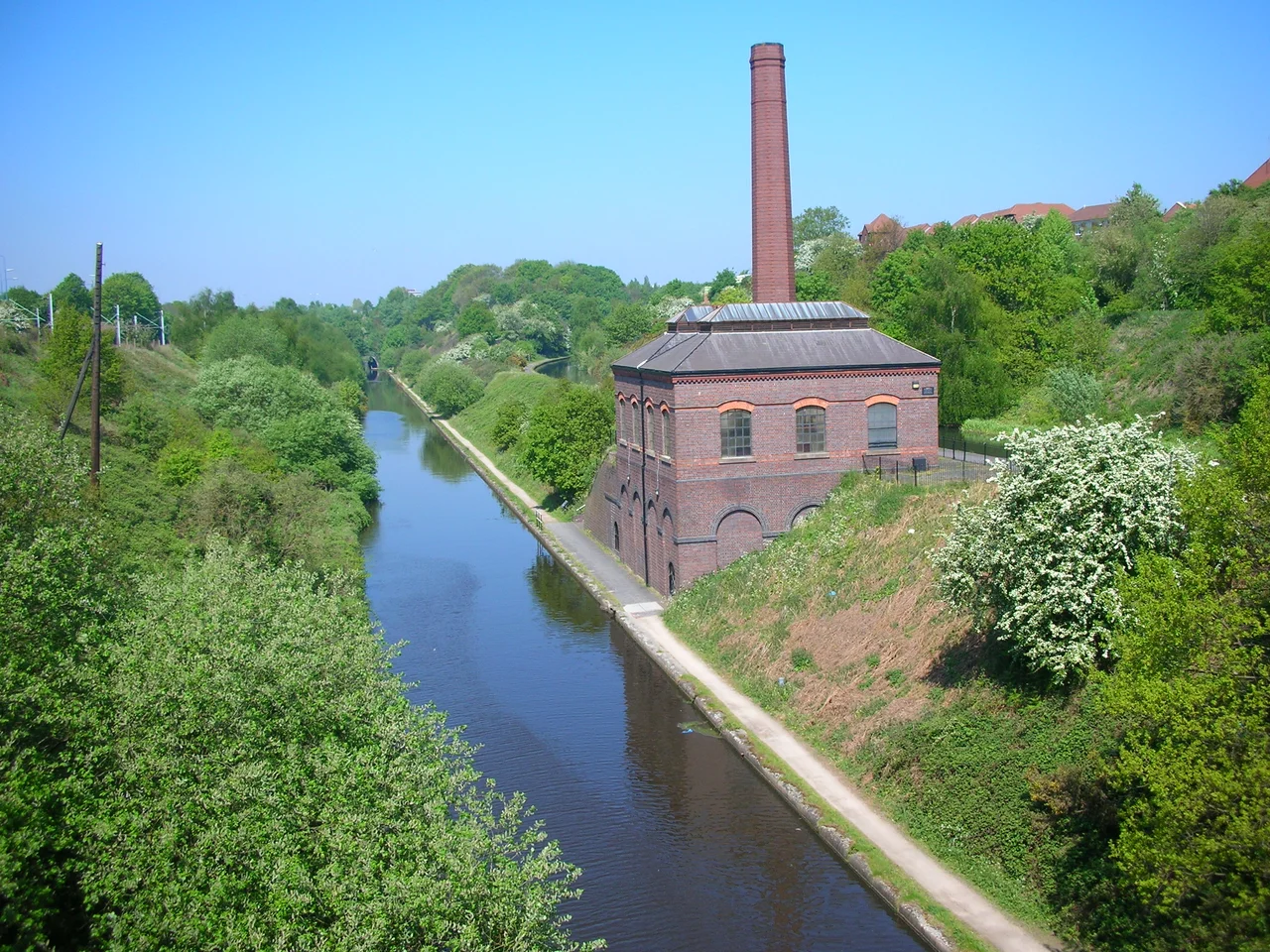
By the 1820s Brindley's winding original line could no longer handle the traffic. Between 1825 and 1837 Thomas Telford reworked the route as the New Main Line: double towpathed, largely straight, driven through cuttings and over aqueducts instead of around the contours. The new line saved six miles between Spon Lane, Deepfields and Wolverhampton and dropped the toll on coal by nine pence per ton. Cuts of staggering ambition opened: Galton Bridge over the new cutting at Smethwick was once the longest single-span iron bridge in the world. The old Brindley line did not disappear -- it survives as the Old Main Line, looping above the new in places, with the Engine Arm carrying a feeder canal across Telford's deep cut on a cast-iron aqueduct that still draws photographers. The BCN became a network rather than a single canal: a knot of main lines, branches, loops and links that you could spend a lifetime exploring on foot.
What the Network Connects
Inside the BCN, dozens of named branches survive in varying states of navigation. The BCN Main Line still runs from Aldersley Junction to Gas Street Basin. The Birmingham and Fazeley Canal heads east from Old Turn Junction past the National Indoor Arena to Fazeley Junction, where it meets the Coventry Canal. The Dudley Canal -- with the spectacular 3,154-yard Dudley Tunnel, the second-longest navigable canal tunnel in Britain -- threads under Dudley Castle. The Wyrley and Essington Canal, bought by the BCN in 1840, sprawls north into Cannock Chase territory. Tame Valley Canal, Walsall Canal, Tame, Titford, Rushall -- each has its own personality, its own collection of warehouses turned into apartments and pubs turned into towpath cafés. Outside the BCN, the network connects to the Coventry Canal, the Grand Union, the Staffordshire and Worcestershire, the Stourbridge, and the Worcester and Birmingham Canal, which runs south to meet the Severn at Worcester.
Still Carrying People
Commercial cargo on the BCN essentially ended in the 1960s. What followed was something nobody at the network's eighteenth-century opening could have predicted: leisure. Narrowboats by the thousand now cruise the canals each summer, their owners spending fortnights or full seasons working through the locks. Gas Street Basin -- once a coal wharf -- is surrounded by restaurants, hotels and apartments; the canal walks at Brindleyplace have become one of Birmingham's signature spaces. The BCN Society, founded in 1968 and registered as a charity in 2002, exists to conserve and promote the network. Since 1983 the Society has put up signposts at most of the junctions, restoring a navigational courtesy the old commercial boatmen never needed because they knew every inch of the system. The Society's quarterly journal is called Boundary Post. About 100 miles of the original 174 remain navigable, which is most of what matters and more, even now, than Venice's grand and minor canals combined.
From the Air
The BCN network sprawls across roughly 60 square miles of the West Midlands, centred on Birmingham at approximately 52.48N, 1.91W and extending north-west to Wolverhampton, west to Dudley, and north to Walsall and Cannock. Gas Street Basin sits in central Birmingham next to the ICC and Brindleyplace; Telford's New Main Line cutting at Smethwick is a particularly photogenic feature from the air. Nearest airports: EGBB (Birmingham, 5nm SE of central BCN), EGOC (RAF Cosford, 12nm W), EGBE (Coventry, 22nm ESE). Best viewed at 2,000-4,000 ft AGL on a clear day.
Nearby Stories
- Shepshed 8.5 km away
- Battle of Evesham 11 km away
- Hixon rail crash 12 km away
- Battle of Cropredy Bridge 12 km away
- Wenlock Priory 15 km away
- RAF Shawbury 16 km away
- Market Bosworth 17 km away