
Birmingham New Street railway station
Walk into New Street's main concourse in 2026 and you stand under a vast pillowed atrium of perforated stainless steel and white light. The roof catches the eye and forgives a multitude of subterranean sins beneath it. Twelve through platforms still sit, as they have since 1967, in a concrete cavern below ground level -- ventilated by blowers, choked by diesel exhaust, fed by tunnels that have not changed since the Victorians cut them. The station is impossible. It runs 1,350 trains a day on infrastructure designed for 650. It is the thirteenth busiest station in the United Kingdom and the busiest outside London, with 36.6 million passenger entries and exits between April 2024 and March 2025. Over five million of those passengers were changing trains. New Street is not a destination. It is the place where the British railway network turns around.
Built on the Froggery
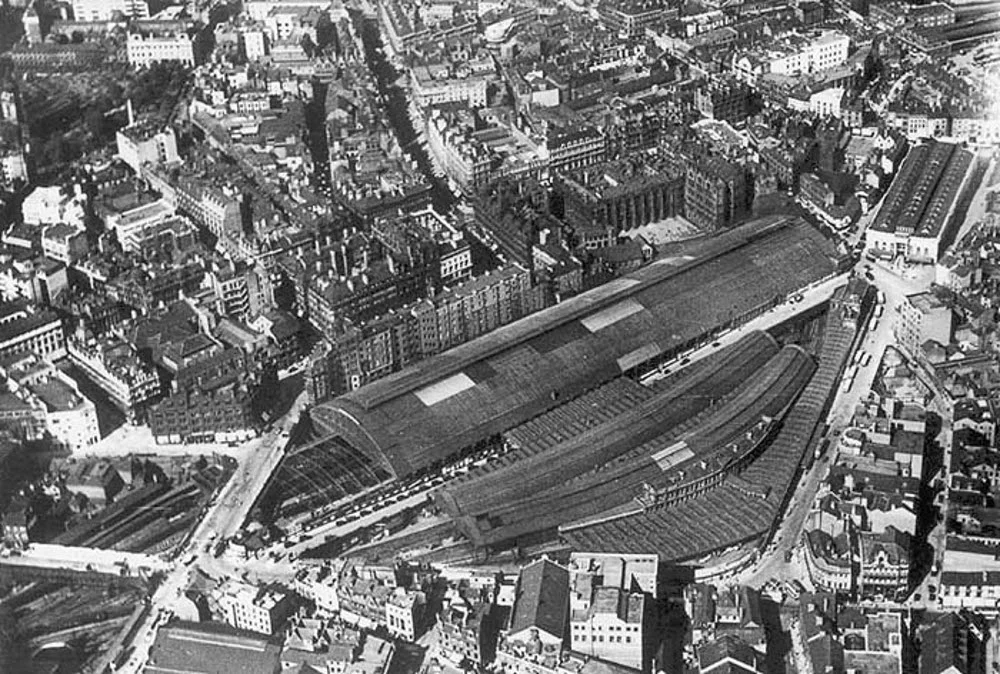
Between 1846 and 1854 the London and North Western Railway built New Street on a piece of central Birmingham known as The Froggery -- a marshy, slum-dense district of streets called Peck Lane, New Inkleys, Dudley Street, Queen Street. About 70 houses were demolished. The Countess of Huntingdon's Connexion chapel, built only six years before, was torn down. The station opened on 1 June 1854 with the largest single-span arched iron-and-glass roof in the world: 211 feet wide, 840 feet long. The designer was Edward Alfred Cowper of the firm Fox, Henderson and Company, who had previously worked on the Crystal Palace. The internal track layout was Robert Stephenson's. The contemporary architect George Gilbert Scott called Cowper's roof at New Street "the most wonderful specimen, probably" of an iron span. It held the world record for fourteen years until St Pancras opened in 1868.
Two Stations in One
Curzon Street, the original Birmingham terminus a short walk to the east, was no longer adequate by the 1880s. The Midland Railway, which had been using both Curzon Street and New Street, needed a way to run its trains through Birmingham without reversing. A new line from the south -- the Birmingham West Suburban Railway -- was extended into New Street in 1885. To cope with the extra traffic, the station gained an extension: a separate trainshed of two trussed arches, designed by Francis Stevenson. From 1889 the new shed handled Midland Railway trains exclusively, while the original LNWR shed kept its own. The two halves of the station were divided by Queens Drive, a central carriageway, with a footbridge running across the entire width. New Street effectively became two stations under different management, joined at the hip. The arrangement survived all the way to 1923, when the LNWR and Midland Railway were absorbed into the LMS in the grouping ordered by the Railways Act 1921.
The Brutalist Bunker
Cowper's record-breaking roof did not survive the Second World War. The Birmingham Blitz tore holes in the glass; the iron frame was deemed beyond economic repair. The roof came down. From 1948 to the early 1960s the station made do with austere platform canopies built from surplus war material. The complete rebuild opened on 6 March 1967, to coincide with the electrification of the West Coast Main Line. The new station, designed by Kenneth J. Davies of British Rail's London Midland Region, sat under a concrete deck supporting a shopping centre and a multi-storey car park. Twelve through platforms replaced the previous eight through and six bay platforms. It was efficient at the level of trains-per-hour. As a building, users hated it. By 2007 customer satisfaction was 52 percent, the joint lowest of any major Network Rail station. Country Life magazine voted it the second-biggest eyesore in the UK in 2003. The architectural critic Simon Jenkins called it "hideous." Steven Parissien called it a "depressing underground bunker."
Gateway Plus
A 388-million-pound rebuild was announced in 2008. Foreign Office Architects won the design competition. Work began in April 2010. The reconstruction kept the platforms and tunnels intact -- those were never the problem -- and replaced the street-level building entirely. A new concourse three and a half times larger than the 1960s original opened in two phases, on 28 April 2013 and 20 September 2015, with a domed atrium overhead clad in perforated stainless steel that catches light and reflects the surrounding city. Four days after the concourse opened, the connected Grand Central shopping centre opened, anchored by a John Lewis department store. Patches of the past survived: the Grade II-listed 1964 power signal box -- once the largest relay interlocking in the world -- still stands beside the Wolverhampton end of the platforms, visible from Navigation Street. A bronze sculpture of a snorting Brahma bull, originally created as the symbol of the 2022 Birmingham Commonwealth Games, was permanently installed at the station in 2023 and nicknamed Ozzy after the city's own Black Sabbath frontman. Ozzy no longer snorts or stomps, but he watches the crowds.
The Tunnels Underneath
Every train arriving or leaving New Street must use one of several Victorian tunnels under the city. The Stour Valley Line Tunnel heads west to Wolverhampton: 927 yards in total, including the 1852 New Street North Tunnel of 751 yards and the more recent 176-yard Arena Tunnel under the National Indoor Arena. The New Street South Tunnel heads east under the Bullring and Moor Street station, opened in 1854, widened in 1896 to hold four tracks. South-west toward Five Ways runs a sequence of four shorter tunnels -- Holliday Street, Canal Tunnel passing under the Birmingham Canal Navigations, Granville Street and Bath Row -- all dating to 1885. The signalling is now controlled from the West Midlands Signalling Centre in Saltley. The station has the IATA location identifier QQN. Diesel trains still ventilate exhaust into the platform cavern, which is why air-quality monitors are nailed to the walls. New Street is, in 2026, what it has been since the 1850s: a stubbornly inadequate piece of infrastructure that the country has refused to replace, because no replacement could be built without shutting down the West Midlands rail network for a generation. Instead, every twenty years, Britain rebuilds the building above it.
From the Air
Located at 52.48N, 1.90W in the heart of Birmingham city centre, immediately north of the A38 city ring road and surrounded by Grand Central / Bullring / The Mailbox developments. The new concourse roof's distinctive bulbous atrium catches light and is visible from the air. Nearest airports: EGBB (Birmingham, 5nm ESE -- direct rail link to New Street in 10-20 minutes), EGBE (Coventry, 22nm ESE), EGOC (RAF Cosford, 14nm W). Best viewed at 2,000-3,000 ft AGL with the Rotunda and Bullring providing the city-centre landmarks.
Nearby Stories
- Shepshed 8.5 km away
- Battle of Evesham 11 km away
- Hixon rail crash 12 km away
- Battle of Cropredy Bridge 12 km away
- Wenlock Priory 15 km away
- RAF Shawbury 16 km away
- Market Bosworth 17 km away