.jpg)
Blackrock Castle
Every three years in August, for several centuries, the Mayor of Cork climbed into a boat off Blackrock Castle and threw an arrow into the harbour. The dart - about four feet long - marked the jurisdiction of Cork Corporation over the waters of the upper harbour. The ceremony was called 'throwing the dart,' and it was conducted with the seriousness of any other claim of sovereignty. The same circular tower that watched those Mayors row out into the Lee in the 18th century is still there today, its walls 2.2 metres thick, its diameter 10.5 metres. Above it now sits a radio telescope, beaming messages from Cork schoolchildren towards nearby stars.
An Elizabethan Petition Against Pirates
In the late 16th century, Cork's citizens petitioned Queen Elizabeth I to build them a fort. Pirates were a real problem - small, fast vessels that ran into the harbour, seized ships, and disappeared back out to sea. The Crown approved. In 1582 a fortification went up on the site at Blackrock, two kilometres downriver from the city. Around 1600 a round tower was added 'to safeguard against pirates carrying away vessels entering the harbour.' The phrase from the records is precise: pirates were not just attacking ships, they were stealing them whole. The tower's job was to bring guns to bear on anyone trying. Its lower courses are what you see today on the water's edge.
Civic Property
James I granted Cork a charter in 1608, and Blackrock Castle became civic property - owned and operated by the city. The Council Book of Cork records references to the castle in 1613 and 1614. It was used as a defensive position, certainly, but also as a venue. Cork Corporation held its banquets here. Convivial gatherings of merchants and councillors filled the rooms. The 'throwing the dart' ceremony grew out of these civic uses - a ritualised assertion that everything the dart's flight covered belonged, in legal terms, to the people who threw it. The custom held into the 19th century, illustrated in the London papers and recorded with all the gravity of any English royal procession.
Two Fires and a Mayor's Rebuild
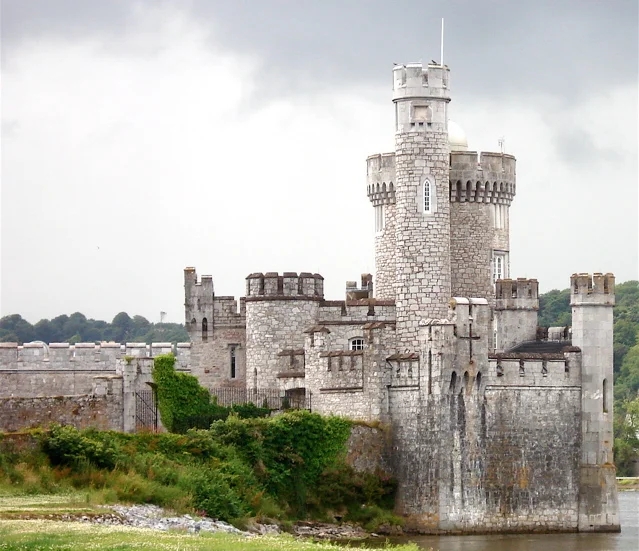
In 1722 fire destroyed the old four-storey tower. The citizens of Cork rebuilt it for 296 pounds. A century later, in 1827, fire took the castle again - this time after a banquet, the cause unrecorded but easy enough to guess. Mayor Thomas Dunscombe directed the rebuild starting in 1828. By March 1829 it was finished. The architects added three storeys to the original tower, replaced the outbuildings, and gave the whole complex the neo-Gothic, mock-baronial silhouette that survives. The new building cost a thousand pounds. What you see when you approach Blackrock today is essentially Dunscombe's castle, a Romantic-era reimagining of the medieval idea, with the much older circular tower at its core.
Restaurants, Rowers, and a Telescope
After leaving civic ownership the castle had a varied 20th-century life - private residence, offices, headquarters of a rowing club, and a restaurant. None of these uses lasted. In the early 2000s the Cosmos at the Castle project transformed Blackrock into something genuinely unusual: an astronomy centre with a working observatory, a radio telescope, and labs staffed by researchers from what is now Munster Technological University. Visitors get a 'tour of the universe' exhibit. School groups compose messages and watch them beamed towards nearby stars - signals that will arrive at their destinations, light-years from now, long after the children who sent them have grown old. A 16th-century fort built to stop pirates is now broadcasting to deep space.
Where the City Meets the Sea
The castle sits on a small headland where the River Lee widens into the upper harbour. Walking the path from Blackrock village brings you along the water's edge to the gate. The setting is theatrical - turrets against sky, water on three sides, sailing club boats moored just offshore. The restaurant in the castle keeps the building active. The observatory keeps it useful. The neo-Gothic profile, half medieval fantasy and half real fortification, photographs as well at dusk as it does at noon. Few buildings have shifted purpose as cleanly as Blackrock has - from pirate-deterrent to civic dining hall to astronomy outreach centre, with stops as private home, offices and oar storage along the way.
From the Air
Located at 51.90°N, 8.40°W at Blackrock, on the southern bank of the River Lee about 2 km east of Cork city centre. The castle sits on a small headland where the river widens toward the upper harbour. From low altitudes the neo-Gothic turrets and circular tower form a distinctive silhouette against the water. Cork Airport (EICK) is about 4 km south-west; Cork city centre is immediately upriver. Best viewed at lower cruising altitudes in clear light when the harbour shoreline is visible.
Nearby Stories
- St. Declan's Monastery 0.8 km away
- Aghavrin House 2.4 km away
- Mitchelstown Castle 7.4 km away
- Clonakilty 9.5 km away
- Inislounaght Abbey 16 km away
- Walter Siepmann 23 km away
- Newcastle West 33 km away
- SM U-27 110 km away