.jpg)
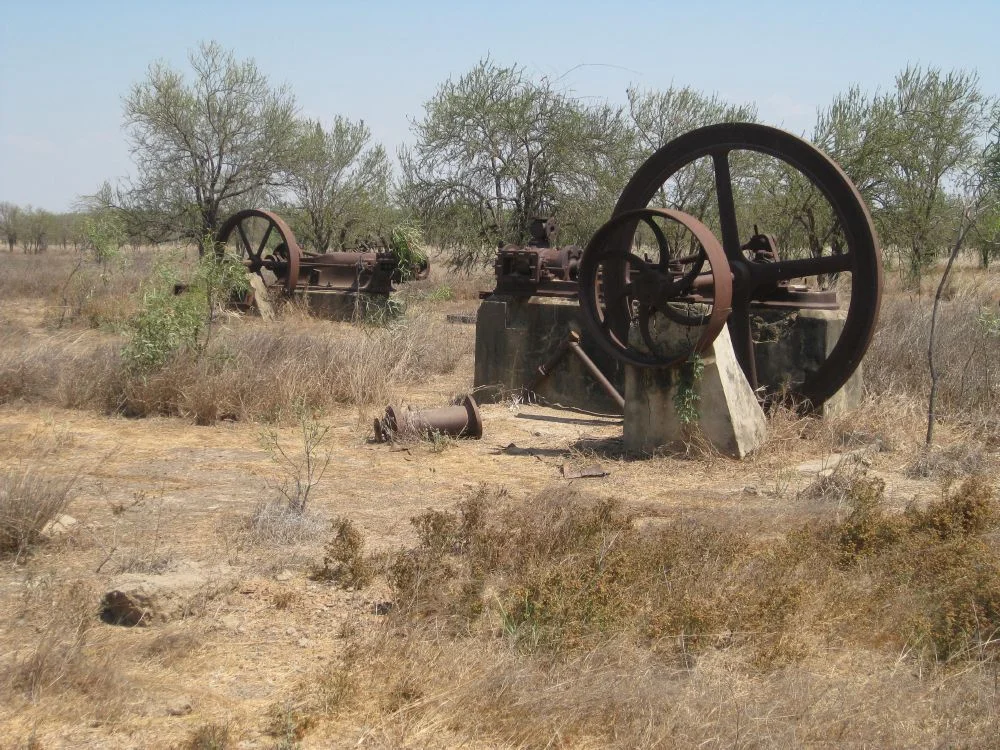
Boiling Down Works, Burketown
When a herd of cattle is worth more dead than driven, you build a boiling down works. That was the cold logic that put one of these grim, useful places on the bank of the Albert River near Burketown in the 1860s, at the very edge of the colonised continent. Here, on Truganinni Road, beasts that could not be walked to a distant market were instead rendered down — boiled for their fat, salted for their meat — and the products shipped out by sea. Little survives now but the site itself, heritage-listed since 1992, and the long story of how hard it was to make money out of cattle in the Gulf.
Rendered for Tallow and Brine
A boiling down works existed for a brutally simple reason. In the colonial economy, stock far from any railway or market often fetched almost nothing on the hoof, but their tallow — the rendered fat used for soap, candles and lubricant — could be barrelled and sold anywhere. The first attempt at Burketown came in 1867, with a plan to cure beef in brine and export it to Batavia, the Dutch port that is now Jakarta. It failed quickly and closed in 1870. The idea did not die. The Gulf had cattle and no easy way to sell them, and that equation kept pulling investors back to the riverbank.
Boom, Fire and Twenty Thousand Cattle
A new works rose in late 1891 and was running by July 1892, only to shut within a year or two as drought gripped the country. It reopened, then closed again in 1896 under a quarantine order against cattle tick and disease. In 1898 the Endeavour Meat Export Agency announced a revival — and then the meatworks promptly burned down that June, forcing a rebuild before it could reopen in 1899. The high point came in February 1901, when the works processed twenty thousand cattle in a single season. Even then the business bled money, partly from the costly decision to own and run its own ships. By October 1901 it was idle again, undercut by the high prices that cattle barons like the Kidman Brothers and Elder, Smith & Co were paying for stock.
Eaten by the Country
Remoteness was the works' undoing. Everything that made Burketown hard — distance from markets, drought, disease, the expense of shipping — pressed on the meatworks until it could not hold. In November 1902 the Queensland Government quietly withdrew its meat inspectors, citing "the closing down of the meatworks and the uncertainty about their reopening." By 1911, when locals were lobbying for a railway to carry cattle east for processing instead, the argument made itself: it was no longer possible to process cattle at Burketown, because, as one report put it, "the white ants are making havoc with all that remains of the Burketown works." The frontier had reclaimed its own industry, timber by timber.
What the Heritage Listing Holds
The works was added to the Queensland Heritage Register on 21 August 1992, and the listing is really a marker of how hard the Gulf was on the people who tried to make a living from it. There is no grand ruin to photograph; the timber that did not burn was eaten by termites long ago. What survives is the site on Truganinni Road and the story it carries — a thread that runs straight through Burketown's wider history of boom and collapse, of meatworks and missions, cyclones and fevers. The boiling down works belongs to the same fragile early chapter as the town's other heritage survivors, and stands as a quiet reminder that for every settlement that thrived, others spent decades simply refusing to fail. Burketown endured; its first great industry did not.
From the Air
Located at roughly 17.74°S, 139.56°E on Truganinni Road near Burketown, on the flat coastal plain a short distance inland from the Gulf of Carpentaria. Burketown Airport (YBKT) is right at the town with 24-hour AVGAS and JET A1; Normanton (YNTN) lies to the east and Mornington Island/Gununa (YMTI) offshore to the north. The site reads from the air as open savanna beside the tidal Albert River — little remains above ground, so use the town grid and riverbank as your landmarks. Best in the dry season, June to October, when the surrounding flats are firm and clear; the wet season (December-March) floods the plain and can isolate the area for weeks. Recommended viewing 1,500-3,000 ft.
Nearby Stories
- 2000 Australia Beechcraft King Air Crash 26 km away
- Bentinck Island 40 km away
- Leichhardt Falls 60 km away
- Old Westmoreland Homestead 66 km away
- Flinders River 72 km away
- Lawn Hill crater 86 km away
- Wollogorang Station 110 km away
- Delta Downs Station 155 km away