.jpg)
Bondi Beach
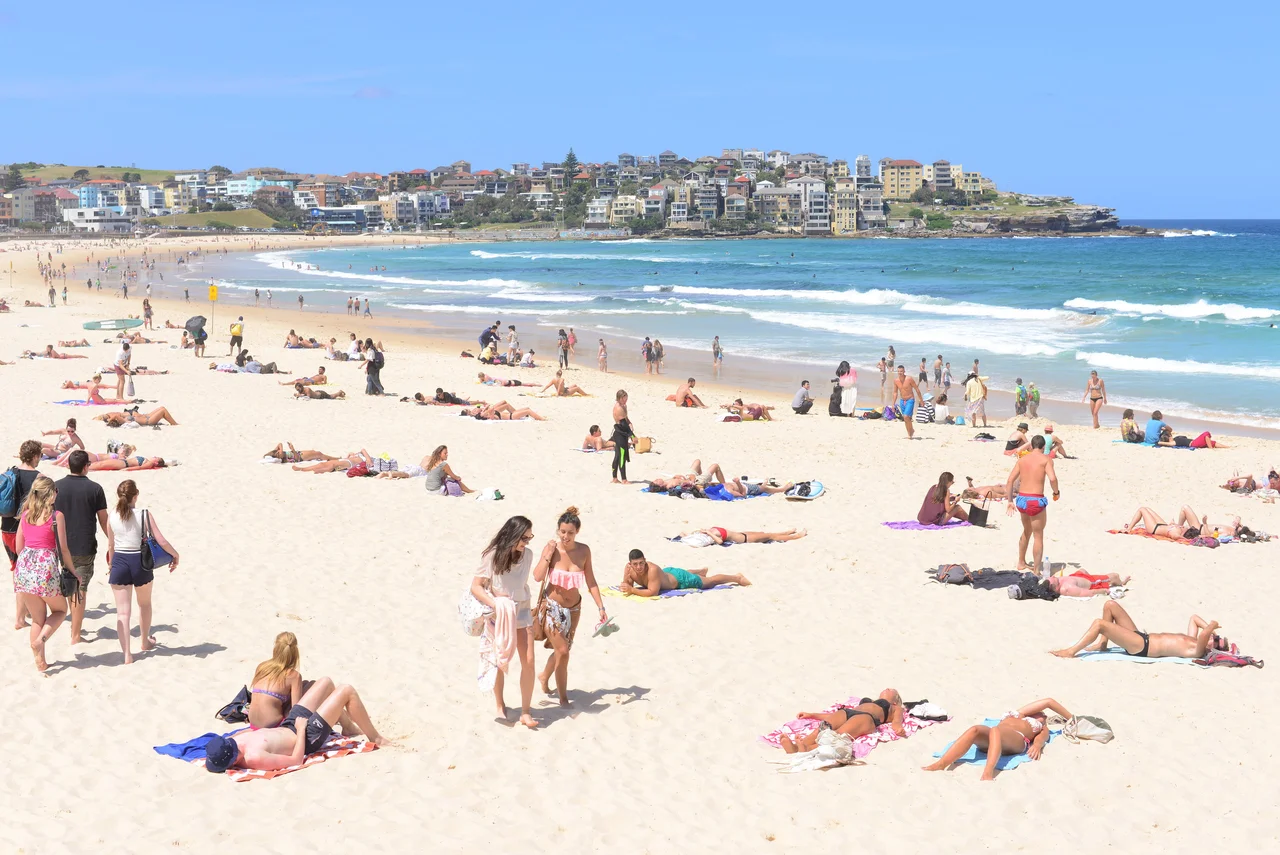
The name is a sound. In the Dharawal language, Bondi means the noise of water breaking over rocks, a word the Aboriginal clans of Sydney's coast gave to the place long before anyone thought to bottle its image and sell it to the world. Today Bondi is shorthand for an idea of Australia, a kilometre-long crescent of sand seven kilometres east of the city centre, packed with surfers, backpackers, and locals who treat the ocean as a daily appointment. But the beach is older and stranger than the postcard. It has been a private picnic ground, a battleground over swimsuit hemlines, the site of the largest mass surf rescue in the nation's history, and the birthplace of a movement that taught the world how to pull drowning people from the sea.
How a Picnic Ground Became Everyone's Beach
Bondi was almost a gated resort. In 1851 Edward Smith Hall and his son-in-law Francis O'Brien bought two hundred acres that took in most of the beachfront, and O'Brien ran it as a private amusement ground, threatening at one point to lock the public out entirely. The council disagreed. In mid-1882 Bondi became a public beach, and the crowds came fast. A tramway reached the sand in 1884; the first surf bathing sheds went up in 1903. By 1929, an estimated sixty thousand people might cram the beach on a single summer weekend, and the opening of the Bondi Pavilion that year drew a crowd of two hundred thousand. The beach also became a front line in Australia's long argument with itself about decency. Inspectors once measured swimsuits with rulers and ordered offenders off the sand, a rule that grew absurd as the bikini arrived after the war and was finally relaxed in 1961.
Black Sunday and the Lifesavers
On 6 February 1938, a fine summer's day held roughly thirty-five thousand people. Then three enormous waves rolled in so quickly the water could not recede, and the backwash dragged hundreds of swimmers off a sandbank into deep water. Lifesavers grabbed reels, floats, boards, and skis, and many simply swam into the chaos with nothing but their skill. When it was over, around 250 people had needed help and five had died. It became known as Black Sunday, and it remains the largest mass surf rescue Australia has ever seen. Bondi was the right place for it. The Bondi Surf Bathers' Life Saving Club, formed at a meeting in February 1907, is recognised as the oldest surf lifesaving club in the world, and its members helped invent the surf reel, a contraption first rigged from hairpins and a cotton reel and used on this very sand in December 1906. The red and yellow flags that now ring beaches worldwide trace back to people who learned their craft here.
Reading the Water
Bondi looks gentle and is not entirely. The beach faces south, unusually for Sydney, and runs about a kilometre between the sheltered headland of Ben Buckler Point and the cliffs that march toward South Head. Surf Life Saving Australia rates the northern end a mild 4 out of 10, but the southern end earns a 7, thanks to a notorious rip nicknamed the "Backpackers' Rip" for the visitors who mistake its flat, smooth water for the safest place to swim. It is the opposite. The advice has never changed: swim between the flags. Out past the surf, an overlapping shark net guards the bay, and during the migration months pods of whales and dolphins pass offshore. Now and then a little penguin turns up among the surfers in the southern line-up, an unbothered local in a place that draws millions of strangers.
A Community on the Sand
Bondi has always been a place people arrive at. Through much of the twentieth century it was a working-class suburb, with many residents born in New Zealand; after the Second World War it became home to Jewish migrants from Poland, Russia, Hungary, Czechoslovakia, and Germany, building synagogues and a community that endures today. That openness is part of what makes the beach matter, and part of what made its hardest day so wounding. On 14 December 2025, during a Hanukkah celebration, two gunmen — a father and son, Sajid and Naveed Akram — opened fire; fifteen people were killed and more than forty injured, their ages ranging from ten to eighty-seven, before a bystander named Ahmed al-Ahmed tackled and disarmed one of the attackers, with police fatally shooting the other. It was the deadliest terror attack in Australian history. Bondi grieved, and then it did what it has always done. The swimmers returned to the water, the lifesavers raised the flags, and the sand stayed open to everyone, which has always been the whole point of the place.
From the Air
Bondi Beach sits at 33.891°S, 151.274°E, a south-facing crescent on Sydney's eastern coastline about 7 km east of the CBD. From the air it is unmistakable: a bright arc of sand between Ben Buckler Point to the north and the sea cliffs running south toward Coogee, with the Bondi Icebergs pool jutting into the surf at the southern end. Best viewed on a coastal run at 1,500 to 2,000 feet, ideally on a clear morning when the south-facing sand catches the light and the rip channels show as darker streaks in the water. Sydney Airport (YSSY / Kingsford Smith) lies about 10 km southwest; expect busy controlled airspace over the eastern suburbs and coordinate with ATC. The Sydney Heads and harbour entrance lie just to the north as a navigation reference.
Nearby Stories
- Royal National Park 28 km away
- Jervis Bay 107 km away
- Hive shipwreck 149 km away
- Apsley Falls 283 km away
- Smoky Cape Lighthouse 316 km away
- South West Rocks Pilot Station Complex 346 km away
- Roxy Theatre and Peters Greek Cafe Complex 413 km away
- 2003 Fiordland Earthquake 1774 km away