
Bourtange
Step through the gate and the calendar drops back nearly three centuries. The market square has fourteen linden trees that have stood here for some 300 years. The cannons still fire on Sunday afternoons during high season. About 430 people make their lives inside these earthen walls, between officers' houses and barracks restored to the exact appearance the fort wore in 1742. Bourtange is not a museum that happens to have residents - it is a village that happens to be a museum, a place where a clock maker keeps shop in a former bridge keeper's house and the supermarket doubles as a flower seed store.
The Year Frozen at 1742
When the municipality of Vlagtwedde began restoration in the 1960s, they had to choose a date. They picked 1742, the year the fort stood at its full military height. The original street pattern had survived intact, and historical maps, drawings, and paintings from the period filled the archives. The moats were dug out again. Officers' houses, the school, the church, and the barracks were rebuilt where they had always been. The main works wrapped up in 1992. What you walk through today is not a reconstruction estimate or a hopeful guess. It is a town pinned to a specific summer in the middle of the eighteenth century, when soldiers drilled in the bastions and the swamps still made the place worth defending.
Officers, Schoolmaster, Pointy Wooden Horse
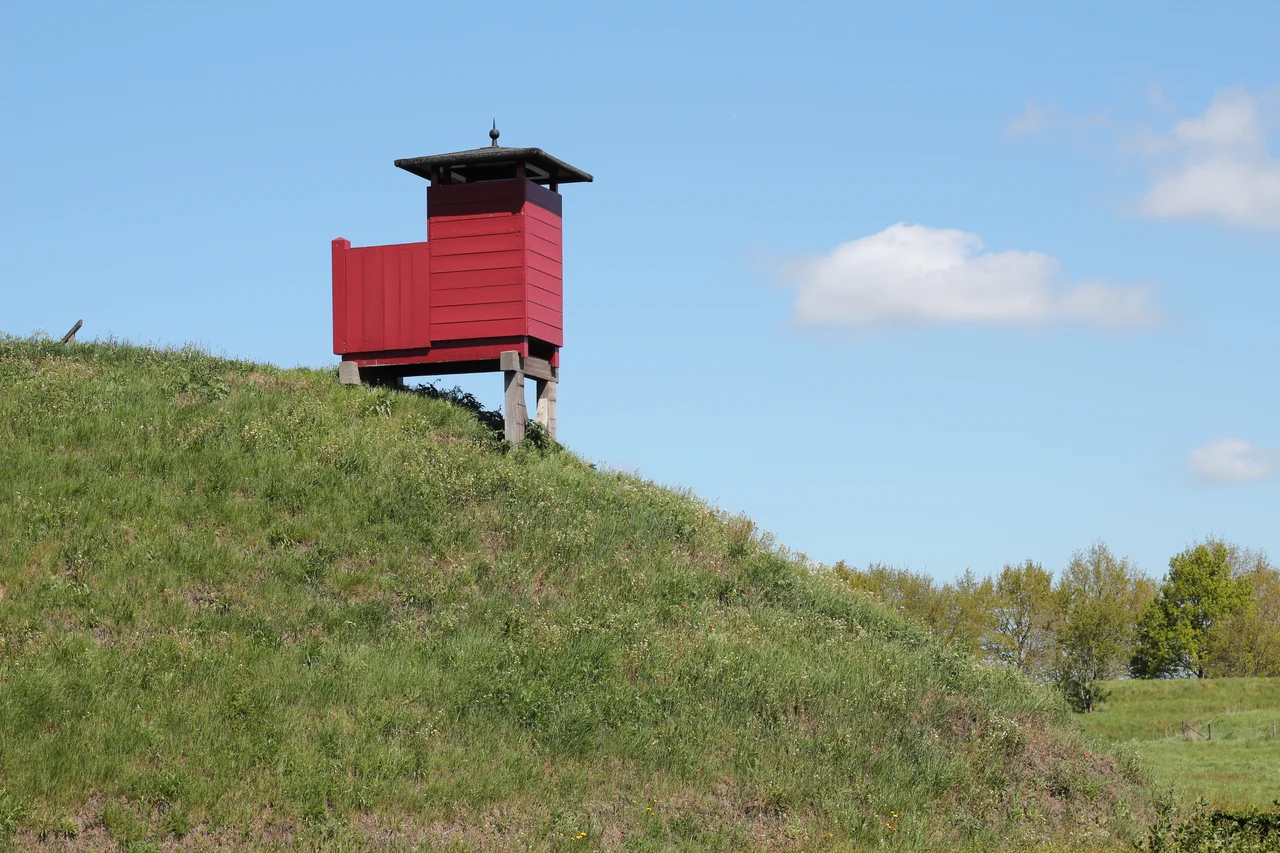
The cottages around the market square are not the homes of merchants. They were built for the men who ran a military stronghold. There is a Major's House, a Captain's House, a Commander's House, and a Schoolmaster's House. The architecture is functional rather than grand - this was an office, not a court. In front of the Major's House stands a red-painted wooden horse with a sharply pointed back. Soldiers who broke discipline were placed astride it with weights tied to their feet. The pain was the point. Behind the officers' dwellings, the soldiers' barracks curve in a wide arc, putting the rank and file at the perimeter and the brass at the center. The little church on the square replaced an earlier one in 1869, but it still holds a creed board from 1607, a triptych that survived the dismantling of its predecessor.
Secreten and Other Small Truths
Three of the original secreten still hang above the water at the edges of the fort - tiny toilet closets perched like wooden boxes on the walls. They have proved an unexpected gift to historians. Soldiers and residents used them not only for their intended purpose but also as a convenient way to dispose of broken cups, worn buckles, and snapped clay pipes. Every excavation pulls another fragment of daily life from the muck below. The fort's old powder magazine could hold up to 45,000 pounds of gunpowder. The mill that once stood on the Mill's bastion was moved to the hamlet of Ter Haar in 1832; the original still turns there, the only mill of its type left in the Northern Netherlands. The replica in Bourtange now stands where the original once did.
The Battle Fought Every June
Every Sunday afternoon at three o'clock, from March through October, a cannon fires across the square. It is a small ceremony, almost a courtesy to visitors. The real performance comes in June, when the largest historical reenactment in the Netherlands fills the bastions. Hundreds of volunteers take up roles as commanders, gunners, flag bearers, musketeers, pikemen, and camp guards. They sleep in canvas tents pitched on the grass. The Battle of Bourtange has not been fought for centuries, but the smoke and shouting and pike drill bring back something of what these walls were built to do. The rest of the year, the cafés open their terraces, and on a sunny afternoon the linden trees on the market square shade tables full of cappuccino drinkers who almost forget they are sitting inside a weapon.
A Backward Village With No Future
That phrase appears in the village's own telling of its history, describing Bourtange in the 1950s. The fort had been abandoned as a military stronghold in 1851. Most of the moats were filled. An old cannon barrel sat as the lonely reminder of what the place had been. Young people moved away. Businesses closed. The decision to restore the fort was an act of belief in a future the village did not appear to have. It worked. The reconstruction created a tourist economy, but more importantly it gave the residents a reason to stay. Today friendly hotels, two restaurants on the market square, and a campsite just outside the walls support a community that is small but no longer fading. The Sikkepit farm sells cheese and fruit. The information center sells stamps and recharges your transit card. It is a village in the present tense.
From the Air
Located at 53.0067 N, 7.1917 E in the Westerwolde region of Groningen province, hard against the German border. The five-pointed star is unmistakable from the air, surrounded by flat polder farmland - one of the most photogenic shapes in European cartography. Nearest commercial airport is Groningen Airport Eelde (EHGG), about 60 km west. Bremen Airport (EDDW) is about 100 km east across the German border. The German border at Vlagtwedde lies less than 2 km east; the road continues into Germany within minutes. Visible from cruising altitude in clear weather.
Nearby Stories
- Dollart 4.3 km away
- St. Walfriduskerk 6.7 km away
- Meppen 7.5 km away
- 2011 CPISRA Football 7-a-side World Championships 7.6 km away
- Friesoythe 8.7 km away
- Hoogeveen 15 km away
- Quakenbrück 16 km away
- Lordship of Gödens 29 km away