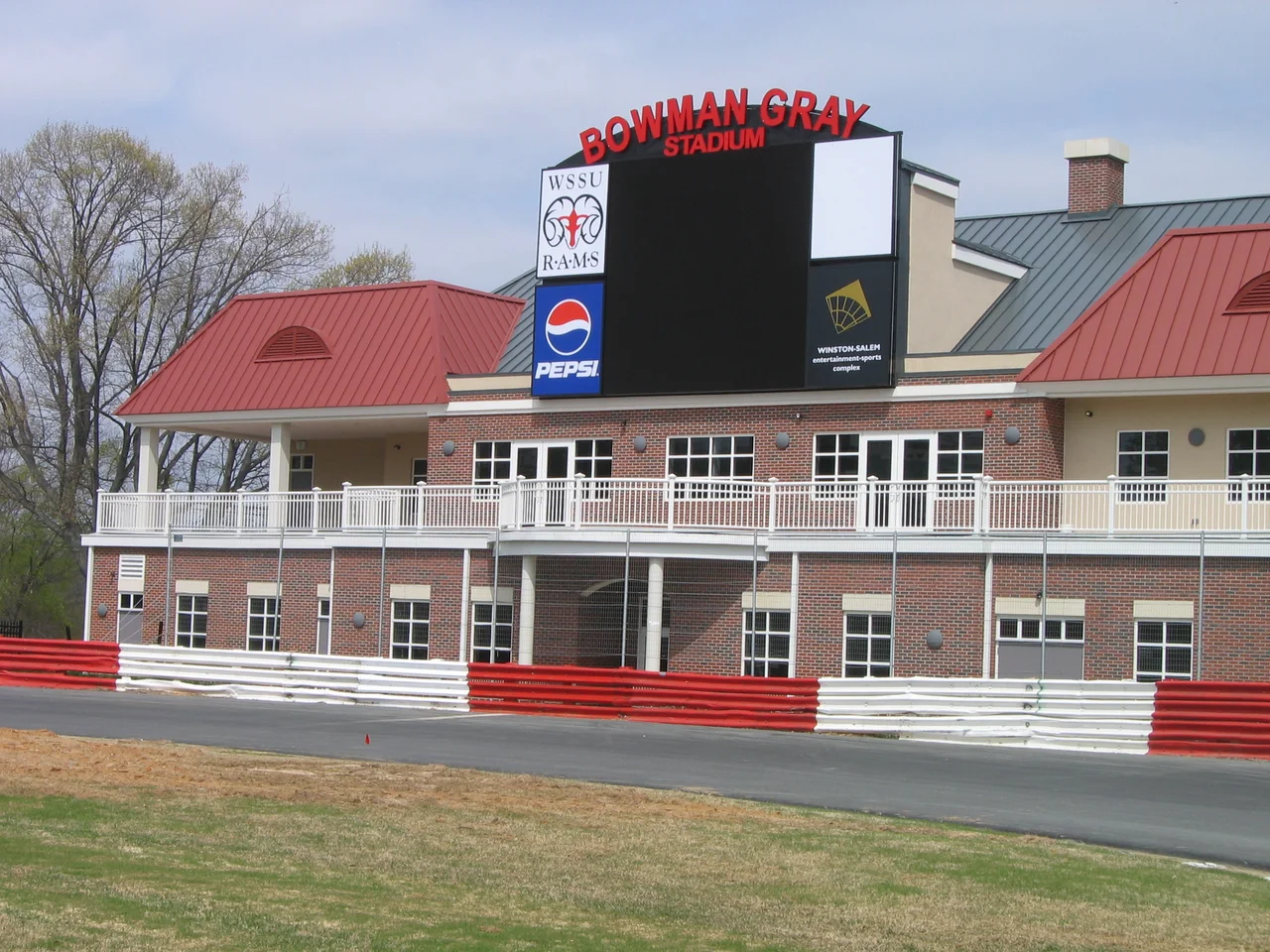

Bowman Gray Stadium
The track is a quarter mile of flat asphalt wrapped around a football field. There is no banking to speak of. The walls are close. The grandstands lean in over Turn Four like the upper deck of an old movie palace, and on a Saturday night in summer the noise carries half a mile in every direction. Locals call Bowman Gray Stadium the Madhouse, and they mean it as a compliment. NASCAR has sanctioned weekly racing here since 1949, longer than at any other track on the schedule, and on February 2, 2025, the Cup Series came back for the first time since 1971.
A Depression-Era Gift
In November 1936, the city of Winston-Salem filed plans with the Works Progress Administration for a 10,000-seat horseshoe stadium. The widow of Bowman Gray Sr., a former president of the R. J. Reynolds Tobacco Company, agreed to put up $30,000 of her own. The stadium that opened on May 1, 1938, cost twice its original budget and seated about 11,500 along a 42-acre parcel served by U.S. 52 and U.S. 421. The first event was a Christian music festival. The first college football game came on October 22, when Duke beat Wake Forest 7-0 in the formal dedication of the stadium. Auto racing, which would make Bowman Gray famous, arrived as an afterthought.
Paved Under Lou Franco
The first auto races were midget cars on a dirt loop around the football field, run by promoter J. C. Calhoun in September 1939. The track sat largely quiet during the war. In 1947 a new promoter, Lou Franco, paved the dirt with asphalt under city funding, with the understanding that he would pay the city back. Driver Bernie Fox was killed that year in one of the early accidents on the new surface. Franco lost money, accumulated debts, and left town without paying anyone. The stadium was a financial embarrassment within months of being paved. Two years later, in 1949, racing promoters Bill France Sr. and Alvin Hawkins took over the lease under the newly formed sanctioning body called NASCAR. As part of the deal, they agreed to pay off Franco's paving debts.
The Cup Years and the Long Pause
By the early 1950s the stadium was clearing its debts, expanding capacity to 17,970, and attracting NASCAR's top talent. Bowman Gray hosted its first NASCAR Cup Series race on May 24, 1958, won by Bob Welborn. From 1958 through 1971 it held points-paying Cup races. The last of those, in 1971, ended in a famous controversy: Bobby Allison crossed the line first but was disqualified for running a smaller Grand American car in a combination race. NASCAR finally reversed the call in 2024, restoring Allison's win 53 years after the fact. The track itself kept running weekly Modified races every Saturday from late spring through summer, the surface widening through repaves in 1973, the field house collapsing into termite-infested decline by the late 1970s. Drivers died on the track over the decades. William Justice in 1950 was burned in his car, which led BGS to mandate fuel cells. Billy Myers collapsed at the wheel in 1958 and died of an apparent heart attack. Bubba Beck died the same way in 2002, and Robbie Brewer in August 2025.
The Madhouse Reputation
The weekly Modifieds built Bowman Gray's reputation for what the Winston-Salem Journal called "a wild and rowdy atmosphere." Cars touched in tight corners. Drivers got out and threw helmets. Fights spilled across pit road. In 2010 the History Channel built a 13-episode reality series titled MadHouse around the track and its regulars. Discovery Channel followed in 2018 with Race Night at Bowman Gray, pulled off the air after three episodes and quietly moved to the network's streaming app. The show was uneven, but the nickname stuck because the racing earned it. On any given Saturday night you could see the most stubborn short-track drivers in the Southeast going wheel-to-wheel for 200 laps on a circuit smaller than some shopping mall parking lots.
The Cup Returns
In March 2024, NASCAR took over the racing lease directly, ending a 75-year operating arrangement with the Hawkins family's Winston-Salem Speedway, Inc. Five months later, NASCAR executive Ben Kennedy announced that the Clash, the season-opening exhibition that had been run at the Los Angeles Memorial Coliseum, would move to Bowman Gray for 2025. The stadium was retrofitted with a new lighting system, SAFER barriers, and protective catchfence. On February 2, 2025, Cup cars raced at Bowman Gray Stadium for the first time since 1971. In June, the Winston-Salem City Council approved funding for a new million-dollar LED video scoreboard. The stadium also still serves as home field for the Winston-Salem State Rams under a lease running to 2037. Half football venue, half short track, fully unrepeatable: from any cruise altitude over Winston-Salem on a summer Saturday, Bowman Gray is the brightest small light in town.
From the Air
Located at 36.08 degrees north, 80.22 degrees west, just east of downtown Winston-Salem, North Carolina, along the U.S. 52 and U.S. 421 corridor. The stadium is recognizable from the air as a horseshoe-shaped grandstand wrapping a green football field with a quarter-mile asphalt oval encircling it. Best viewed below 3,000 feet AGL; at night during weekly racing or the Cup Clash the lighting makes the venue unmistakable. Nearest tower-served airport is Smith Reynolds (KINT) at Winston-Salem, only about 2 miles north-northeast, so most overflights will be transitioning the Class D. Piedmont Triad International (KGSO) lies about 18 miles east-northeast. Contact KINT tower before low overflight; race nights generate considerable ground traffic.
Nearby Stories
- Battle of Wetzell's Mill 5 km away
- Hanging Rock State Park 5.9 km away
- Mebane's Bridge 11 km away
- 2025 North Carolina Cessna Citation II Crash 13 km away
- Wil-Cox Bridge 16 km away
- North Wilkesboro Speedway 19 km away
- Galax, Virginia 31 km away
- Deep River Camelback Truss Bridge 60 km away