.jpg)
Brazilian War of Independence
The man who commanded the Brazilian navy in its war for independence had, a decade earlier, been dismissed from the British Royal Navy for stock fraud. Thomas Cochrane, 10th Earl of Dundonald, was one of the most brilliant and most disgraced naval officers of the Napoleonic era. When Pedro I offered him command of the imperial fleet in 1823, Cochrane took the job, sailed south, and proceeded to defeat Portuguese forces that outnumbered him, along a coastline that stretched thousands of kilometers. The Brazilian War of Independence was won in part because of him, and in part because of the enslaved people and volunteers and French mercenaries who fought alongside the imperial troops ashore. But Cochrane is the figure who binds the story together.
How an Empire Was Born
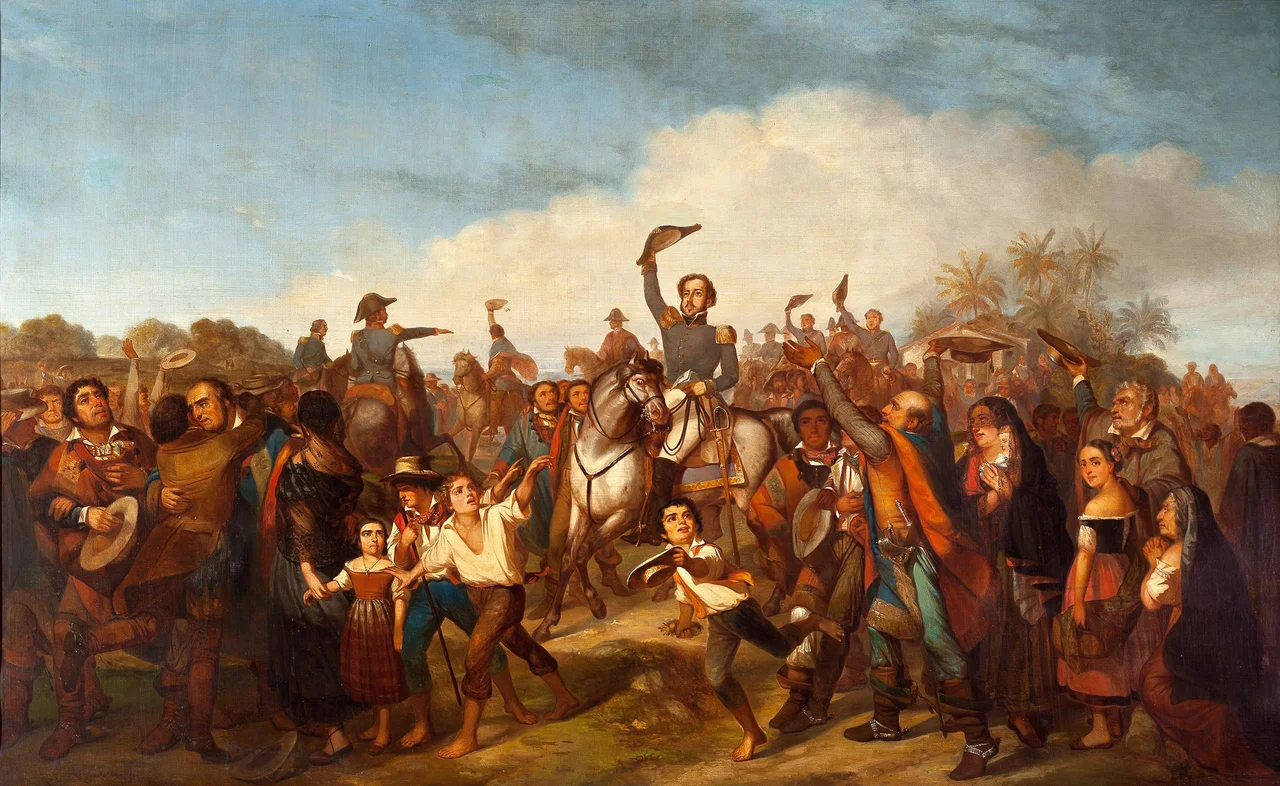
Brazil's independence did not start with a manifesto. It started with geography. In 1808 Napoleon's armies pushed into Portugal, and the entire Portuguese royal court - the king, the queen, the ministers, the treasury, the royal library - fled across the Atlantic to Rio de Janeiro. For thirteen years, a European monarchy governed its home country from a South American colony. When King John VI returned to Lisbon in 1821, he left his son Pedro behind as regent. The Cortes, Portugal's revolutionary legislature, tried to pull Brazil back into colonial status. Pedro refused. On 7 September 1822, on the banks of the Ipiranga brook outside São Paulo, Pedro cried out for independence and drew his sword. The Grito do Ipiranga - the Cry of Ipiranga - marks the symbolic founding of Brazilian sovereignty. But Portuguese garrisons still held Salvador, São Luís, Belém, and Montevideo.
Fighting at the Edges
The war that followed was fought not across Brazil but around it - a scattered series of sieges and naval engagements along the Atlantic coast. Roughly 10,000 Portuguese troops held Salvador in Bahia. Another 3,000 were besieged in Montevideo. Smaller garrisons controlled other ports in the north. Against them, Brazil assembled somewhere between 30,000 and 40,000 troops: regulars, militia, volunteers, and enslaved men promised freedom in exchange for military service - an old tactic of imperial expansion used by many 19th century powers. Pierre Labatut, a French general who had served under Napoleon, commanded the land forces. Logistical problems, poor training, and feuding commanders slowed the Brazilian advance. Labatut was eventually removed. The real decisive action happened at sea.
Cochrane's Campaign
Cochrane's squadron was small but devastating. He used the same tactics that had once made him a terror to French fleets in the Mediterranean: aggressive maneuvering, night attacks, and a psychological approach that convinced opponents he commanded more ships than he did. By bottling up Portuguese supply lines and cutting off reinforcements from Europe, Cochrane isolated the Portuguese garrisons in Bahia. On 2 July 1823, the siege of Salvador ended with the surrender of approximately 10,000 Portuguese troops - one of the largest single capitulations of the war. Cochrane then sailed north, convincing the garrisons at São Luís in Maranhão and Belém in Pará to surrender, sometimes by bluff alone. Within a year of Pedro's declaration, the continental war was essentially over.
An Expensive Peace
Recognition came slowly. From 1822 to 1825, Portugal lobbied European powers to refuse Brazilian sovereignty. The United States recognized the new empire in 1824, days after the Constitution of the Empire of Brazil was adopted. But European acceptance required Portuguese agreement. The British, who needed Brazilian trade and did not want a prolonged Atlantic conflict, mediated. Portugal finally recognized independence in 1825, but demanded two million pounds in compensation for seized Crown property. Britain loaned Brazil the full amount, making the infant empire instantly indebted to London. The Treaty of Rio de Janeiro, signed on 29 August 1825 and exchanged in Lisbon on 15 November, formally ended the war. The letters patent issued by King John VI described the transfer of sovereignty as a paternal gift - a diplomatic fiction that softened the political humiliation of losing the empire's richest possession.
Legacy
Unlike the Spanish American wars of independence, which fragmented the continent into more than a dozen republics, Brazil emerged from its war as a single, unified monarchy. That unity held through the 19th century under Pedro I and his son Pedro II, even as neighboring republics fractured and fought civil wars. The Brazilian Empire lasted until 1889, when a military coup deposed Pedro II and established a republic. The Cisplatina province, where the war's southern siege took place, had already broken away in 1828 to become independent Uruguay. Portugal, having lost its only territory in the Americas and a significant portion of its colonial income, turned its attention to Angola and Mozambique, intensifying a colonial project in Africa that would last another century. The Brazilian war was short - about a year of serious combat - but its outcome shaped South America for generations.
From the Air
The war was fought primarily along Brazil's Atlantic coast from Salvador (SBSV) in Bahia north to Belém (SBBE) in Pará, and south to Montevideo. Key coastal cities involved: Salvador, São Luís, Belém, Rio de Janeiro, Montevideo. Approximate conflict center: -14°S, -53°W.
Nearby Stories
- Central-West Region, Brazil 61 km away
- Kuhikugu 130 km away
- Querência 137 km away
- Aruanã 159 km away
- Serra Azul State Park 191 km away
- Mozarlândia 213 km away
- Mato Grosso Tropical Dry Forests 216 km away
- Guiratinga 266 km away