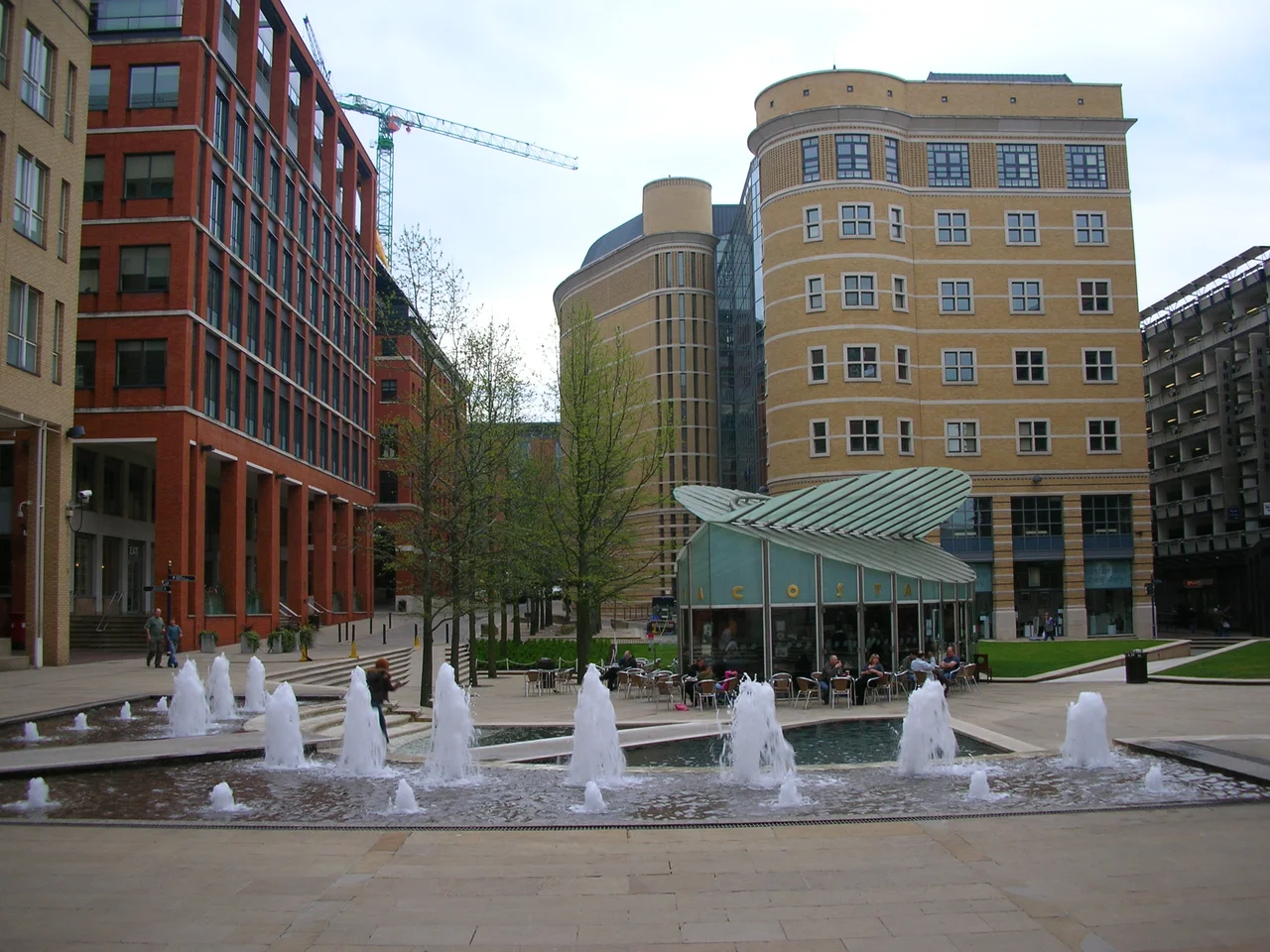

Brindleyplace
For most of the 1970s and 1980s, this corner of Birmingham was a wound. The factories that had defined the area at the height of the city's industrial swagger had emptied out, and what remained was broken glass, weeds pushing through paving, and a stretch of canal that nobody walked beside. Then Rosehaugh paid twenty-six million pounds for it in 1990, went into receivership within two years, and sold the same land to Argent for three million. Out of that bankruptcy, Brindleyplace was born.
Building on a Receivership
The story of Brindleyplace is partly the story of two collapsed development companies and one stubborn third one. Merlin pulled out first. Rosehaugh tried next, paying inflated 1990 prices and then watching the property market crater around them. By the end of 1992 their receivers were taking three million for what the company had paid twenty-six million for. Argent, the firm that finally built the place, started with Water's Edge along the Birmingham Canal Navigations Main Line and worked outward. Carillion put up most of the early structures. The Victorian school that had once stood derelict on the edge of the site was converted into the Ikon Gallery, its red brick and pointed windows preserved while the interior was gutted and rebuilt for contemporary art. By the time the development was complete, Argent had spent around three hundred and fifty million pounds turning the wound into a working quarter.
A Canal Becomes a Threshold
James Brindley was the eighteenth-century engineer who threaded canals through the Midlands, and he gave his name to the street, which gave its name to the development. He would probably recognise the water if not the buildings around it. The Birmingham Canal Navigations Main Line still runs between Brindleyplace and the International Convention Centre opposite, exactly as it has since the days when narrowboats hauled coal and finished goods between the workshops. Footbridges cross it now. Pizza Express and Wagamama sit where loading bays used to be. Two million people walk along Water's Edge each year, dropping nearly fourteen million pounds into the restaurants and cafes that face the canal. The water is the same; the economy along its banks is unrecognisable.
Numbers Instead of Names
Most of the buildings in Brindleyplace are simply called by numbers. One. Two. Three. All the way up to Eleven Brindleyplace, completed in 2009 at fifty-nine metres and acting as the development's tallest building. It is also the one Argent did not originally plan to build. The masterplan had been low-rise throughout; Eleven was added at the back of the Novotel in 2007 and topped out the following year, its glazed facade now visible across the canal. Most of the rest are six storeys or so, deliberately scaled to feel like a piece of city rather than a corporate park. Deutsche Bank occupies more space across the development than any other tenant. Lloyds keeps over a thousand employees in Two Brindleyplace alone, in a six-storey building whose Flemish-bond brickwork is tied laterally to its floor plates so that the walls can carry their own wind loads.
Sculpture in the Squares
Three squares anchor the development: Central, Oozells, and Brunswick. Central Square holds Miles Davies's Aquaduct, a six-metre-tall sculpture in bronze and phosphor that was the winning entry in a Royal Society of British Sculptors competition. Davies finished it in August 1995, unveiled it on a low stepped base, and lit it from below so the bronze glows at night. His second piece for the development, Gates, takes the shape of traditional canal lock gates. Both are hollow, both are unmistakably about water even when there is no water in the sculpture. The Ikon Gallery looks out over Central Square from one corner, free to enter, run by a charitable trust, showing contemporary work in a building that started life educating Victorian children.
The Quiet Politics of a Managed Place
Argent made an unusual decision when Brindleyplace opened. Rather than selling the development off in pieces, they kept it together and managed the public realm themselves, working with GVA. The reasoning was straightforward and a little cynical: if the buildings had different owners, no one would maintain the spaces between them. Over seventy staff now keep the squares and walkways clean. The annual maintenance budget for the public realm alone runs to nearly nine hundred thousand pounds. It is the kind of expense that disappears into the experience of walking through somewhere that feels cared for, the kind of work that only becomes visible when it stops being done. The West Midlands Metro now runs trams down Broad Street past the development, with stops at Library and Brindleyplace, knitting the area into the wider city in a way that the old industrial site never was.
From the Air
Brindleyplace sits at 52.4773 degrees north, 1.9131 degrees west, on the west side of central Birmingham. From cruising altitude in clear conditions, look for the Birmingham Canal Navigations Main Line threading west from the city centre between the curved glass of the International Convention Centre and the low brick blocks of the Brindleyplace estate. Eleven Brindleyplace, at fifty-nine metres, is the tallest structure in the development. Birmingham Airport (EGBB) lies about eight miles east-southeast; Coventry (EGBE) is roughly nineteen miles southeast. Best viewing altitudes are 1,500 to 3,000 feet.
Nearby Stories
- Shepshed 8.5 km away
- Battle of Evesham 11 km away
- Hixon rail crash 12 km away
- Battle of Cropredy Bridge 12 km away
- Wenlock Priory 15 km away
- RAF Shawbury 16 km away
- Market Bosworth 17 km away