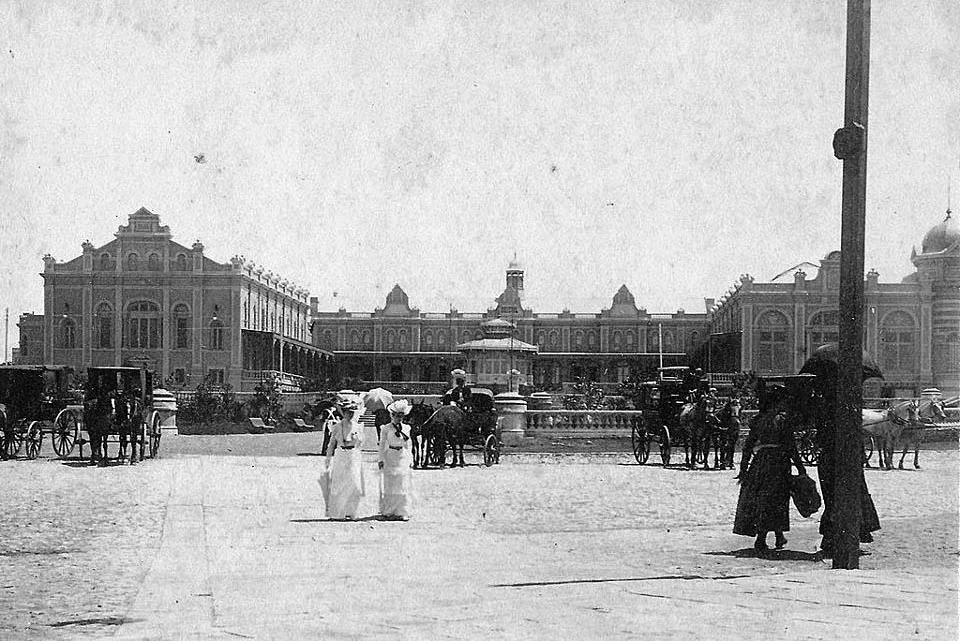

Bristol Hotel, Mar del Plata
It rained on opening night. On 8 January 1888, the leading families of Buenos Aires stepped off an overnight train into a village of barely a few dozen houses, hammered by Atlantic wind and a cold drizzle - and they fell in love anyway. The seascape did the work the weather could not. By half past nine, in a salon lit against the storm, the vice-president of Argentina rose to give a welcoming speech, twenty-four chefs hired from Europe were plating the first dinner, and a remote ranching outpost had just declared itself a resort. The Bristol Hotel had opened, and Mar del Plata would never go back to salting meat.
The Basque Who Saw a Port
Before the Bristol there was Pedro Luro, a Basque immigrant who arrived with nothing and built a fortune in cattle. Luro looked at the village founded in 1874 and saw a port - a way to ship hides, meat, wool and grain to Buenos Aires without dragging them through the swamps of the Salado River. By 1881 his warehouses, mills and factories dominated the local economy. Then he gambled on a different future: he built a Grand Hotel around 1883, enlarged it to 110 rooms, and bet that the railway would bring people who wanted not cargo space but sea air. The summer of 1886-87 proved him right when 1,415 passengers stepped off the train. Luro never saw the resort bloom. His health failing, he sailed for Paris in 1886 and died there in 1890.
A Palace of Slate and Tunnels
Luro's son Jose and the financier Gaston Sansinena founded the Sociedad Anonima Bristol Hotel in 1887 to build something grander. The first building, the casa vieja of 1888, rose three stories in Mock-Tudor style - masonry below, brick-paneled timber above, a slate roof bristling with gables and twin towers. The dining hall of 1890 faced the sea in Italian style, its ceiling reputed the most luxurious in Latin America, holding within it a roulette room and a festival room. Across three city blocks the complex sprawled, linked underground by brick tunnels that guests and staff shared, one mosaic-floored passage running beneath Calle Entre Rios. Outside, wooden bathing huts marched onto the sand and the first rambla, a three-meter boardwalk, was laid directly on the beach.
The Biarritz of Argentina
There is a legend, printed decades later, that among the guests at the opening was the young Tsarevich Nicholas - the future Nicholas II of Russia - traveling with the crew of a school ship. The source itself calls it unconfirmed, and it has the shimmer of a story a resort tells about itself. What is certain is grander than any single guest. The Bristol made sea-bathing fashionable for a nation. La Perla followed in 1892, the Royal in 1907, the Saint James and Centenario in 1910. When Mar del Plata was declared a city in 1907, Argentines were already calling it the Biarritz of Argentina. In 1913 a new French rambla opened with Belgian ceramic pavements, balustrades and Greco-Roman statues - the high-water mark of a borrowed European dream.
The End of a Gilded Age
Empires of leisure rarely fall to fire or war. The Bristol fell to democracy. Through the 1930s, cheaper hotels multiplied and ordinary families claimed the beach the aristocracy had pioneered, staying for shorter holidays in vacation apartments and union lodgings. The government that emerged from the 1943 coup cut rents and protected tenants, and in June 1944 the Bristol simply closed - its closing, one historian wrote, symbolized the end of the belle epoque. The auction of its furniture, porcelain, vehicles and even its towels took eight straight weeks. The annex came down in 1945, the rest in stages through the 1970s as the 30-story Bristol Center rose in its place. In 1974, sanitation workers digging in Calle Buenos Aires broke into one of the old tunnels, glimpsed the lime-yellow brick and Italian mosaics, and sealed it again. The name survives where it always mattered most: Playa Bristol, the most popular beach in the city.
From the Air
The Bristol once stood at roughly 38.00 degrees S, 57.54 degrees W, on the block now occupied by the Bristol Center tower at San Martin and the Boulevard Maritimo, fronting Playa Bristol in central Mar del Plata. From the air, the curve of the central beaches and the bulk of the Bristol Center skyscraper mark the spot; the twin Casino and Provincial Hotel buildings sit immediately to the south. Best viewed at 2,000-4,000 ft on a clear summer day, when the Atlantic beach crowds are visible below. Nearest field is Astor Piazzolla International Airport (MDQ / SAZM), about 7 km northwest; the smaller Camet aerodrome lies north of the city near Parque Camet. Coastal fog and the southeasterly Sudestada winds can cut visibility, especially in late autumn.
Nearby Stories
- Museo Juan Manuel Fangio 32 km away
- Cariló 70 km away
- Murder of Fernando Báez Sosa 75 km away
- Tandil 113 km away
- Campos del Tuyú National Park 190 km away
- Tres Arroyos 197 km away
- Monte Hermoso 340 km away
- HMS Sheffield (D80) 1640 km away