
Brixton
On 22 June 1948 the Empire Windrush docked at Tilbury and 492 passengers from Jamaica filed down the gangplank into a country that had asked them to come and was about to forget it had. They were temporarily housed in the Clapham South deep shelter, and the nearest Labour Exchange was on Coldharbour Lane in Brixton. So that is where they walked first, looking for work. The Caribbean community that has shaped Brixton for nearly eighty years was not chosen for the neighbourhood by accident or by some demographic algorithm. It was chosen by a bureaucratic decision about where the nearest job centre happened to be.
Brixi's Stone
Long before any of this, before the market or the underground station or the murals, a Saxon lord named Brixi set a boundary stone somewhere on what is now Brixton Hill, marking the meeting place of his hundred court of Surrey. The road past the stone was called Bristow Causeway. The fields ran down to the marshes of the Effra, a river the Victorians eventually buried under their high-level interceptor sewer so completely that most people who live here have no idea a river runs beneath their feet. Until 1816, Brixton was farmland and market gardens, famous for strawberries and game. Then Vauxhall Bridge opened, the railways arrived in 1862, and a quiet hill became a Victorian suburb almost overnight.
Electric Avenue
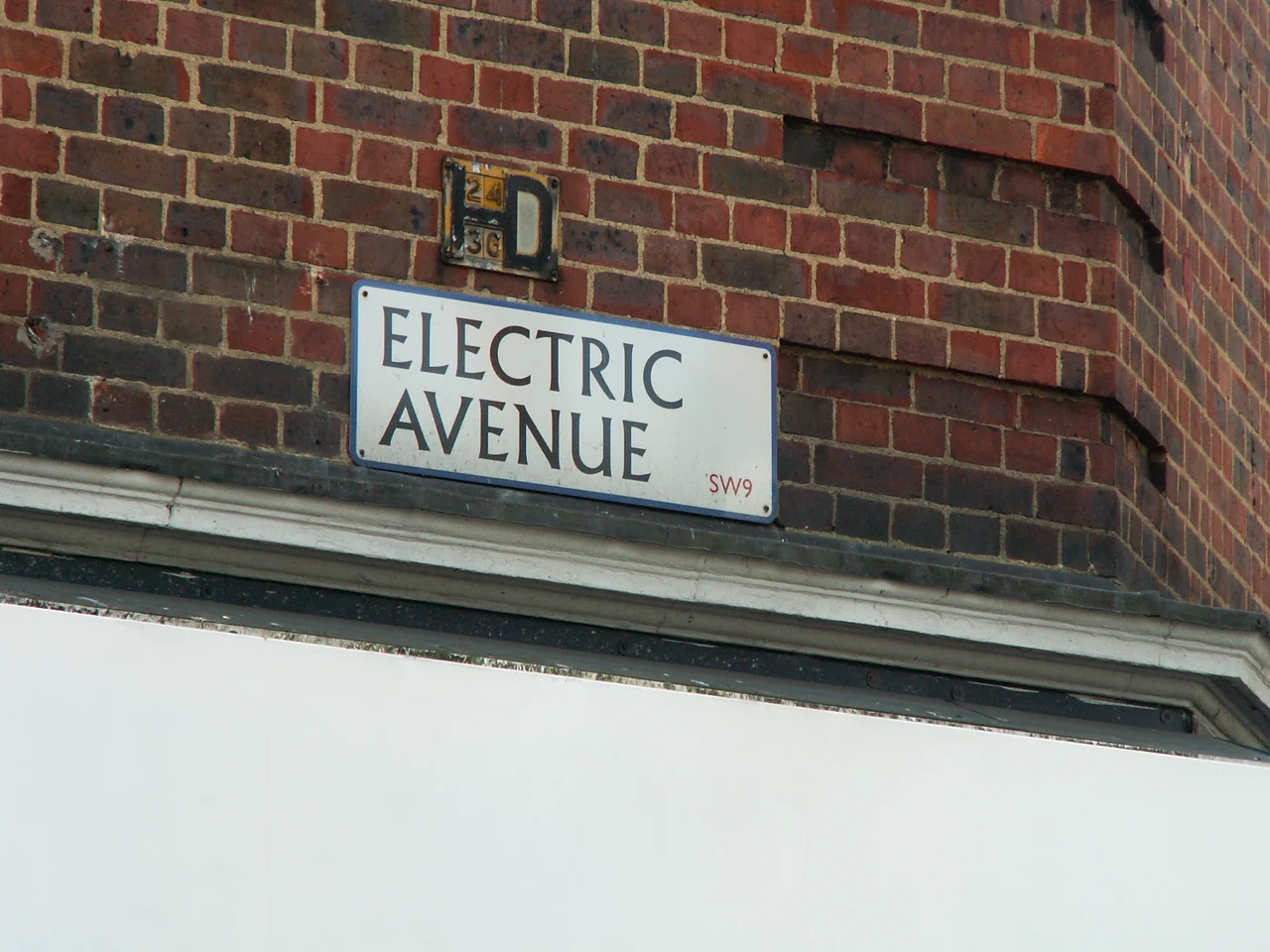
Brixton Market began on Atlantic Road in the 1880s. In 1877 the Bon Marche department store opened on Brixton Road — the first purpose-built department store in Britain. And Electric Avenue, that street whose name Eddy Grant turned into a 1983 hit, became one of the first shopping arcades in the country to be lit by electric light. By 1925 Brixton was the shopping capital of south London: three department stores, cinemas, a theatre, a thriving market. It was middle-class, then working-class, then bombed. The Luftwaffe damage created a housing crisis. The housing crisis met the Windrush arrivals, and what followed was a generation of Caribbean families building something new in the spaces the old order had left empty.
8 January 1947
David Robert Jones was born in a terraced house at 40 Stansfield Road, on the boundary between Brixton and Stockwell. He would later take the name Bowie. He spent his early childhood here before the family moved to Bromley, but Brixton claims him, and rightly. The mural on Tunstall Road, painted by Australian artist Jimmy C in 2013, became an instant gathering place when he died on 10 January 2016: flowers, candles, handwritten notes covering the pavement for weeks. Bowie is one strand of a Brixton musical lineage that runs through soundsystem reggae, jungle, dubstep, and grime, much of it pressed onto vinyl at Desmond's Hip City and Supertone Records, much of it broadcast on pirate stations like Lightning and Vibes FM before any of it touched a mainstream chart.
April 1981
The trigger was Operation Swamp 81. Plainclothes officers were sent into Brixton to use the so-called 'sus law', which permitted stops on the mere suspicion of intent to commit a crime. Within five days they had stopped almost a thousand people, most of them young Black men. The pressure built. On the weekend of 10-12 April the streets around Railton Road erupted. Roughly 279 police and 45 civilians were injured. More than a hundred vehicles burned, fifty-six of them police. The Scarman Report that followed found unquestionable evidence of disproportionate and discriminatory policing — and led directly to the Police and Criminal Evidence Act 1984 and to the creation of an independent Police Complaints Authority the following year. Scarman's findings were largely ignored in practice. Eighteen years later the Macpherson Report, written after the murder of Stephen Lawrence, concluded that the Metropolitan Police remained, in his unflinching phrase, 'institutionally racist'.
Cherry Groce
Just after seven on the morning of 28 September 1985, Metropolitan Police officers raided the home of Dorothy 'Cherry' Groce on Normandy Road. They were looking for her 21-year-old son Michael. He was not there. Detective Inspector Douglas Lovelock shot Cherry Groce as she lay in bed. She was paralysed from the waist down. She lived in a wheelchair for the next twenty-six years and died in 2011 from complications of her injuries. The 1985 Brixton uprising began that same day; over the following two days a photographer, David Hodge, was beaten to death, 43 civilians and 10 officers were hurt, and the Pizza Hut on Atlantic Road was firebombed. Lovelock was prosecuted and acquitted of malicious wounding. The Metropolitan Police did not formally apologise to Cherry Groce or her family until March 2014, twenty-eight and a half years later.
The Pound and the Place
Brixton has refused, repeatedly, to be only a place where things happen to it. In 2009 Transition Town Brixton launched the Brixton Pound, one of the first inner-city local currencies in Britain, designed to keep money circulating among independent shops. The notes featured Len Garrison, founder of the Black Cultural Archives, then Bowie, then the World War II SOE agent Violette Szabo, and basketball player Luol Deng. After the 1981 riots, the council funded a series of murals that still survive — Stephen Pusey's Brixton Academy mural showing children of mixed backgrounds in harmony, deliberately answering the question of what the neighbourhood actually was, against the question outsiders kept asking. The gentrification debate of the 2010s and 2020s is the latest chapter of an old argument. The flat where Bowie was born is now worth several million pounds. The market that survived the Windrush years and the riots is now contested by property developers and long-running food traders. Brixton goes on.
From the Air
Brixton lies at 51.46N, 0.12W, about three miles south of the Thames and three south-southeast of Westminster. The Brixton Underground station and the Ritzy Cinema mark the centre. London City Airport (EGLC) is to the northeast; Heathrow (EGLL) lies to the west and Gatwick (EGKK) to the south. Biggin Hill (EGKB) is the closest general-aviation field. From altitude the Brixton skyline is dominated by the green of Brockwell Park and the curving horseshoe of the Southwyck House 'Barrier Block' on Coldharbour Lane. Recommended viewing altitude 2,000-3,000 ft AGL.
Nearby Stories
- Battle of Britain, Northfleet 1.1 km away
- Bayham Old Abbey 5.4 km away
- Catharine Macaulay 6.4 km away
- Hatfield rail crash 8.8 km away
- Chequers 8.9 km away
- Chelmsford Cathedral 10 km away
- Queen Victoria Hospital 13 km away
- Fishbourne Roman Palace 36 km away