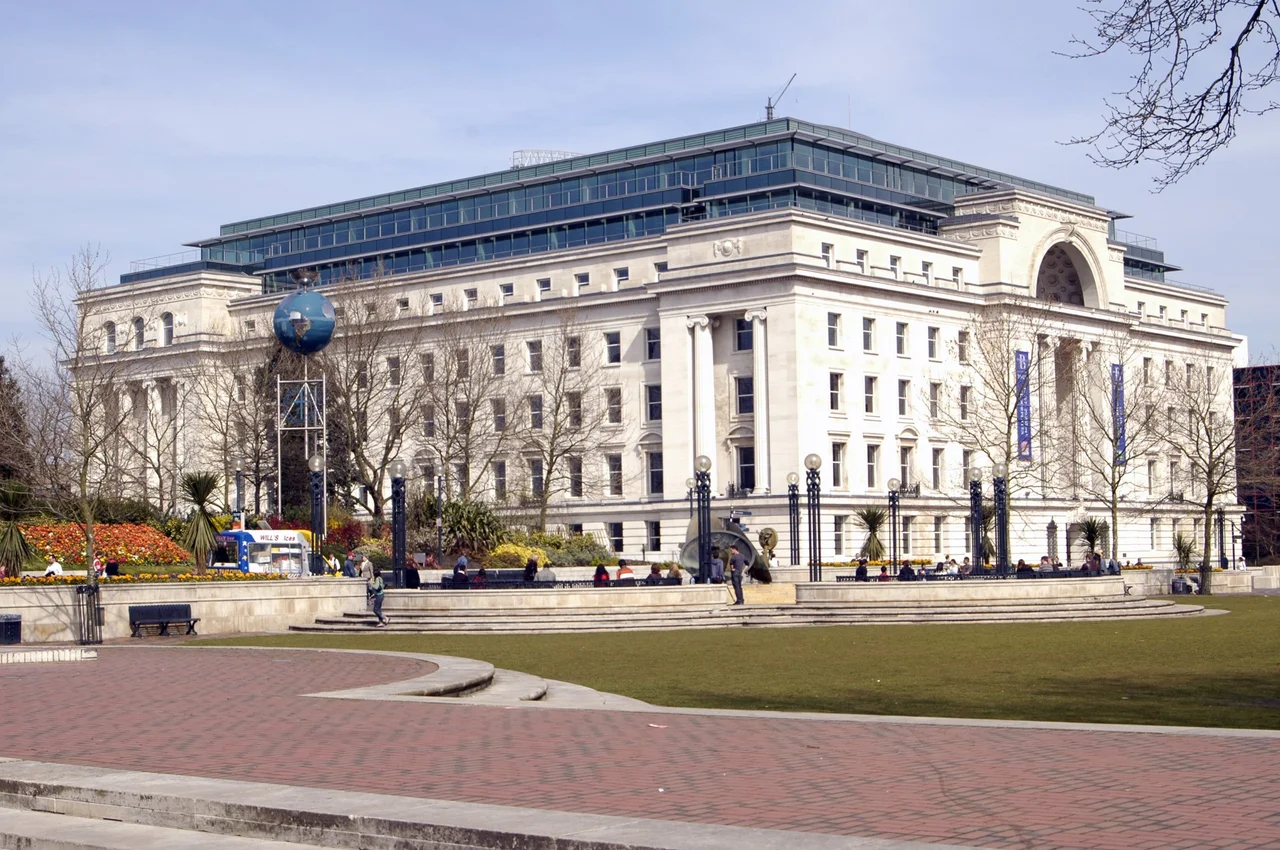

Broad Street, Birmingham
Five young men from Birmingham walked into a basement club on Broad Street in 1978 and started rehearsing. The club had restyled itself after Studio 54 in New York and the Blitz in London, all neon and mirrors and bad ideas, and the band that practised there was about to be called Duran Duran. The Rum Runner is gone now, demolished in 1987 to make way for a Hyatt. But that period, when a suburban high street accidentally became one of British music's launchpads, set the template for what Broad Street has tried to be ever since: a place that wants to be other places, louder than it actually is.
From a Country Path to a Banker's Address
Broad Street did not start broad. In the 1750s it was a country path running across Easy Hill from what is now Victoria Square out toward Five Ways and on to Stourbridge. Then John Baskerville built his house here, the printer and typeface designer whose work still appears in Penguin paperbacks today, and the lane that passed his front door had to be widened to handle the visitors. The widening gave it the name. St Martin's Church owned the land at the southern end and started developing it after an Act of Parliament in 1773. The Crown Inn went up in 1781 and survives in modified form today. By the nineteenth century the canals at the northern end had pulled in heavy industry, and the residential streets at the southern end had filled in toward Edgbaston. Today Broad Street holds the regional headquarters of Lloyds, RBS, Deutsche Bank, and HSBC, employing more than fifteen thousand people in finance alone.
The Decade That Changed Everything
Through the 1970s and most of the 1980s, Broad Street remained a quiet stretch of offices, churches, and the occasional pub. The International Convention Centre changed that. It opened in 1991 on the site where Bingley Hall had stood until fire took the hall in 1984, and it brought conference traffic in numbers Birmingham had never seen. The Symphony Hall opened next, then the National Indoor Arena nearby. Bars and restaurants chased the visitors. By the late 1990s Broad Street had become a nightlife corridor so dense that the city council was floating proposals to ban cars after eight o'clock. A 2008 plan to scrap the night bus along the road went through despite local concern. The party kept getting louder, and parts of the city kept trying to manage its volume.
Black Sabbath Bridge
All four members of Black Sabbath grew up within a few miles of this street. Tony Iommi, Geezer Butler, Bill Ward, and Ozzy Osbourne built the sound that would name a genre out of factory racket, Birmingham accents, and Iommi's missing fingertips. In 2019 the bridge across the Birmingham Canal at Broad Street was officially renamed the Black Sabbath Bridge, and a bench designed by a fan named Mohammed Osam was installed on it, featuring bronze avatars of the four musicians. Ozzy was already honoured on the pavement nearby. He became the first name on Birmingham's Walk of Stars in 2007, a Hollywood-inspired strip running along Broad Street that has since added Tony Iommi, Jasper Carrott, Noddy Holder, Murray Walker, and Norman Painting of The Archers. Walking the pavement, you cross a lot of voices.
The Last of the Old Buildings
Most of what made nineteenth-century Broad Street was knocked down across the twentieth. The Unitarian Church of the Messiah, the Roman Catholic St Peter's, the Anglican Immanuel Church, the Masonic Hall that became Central Television studios before being demolished in 2008. The Birmingham Municipal Bank survives as a Grade-II-listed shell, the country's first municipal bank, awaiting redevelopment. The Crown Inn from 1781 is still there, modified. So is the Martin and Chamberlain building that sits over the canal tunnel leading to Gas Street Basin, a small grade-II miracle of red brick perched on top of a tunnel mouth. Across the road, Centenary Square spreads out with the Library of Birmingham, Baskerville House, the Hall of Memory, and the Repertory Theatre arranged along its northern edge. The contrast between civic seriousness on one side and Friday-night rowdiness on the other is part of the street's working personality.
Trams Down the Middle
Between 2015 and 2019 the West Midlands Metro extended along Broad Street to Five Ways, with stops at Library, Brindleyplace, and Five Ways. The tracks now run down what was once a country path, then a Georgian residential row, then an industrial fringe, then a banking district, then a nightlife strip. Old layers do not disappear in Birmingham; they get covered. The trams pass the bridge with the Black Sabbath bench. They pass the pavement with Ozzy's brass star. They pass office windows where Lloyds Banking Group still keeps thousands of staff, and bars where the same staff might end the night. Broad Street has been many things. It has rarely been any one of them for long.
From the Air
Broad Street runs roughly east-west at 52.4777 degrees north, 1.9111 degrees west, on the south-west side of central Birmingham. From cruising altitude in clear conditions, look for the diagonal cut of the street between the Convention Centre and the rounded glass disks of the Library of Birmingham on the north side, with Centenary Square as a pale open space. The Birmingham Canal Navigations crosses underneath at the Gas Street Basin. Birmingham Airport (EGBB) lies about eight miles east-southeast; Coventry Airport (EGBE) is roughly nineteen miles southeast. Best viewing altitudes are 1,500 to 3,000 feet.
Nearby Stories
- Shepshed 8.5 km away
- Battle of Evesham 11 km away
- Hixon rail crash 12 km away
- Battle of Cropredy Bridge 12 km away
- Wenlock Priory 15 km away
- RAF Shawbury 16 km away
- Market Bosworth 17 km away