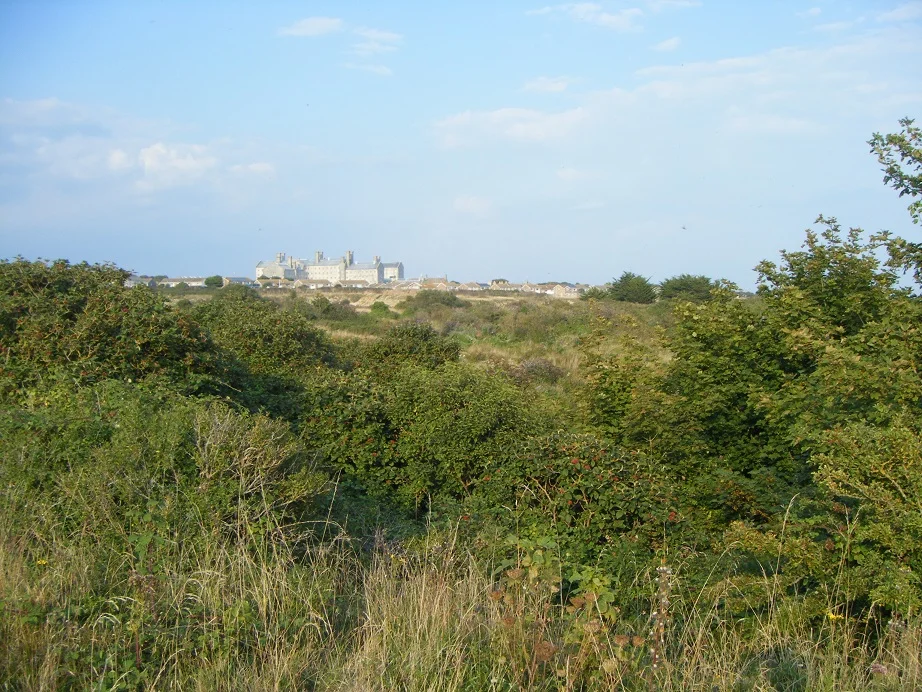

Broadcroft Quarry
The silver-studded blue is a small butterfly the color of a summer sky, and it needs bare ground to lay its eggs. Not grass. Not flowers. Bare, hot, stony earth, the kind that gets left behind when a quarry closes. Every spring, conservation volunteers come out to Broadcroft Quarry on the Isle of Portland with diggers and machetes to scrape the surface clean again, to keep the bare patches bare, because the butterflies need them and the butterflies will not come back if the brambles win. This is a working stone quarry. It still ships Portland limestone to London. It also holds, in seven hectares of its abandoned eastern edge, one of the densest silver-studded blue colonies in southern England.
Stone for the Empire
Broadcroft has been worked since the early twentieth century, originally as a cluster of small family-run operations that merged into a single large quarry as the market grew. The Portland limestone they take out here is the stone that built central London: St. Paul's Cathedral, the British Museum facade, the new United Nations headquarters in New York, countless banking halls and government buildings. Planning consent for modern quarrying on the Isle of Portland was granted in 1951, covering 324 hectares of the island. Portland Stone Firms Ltd holds the consent for Broadcroft along with the neighboring Coombefield and Perryfield quarries, and is the largest landholder on Portland. The current expansion at Broadcroft is being driven by a rolling contract with the Commonwealth War Graves Commission, which uses Portland stone for the headstones it sets above the graves of British and Commonwealth war dead from both world wars.
A Whole Stratigraphic Column
Geologists love Broadcroft. In the past, aggregate quarrying here cut down below the dimension stone beds all the way to the Portland clay at the bottom of the formation, which made Broadcroft the only place on the Isle of Portland where the entire stratigraphic column of the Portland limestone could be seen from top to bottom. The Portland stone formed at the end of the Jurassic, in shallow tropical seas about 145 million years ago, full of marine fossils that occasionally turn up in the blocks shipped out for buildings. Visitors to Portland's quarries sometimes notice the impressions of ammonites in the lintels above the doorways of houses, or the cross-section of a giant clam in a paving slab outside a London office. The stone remembers its sea.
Rewilding by Accident
An abandoned section of Broadcroft Quarry was infilled and left in the late twentieth century, and nature came back on its own. Butterfly Conservation began leasing it from the quarry company in 1994. The 7.3-hectare reserve sits inside Portland's Site of Special Scientific Interest, and it is held up as an example of how brownfield land, the awkward leftover ground that industry creates, can be managed for wildlife. The chalky, calcareous soil of the worked-out quarry suits limestone plants that struggle on richer ground elsewhere. Bee orchids and pyramidal orchids grow here. So do cyperus sedge, yellow vetchling, autumn gentian, tutsan, wild madder, tree-mallow, dwarf gorse, and ivy broomrape. The stripped-down conditions, sparse vegetation and short turf and bare ground, hold the butterflies that suburban gardens cannot.
Silver-Studded Blue
More than twenty-four species of butterfly use the reserve, but the one Broadcroft is famous for is the silver-studded blue, Plebejus argus, a small butterfly whose males are blue and whose females are brown with orange spots. The larvae have a specific relationship with black ants, which tend them and protect them in return for sugary secretions, a symbiosis that requires both species to share the same patches of warm, open, sparsely vegetated ground. The butterflies appear in late June and early July, in numbers high enough that volunteers stand at the edge of the reserve in mid-summer and watch clouds of them drift over the stone. In April and May 2011, a conservation team spent six weeks at Broadcroft cutting back scrubby growth, then brought in a digger to scrape patches of ground back to bare earth where the silver-studded blue and its ants could re-establish. The work was funded by the Awards for All program of the National Lottery's Big Lottery Fund.
A Quarry That Does Both Jobs
Broadcroft is unusual in that it actively does two things at once. On its working side, the trucks come and go and the cutters keep producing dimension stone for Britain's monuments and warehouses and gravestones. On its abandoned side, butterflies feed and breed in numbers that depend, paradoxically, on the bare ground that industrial work leaves behind. Portland Stone Firms occasionally hosts motocross events on the working side, the Track 'n' Trail enduros that competitors rate among the toughest in the country. Butterfly Conservation hosts butterfly walks on the reserve side. Both happen on the same square mile of windswept limestone in the middle of the English Channel, where the wind is always coming off the sea and the stone is always being asked to either go to a building site or stay as a home for something small and blue and rare.
From the Air
Broadcroft Quarry lies at 50.55 deg N, 2.43 deg W on the eastern side of the Isle of Portland, just east of Easton village and close to The Grove. From altitude, Portland's quarries appear as pale geometric scars across the southern half of the island, set against the surrounding Channel waters. Bournemouth Airport (EGHH) is forty-five kilometers east. The Isle of Portland itself, the limestone tied-island connected to the Dorset mainland by Chesil Beach, is among the most distinctive features of the English south coast. Portland Bill lighthouse stands at the southern tip.
Nearby Stories
- Needles Lighthouse 18 km away
- Lyme Bay Canoeing Disaster 19 km away
- HMS Formidable (1898) 19 km away
- National Motor Museum, Beaulieu 22 km away
- Sherborne Castle 22 km away
- Muchelney Abbey 24 km away
- German Submarine U-672 29 km away
- Battle of Cherbourg (1864) 58 km away