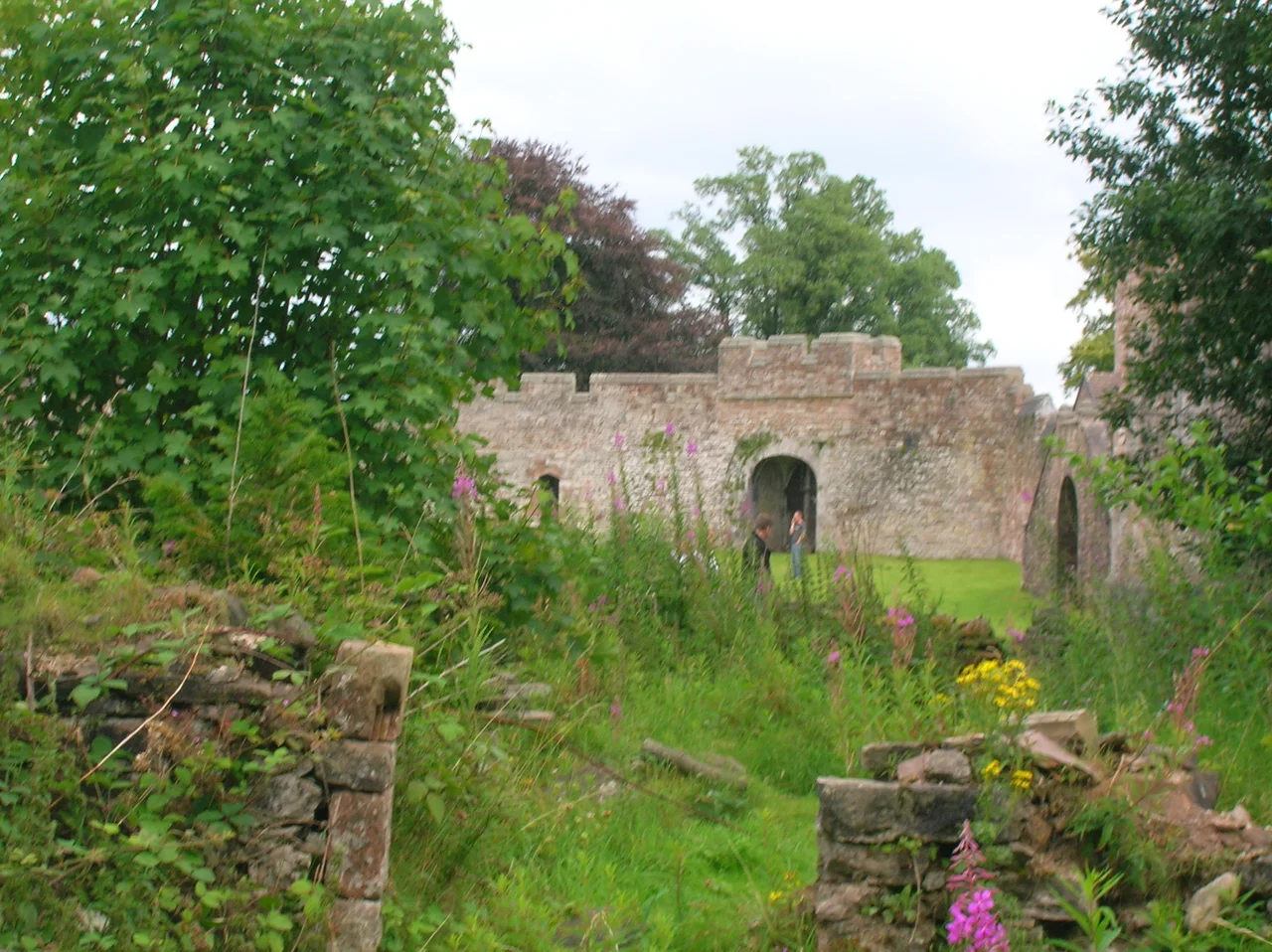

Brougham Hall
In 1941 the British Army drove tanks into the courtyard of a derelict Cumbrian country house and started bolting enormous searchlights to their turrets. The project was called the Canal Defence Light, classified top secret, and almost no one was supposed to know it existed. The house was Brougham Hall, near Penrith, which by that point had been sold for demolition and was waiting to be pulled down. The war saved it from the bulldozers. Eighty years later, volunteers are still piecing it back together, room by room.
The de Burghams
The story stretches back to before the Norman Conquest. The de Burgham family may have held land at Brougham in Edward the Confessor's time, somehow keeping their position after the Conquest reached this corner of north-west England around 1092. A Wilfred de Burgham appears in records during Henry II's reign. They held their land by military service to the Vieuxpont lords who lived at nearby Brougham Castle, the ruined Roman-and-medieval pile that still stands less than half a mile away across the fields. The Hall was usually sold in third parts, passing through various medieval families until Lady Anne Clifford bought one third in 1654 and rebuilt the chapel of St Wilfrid around 1659. Her steward James Bird acquired the rest after her death, becoming the first single owner since the de Broughams.
Henry Brougham's Showpiece
The Hall's transformation came with the rise of Henry Brougham, 1st Baron Brougham and Vaux, one of the great Whig politicians of the early 19th century. Brougham defended Queen Caroline against George IV's attempt to divorce her, championed the Reform Bill, helped abolish slavery in the British Empire, and as Lord Chancellor pushed through the Reform Act of 1832. He rebuilt and extended the Hall between 1830 and 1847 to designs by the Gothic Revival architect Lewis Nockalls Cottingham, with the building work mostly overseen by his brother William Brougham, the 2nd Baron. The result was a romantic medieval-style country house with a thirteenth-century gateway at its core, a Tudor hall dating from around 1480-1520, and a seventeenth-century guardhouse built by James Bird. London society visited, royalty visited. King Edward VII came in 1905.
The Spendthrift Lord
Then came Victor Brougham, 4th Baron Brougham and Vaux. He inherited a crippled estate after the First World War, when many country houses faced financial collapse, and tried to recover the situation by becoming a professional gambler. It did not work. By 1934 he sold the Hall to pay creditors, and the next owner sold it on for demolition. The interiors went, the contents were dispersed, and the building was stripped for parts. It would have been pulled down completely if the war had not intervened. The army took it over and the secret tank project began. From 1941 to 1945, engineers and crews worked in the half-ruined rooms developing the Canal Defence Light, which fitted high-intensity searchlights into modified tank turrets, intended to dazzle enemy gunners during night attacks. The lights saw very limited combat use but the development work happened here, and a plaque inside remembers the men who served at Brougham.
Rebuilding by Hand
After the war the Hall sat derelict again, weeds in the courtyard, slates falling. In 1967 Christopher Terry bought it and his family began the slow work of arresting the collapse. The project continues today as a volunteer restoration. Visitors come throughout the year to walk the courtyard, see the surviving fragments, watch craftspeople at work, and visit small shops and workshops that have grown up inside the consolidated buildings. It is not a polished National Trust experience. It is a real building being saved by real hands, with all the rough edges and unfinished corners that implies. The bunker used during the secret tank project is still there. So is the thirteenth-century gateway. So is St Wilfrid's chapel, rebuilt by Lady Anne Clifford and still standing nearly four hundred years on.
From the Air
Located at 54.648°N, 2.733°W in the village of Brougham just south-east of Penrith. The Hall sits on a low rise overlooking the River Eamont, with Brougham Castle ruins about half a mile to the north-east on the riverbank. The A66 trunk road and the M6 motorway run nearby. Nearest airports: Carlisle (EGNC) about 17 nm north-west, Newcastle (EGNT) about 50 nm north-east. Best viewed from 2,000-3,000 ft AGL flying south along the Eamont to take in both the Hall and the nearby castle ruins, with Lowther Castle a short distance further south.
Nearby Stories
- Yorkshire Dales National Park 5.8 km away
- Honister Pass 7.8 km away
- Bowes Castle 9.4 km away
- Levens Hall 11 km away
- Black Combe 13 km away
- Hexham 14 km away
- Kirtlebridge Rail Crash 23 km away