.JPG)
Brunswick Lion
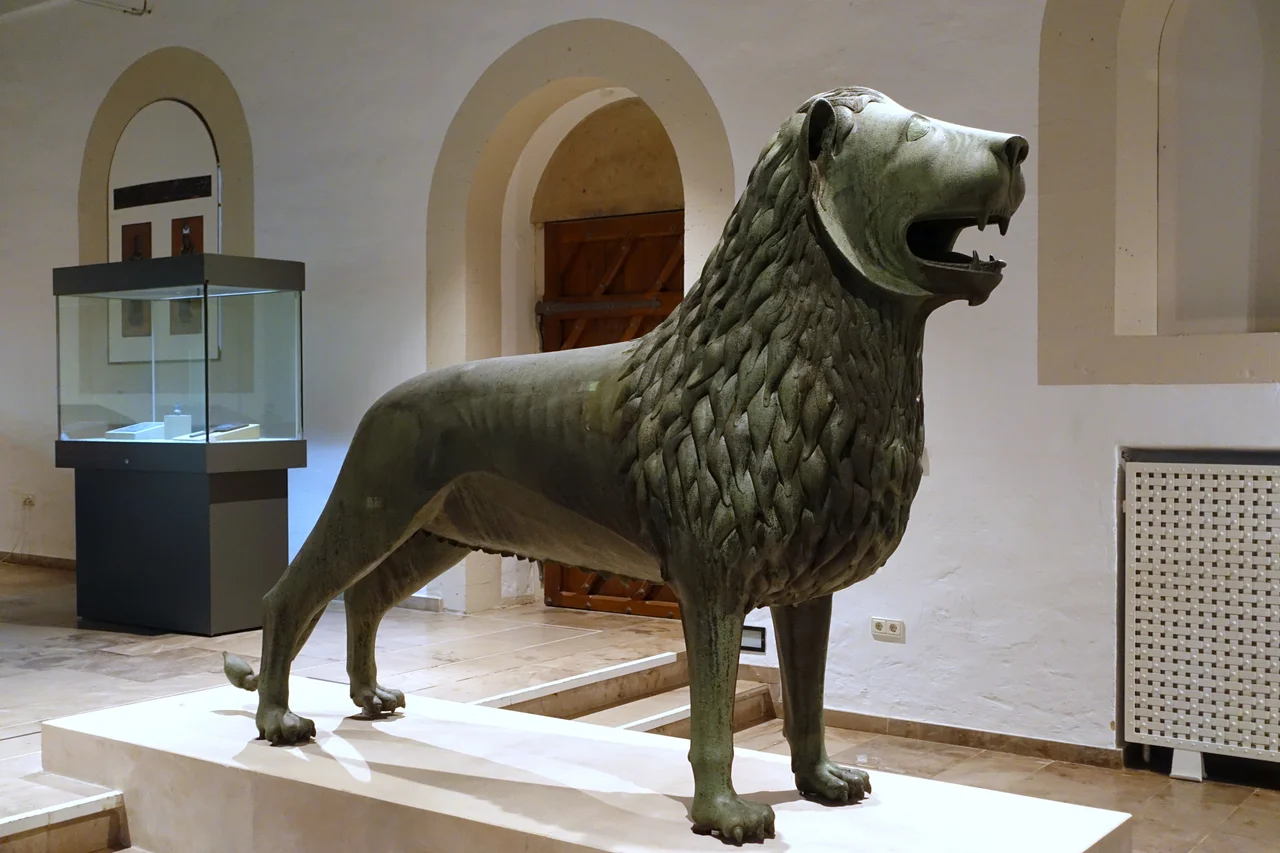
The lion on the Burgplatz is not the lion. It is a good copy, made to be looked at and rained on, and most visitors never learn the difference. The original stands a short walk away, indoors, in Dankwarderode Castle, where the air is filtered and still. It was brought inside in 1980 for a reason that would have baffled everyone who handled it before: eight centuries of Saxon weather had done less damage than a few decades of exhaust fumes.
Twelve Millimetres of Skin
Pick any point on the animal's flank and the bronze under it is, at its very thickest, twelve millimetres. The whole lion — 2.79 metres from nose to tail, 1.78 metres to the crest of the mane, 880 kilogrammes on the scale — is a shell. It is usually described as the first large hollow figural casting made anywhere since antiquity, and as the first large free-standing secular sculpture of the Middle Ages north of the Alps. That second phrase carries its qualifiers for a reason: churches north of the Alps held plenty of monumental metalwork, but it was fixed to doors, fonts and columns and belonged to the liturgy. This thing stood by itself in a courtyard and belonged to a man.
It was gilded when new. Traces of the gold still sit between the strands of the mane, and the eyes were originally filled with enamel, which would have caught the light in a way the dull green surface no longer can. Nobody knows who cast it. The controlled naturalism of the body, and the nerve required to pour a figure that thin, point to a goldsmith or a bell-founder rather than a mason.
A Duke Draws His Line
Henry the Lion, of the house of Welf, held both Saxony and Bavaria and made Braunschweig his seat. Newly married to the English princess Matilda, he rebuilt Dankwarderode Castle in the manner of an imperial palace — a deliberate answer to the Kaiserpfalz at Goslar, twenty-odd miles south. The bronze went up in the middle of the castle complex as a seigniorial sign: this is my authority, and my right to judge.
It was also a message aimed over the heads of the citizens at the Hohenstaufen emperor Frederick Barbarossa, whose Italian campaigns Henry had ridden on. The design shows where he had been. The Capitoline Wolf, the Lion of Saint Mark, the equestrian Marcus Aurelius — the sculptural vocabulary of Italy is all through it. The chronicler Albert of Stade put the casting at 1166; modern scholarship spreads it across the years between 1164 and 1176.
The Lion That Starved
Henry died in 1195, and a folktale grew over him almost at once. In the Heinrichssage he travels to the Holy Land, comes upon a lion fighting a dragon, throws in with the lion, and kills the dragon. The lion follows him home to Braunschweig, and when his master dies it refuses food and dies of grief on the grave. Only then, the story says, do the townspeople raise a statue in the animal's honour.
The chronology is the wrong way round — the bronze was already decades old when Henry was buried — but the tale was better than the correction, and it travelled. The Italian composer Agostino Steffani eventually turned it into an opera, Enrico Leone. Nine hundred years on, the city still calls the sculpture the Burglöwe, the Castle Lion, as if it had walked there itself.
Nearly Melted, Then Mined
The lion has been rescued more than once. In 1616, after long quarrels between duke and citizens were finally settled, Frederick Ulrich had the sculpture and its base overhauled; it had stood on two low columns and gained a proper pedestal. In 1812, with the Westphalian government scraping the region for metal ahead of Napoleon's Russian campaign, it came close to the furnace and was talked out of it. The sculptor Georg Ferdinand Howaldt restored it in 1858.
The worst threat was the last. Faced with Allied bombing, the city put up a copy that had already been cast in 1937 and sent the original into the Rammelsberg mines in the Harz, where it sat out the war underground. British occupation forces brought it back to Braunschweig afterwards and it was re-installed with some ceremony — a lion returning from the hills, which is more or less how the legend had it.
Copies, Everywhere
Long before the replicas, the lion had become an image the city could use. It is the heraldic animal of Braunschweig, stamped on the municipal seal of 1231 and on ducal coinage. In 1903 the local Büssing works put it on the radiators of its trucks and buses; MAN bought the company in 1972, and the Büssing signet still rides on commercial vehicles today.
The casts spread with the Welf connection and the city's pride. There is one in front of Ratzeburg Cathedral from 1881, two at the Imperial Palace of Goslar from 1900, one at Lübeck Cathedral since 1975, one at Schwerin from 1995, one in the courtyard of Adolphus Busch Hall at Harvard, and a plaster cast at the Victoria and Albert Museum in London. The Burgplatz version is simply the closest copy to the original — standing in the yard where the real one spent eight hundred years, doing the job of being looked at while the lion itself rests indoors.
From the Air
The Burgplatz sits at 52.2649°N, 10.5242°E, in the middle of Braunschweig's old town in Lower Saxony. From 2,000–3,000 ft the square itself is a small gap between the cathedral roof and the long block of Dankwarderode Castle; the easier fix is the Oker ring — the old moat, now a canal, drawing a green oval of parkland right around the historic core, with the square just north of centre. Braunschweig-Wolfsburg (EDVE) lies about 6 km north-northeast at 52.319°N, 10.556°E, with an active control zone over the city; coordinate before overflying low. Hannover (EDDV) is roughly 60 km west-northwest. The Harz massif rises 40 km to the south and is a reliable visual anchor in clear air. Summer haze over the Braunschweig basin can soften the old town to a grey smudge; the crispest light is a cold high-pressure morning in autumn or winter.
Nearby Stories
- Expo 2000 3.7 km away
- Fagus Factory 5.7 km away
- Ströbeck 13 km away
- Goslar 15 km away
- Helmstedt–Marienborn border crossing 15 km away
- Celle 21 km away
- Sieben Steinhäuser 27 km away
- Stones Fan Museum 49 km away