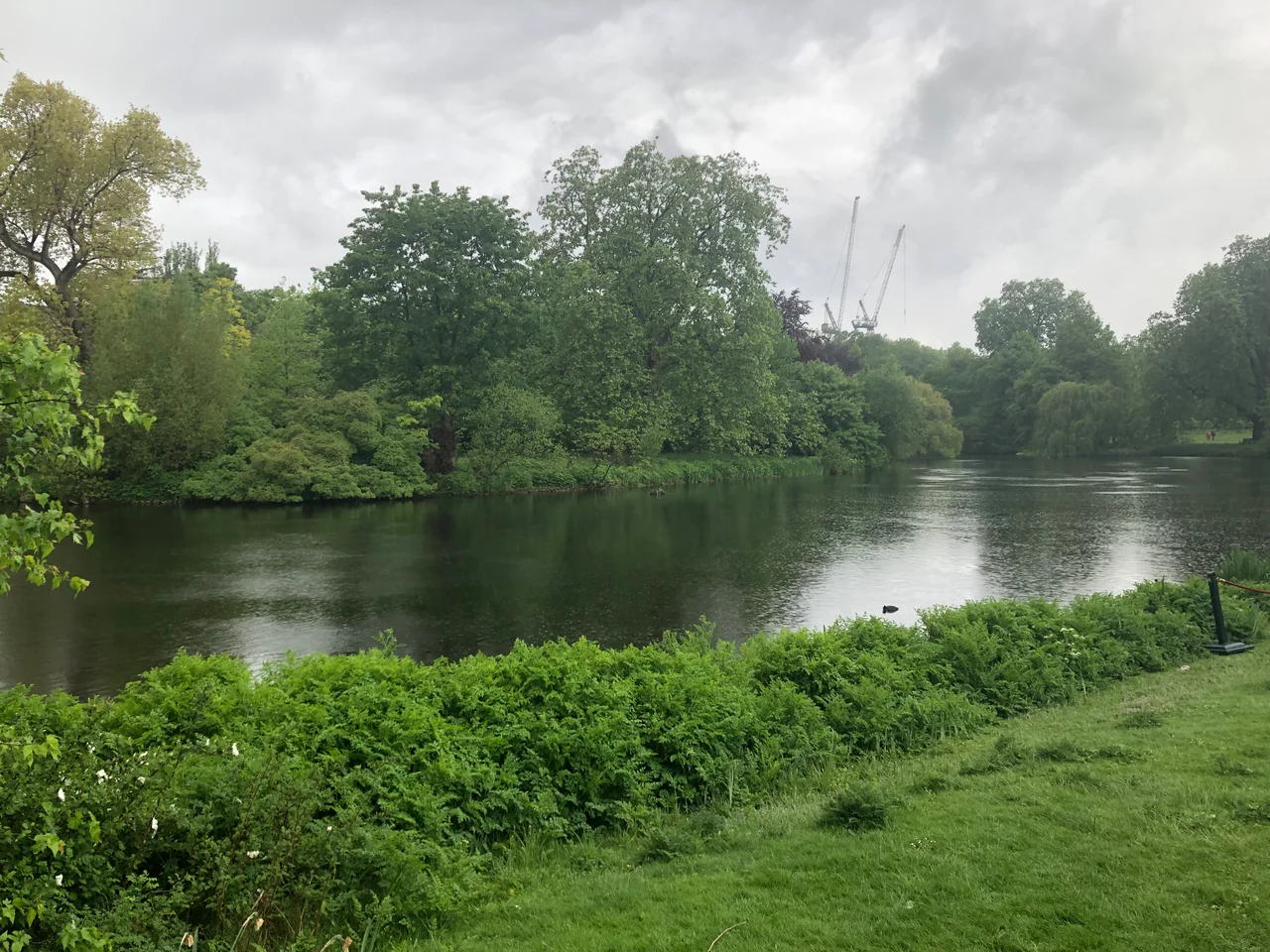

Buckingham Palace Garden
Napoleon had the vase prepared to commemorate victories he intended to win. It is fifteen feet high and carved from a single piece of Carrara marble — presented unfinished to the Prince Regent in 1815, a slightly awkward diplomatic gift after Waterloo, since the marble had been destined for a French monument. George IV had the base completed by Richard Westmacott and intended the urn to be the centrepiece of the Waterloo Chamber at Windsor Castle. The floor would not hold it. The National Gallery took it next, returned it in 1906 to Edward VII, and there it sits to this day, on the grass behind Buckingham Palace, the largest private garden in London arranged around an object too heavy for any room in any palace to bear.
Behind the Wall
The garden covers 39 acres — the largest private garden in London — surrounded by a high wall and screened by trees from St James's Park to the east and Constitution Hill to the north. Most of the people who walk past Buckingham Palace will never see it. Eight full-time gardeners maintain it, with two or three part-timers. The trees include London planes, Indian chestnut, silver maple, and a swamp cypress, plus a single surviving mulberry from the plantation James I installed when he tried, and failed, to start an English silk industry on the site. The Natural History Museum regularly surveys the moths. The Queen's swans occasionally visit. Helicopters land on the great lawn in front of the West Terrace. A tennis court was built in 1919 and, in the 1930s, the future George VI played Fred Perry on it.
Three Royal Garden Parties
Three garden parties are held at Buckingham Palace each summer, plus one at the Palace of Holyroodhouse in Edinburgh. About 30,000 guests attend in total — a number that recovered in 2022 after a two-year pandemic pause. The tradition is Victorian: lavish parties in 1887 and 1897 for the Golden and Diamond Jubilees set the pattern. Invitations now come on the king's behalf, nominated by Lord-Lieutenants, government departments, the armed forces, the diplomatic corps, and a range of charities. Guests take tea and sandwiches in marquees on the lawn. Just before four o'clock, the king and senior members of the royal family emerge from the Bow Room as a band plays the National Anthem. The royal party then processes through the assembled guests toward the Royal Tea Tent, greeting those previously selected for the honour. A second tea tent is set aside for diplomats. Two military bands alternate in playing what one Buckingham Palace document calls a "continuous supply of festive music."
The Lake, the Bees, the Vanished Flamingos
The lake is four hundred feet long and a hundred and fifty across. It was once home to a colony of flamingos, until they were killed by urban foxes — a small London tragedy that no garden wall, however high, has been able to prevent. The water used to be piped in from the Serpentine in Hyde Park; today it comes from a borehole within the garden, aerated by a waterfall that Elizabeth II and Prince Philip installed to replace an earlier cascade built by George VI and the Queen Mother. The large island in the lake holds four beehives. Since 1983, palace honey has been produced there, a small agricultural product in the middle of central London. Twenty-four of the trees in the garden are designated Champion Trees on the Tree Register of the British Isles. More than 1,000 trees in total, 325 species of wild plants, and 35 species of birds have been recorded inside the wall.
The Summerhouse and the Coade Stone
Opposite the Waterloo Vase stands a small temple-like summerhouse, with a pediment supported by four atlantes — male figures bearing the entablature on their shoulders. The structure was originally in the Admiralty garden at the other end of The Mall and was relocated to Buckingham Palace some time later. Peter Coats, who wrote a book about the garden in 1978, noted stylistic similarities to William Kent. Much of the rest of the garden statuary — vases and urns on the West Terrace — was designed by John Nash and made from Coade Stone, an artificial ceramic stone manufactured in Lambeth from the 1770s that proved remarkably resistant to London weather. Eleanor Coade kept the formula secret, and the formula was lost when the factory closed in 1843. Genuine Coade Stone pieces still in good condition today are quietly remarkable: two-hundred-year-old garden ornaments outlasting most modern equivalents.
What the Critics Said
Not everyone is impressed. Simon Bradley, in the 2003 revised Pevsner volume on Westminster, called the garden "beautiful," noting the "irregular lake and artful Picturesque planting." A writer in Country Life took a sharper view, suggesting that no major designer had been employed since Henry Wise in the early eighteenth century, and that the garden lacked the "originality, surprise, vista, architecture, statuary, planting" of a truly great garden — though the same writer conceded its utility as a "helicopter landing pad." The garden is Grade II* listed on the Register of Historic Parks and Gardens. The Waterloo Vase and the Kent Summerhouse, the boundary wall, the entrance screens, the wall around the Royal Riding School, the school itself, the Royal Mews, and two flanking lodges are all Grade I. In 2006, the Time Team archaeologists led by Tony Robinson carried out the so-called Big Royal Dig in the garden, televised live to mark the team's 150th excavation and the 80th birthday of Queen Elizabeth II. They found roughly what you would expect: the layered traces of every garden that had stood there before, and the answer to a few small questions about palaces and the ground they rest on.
From the Air
Buckingham Palace Garden sits at 51.50N, 0.15W in the City of Westminster, immediately west of the Palace itself. From the air, the 39-acre walled enclosure is unmistakable: a large green rectangle west of The Mall, with St James's Park to the east and Green Park to the north. London City Airport (EGLC) lies seven miles east; London Heathrow (EGLL) thirteen miles west. Best viewed from 1,500 to 3,000 feet on a clear day. The Palace is in a Restricted Royal Zone — VFR aircraft must avoid overflight; commercial approaches generally route to the north or south.
Nearby Stories
- Battle of Britain, Northfleet 1.1 km away
- Bayham Old Abbey 5.4 km away
- Catharine Macaulay 6.4 km away
- Hatfield rail crash 8.8 km away
- Chequers 8.9 km away
- Chelmsford Cathedral 10 km away
- Queen Victoria Hospital 13 km away
- Fishbourne Roman Palace 36 km away