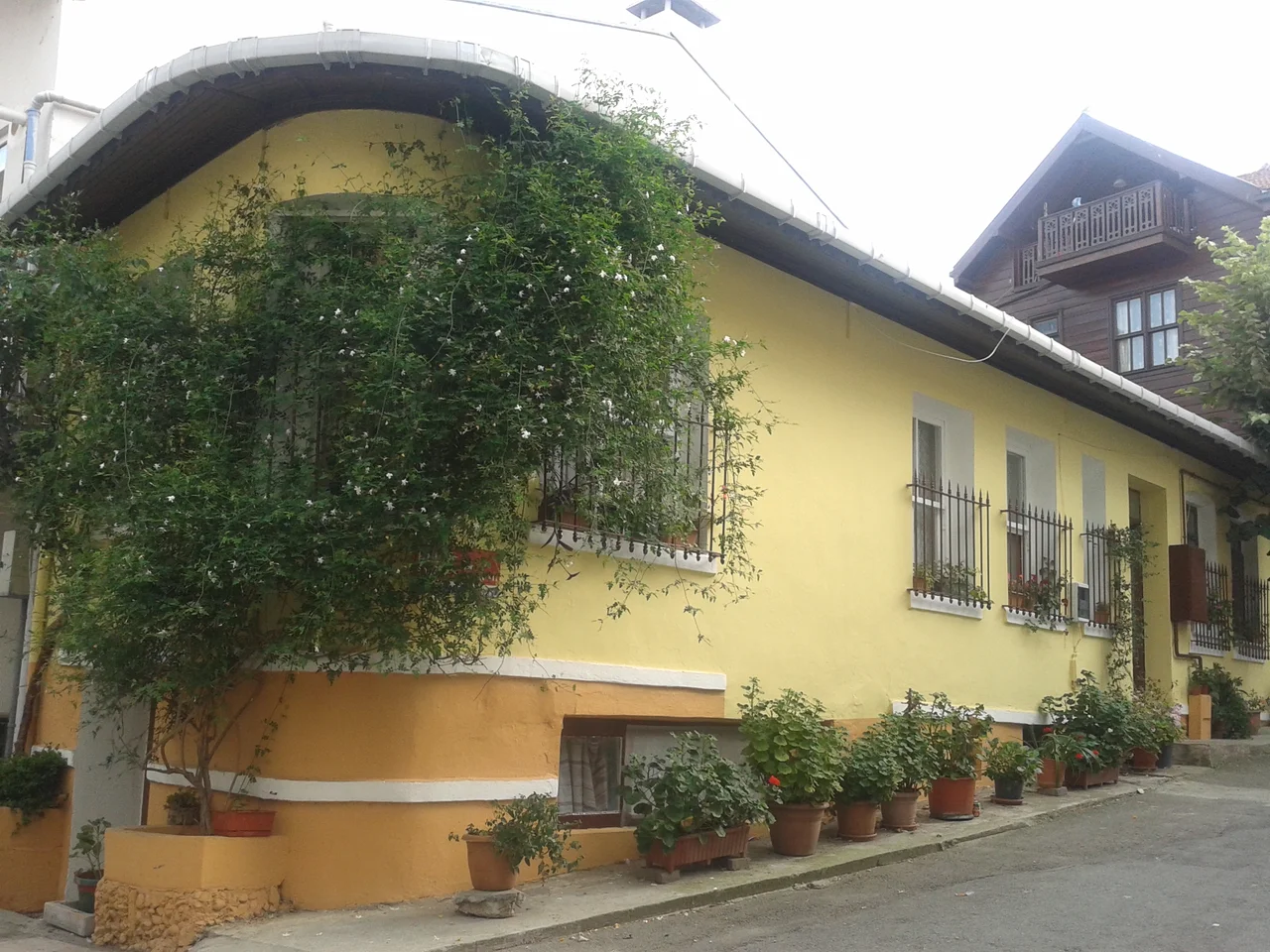

Burgazada
The name started as a Greek word for a tower. Pyrgos became Burgaz became Burgazada — and somewhere in that long phonetic journey, the fortress that Antigonus I Monophthalmus built here in the era after Alexander the Great was swallowed by time, leaving only the name behind. Today Burgazada is the third largest of the Princes' Islands in the Sea of Marmara, a pine-covered hill rising from the water 18 kilometers southeast of Istanbul. Its permanent population is 1,655, according to 2022 figures. On summer weekends, that number grows considerably.
An Island of Layers
Burgazada covers 1.5 square miles and is dominated by a single hill, Bayraktepe — Flag Hill, 170 meters above sea level, also known by the older name Hristos Tepesi (Christ Hill). The hill's summit holds the Monastery of the Transfiguration, a Byzantine foundation built on the site of an ancient Greek temple. The current structure is largely a 19th-century rebuilding, but the practice of treating this hilltop as sacred reaches back considerably further than Ottoman or Byzantine memory.
Lower down the slopes, the Church of Iohannes Prodromos (John the Baptist), completed in 1899, anchors the small harbor town. Its site has an older story: a Byzantine church once stood here that served as a prison for St. Methodius the Confessor, who was exiled to Burgazada in the 9th century for opposing the iconoclast movement. He survived the exile and eventually became the Ecumenical Patriarch of Constantinople. The church built later at the same location, and extensively restored after the 1999 Marmara Earthquake, carries that long memory.
White Russians, Island Monasteries, and the 1917 Arrivals
The Monastery of Hagios Georgios Garipi sits partway up the hill, largely rebuilt in 1897. There has been a monastery on this site since at least the 17th century. After the 1999 Marmara Earthquake shook the island — the same earthquake that damaged structures across the Marmara region — it required extensive restoration again.
In 1917, the monastery received an unusual group of guests: some of the White Russians who fled the Russian Revolution found temporary refuge here. The Princes' Islands, long a place of exile and retreat, absorbed another wave of displaced people, as they had many times before. The island's history accumulates in this way — each era adding its population of newcomers, exiles, summer residents, and permanent settlers — Greek families for centuries, Jewish communities in the 20th century, and eventually a general Istanbul population that has, as elsewhere in the city's islands, displaced the earlier minority communities that once defined the place.
Sait Faik's Island
The most famous resident Burgazada produced was Sait Faik Abasıyanık, widely regarded as one of Turkey's greatest short-story writers. Sait Faik lived on the island for much of his life, and many of his stories — quiet, humane observations of fishermen, harbor life, ordinary people on the margins — are set here. His house on the island, originally known as the Spanudis Mansion, is sometimes open to visitors.
Sait Faik's work resists easy summary. He wrote about people who were poor, overlooked, and fully alive, with an attention to the specific textures of island life — the light on the water, the way time moves differently when the ferry has gone. His Burgazada is not a postcard. It is a place where human beings live with all the difficulty and tenderness that entails. Reading his stories before visiting the island sharpens everything.
The View from Kalpazankaya
At the island's remote southern edge, a rocky outcropping called Kalpazankaya — Counterfeiter's Rock in Turkish — offers the best views back toward the mainland. The name's origin is pleasingly murky; various accounts suggest that counterfeiters once operated in the rocky coves below, using the island's isolation for unlawful purposes. Whether or not the story is true, the name has stuck.
A fire in 2003 burned through most of Burgazada's woodland, a loss that is still visible in stretches where the pine cover has not fully returned. Offshore, the tiny uninhabited islet of Kaşıkadası — Spoon Island — sits close enough to see clearly from the shore. The island's lack of motor vehicles (cars are not permitted on the Princes' Islands in general) gives it a particular quiet; transport is by horse-drawn carriage or bicycle, and the pace of the place reflects that constraint.
Getting There, Getting Around
Şehir Hatları ferries connect Burgazada to the mainland from multiple points: Eminönü and Kabataş on the European side of Istanbul, and Kadıköy and Bostancı on the Asian side. In the usual ferry schedule, Burgazada is the third stop on routes heading out from the city — after Kınalıada and before Heybeliada and the largest island, Büyükada. The crossing from Kabataş takes roughly an hour.
The island supports a small local economy of restaurants, cafes, and guest accommodations geared toward day-trippers and weekend visitors. The Burgazada Sanatorium, founded in 1928 and one of the oldest such institutions in Turkey, long stood empty before being converted to a restaurant. Outside the summer peak season, the island quiets considerably — and for visitors who prefer the Princes' Islands without the crowds, the shoulder seasons offer a different and arguably more rewarding experience.
From the Air
Burgazada sits at approximately 40.879°N, 29.062°E in the Sea of Marmara, roughly 18 km southeast of central Istanbul and part of the Princes' Islands chain. The nearest major airport for this island is LTFJ (Sabiha Gökçen International Airport), located on the Asian shore of Istanbul approximately 25 km to the northeast. From altitude, Burgazada is clearly visible as a distinct forested island rising from the Marmara — smaller than Büyükada to its south but with a prominent central hill, Bayraktepe, at 170 meters. The island chain runs roughly east-west; from 5,000 feet the Princes' Islands are easily identifiable as a group. The Sea of Marmara is typically calm and a deep blue-grey, making the islands stand out sharply against the water.
Nearby Stories
- Second Battle of Çatalca 1.5 km away
- Tarabya 4.1 km away
- Şile 7.9 km away
- Hereke Carpet 12 km away
- Battle of Melantias 19 km away
- Bursa 47 km away
- Bandırma 51 km away
- 2025 Kartalkaya Hotel Fire 192 km away