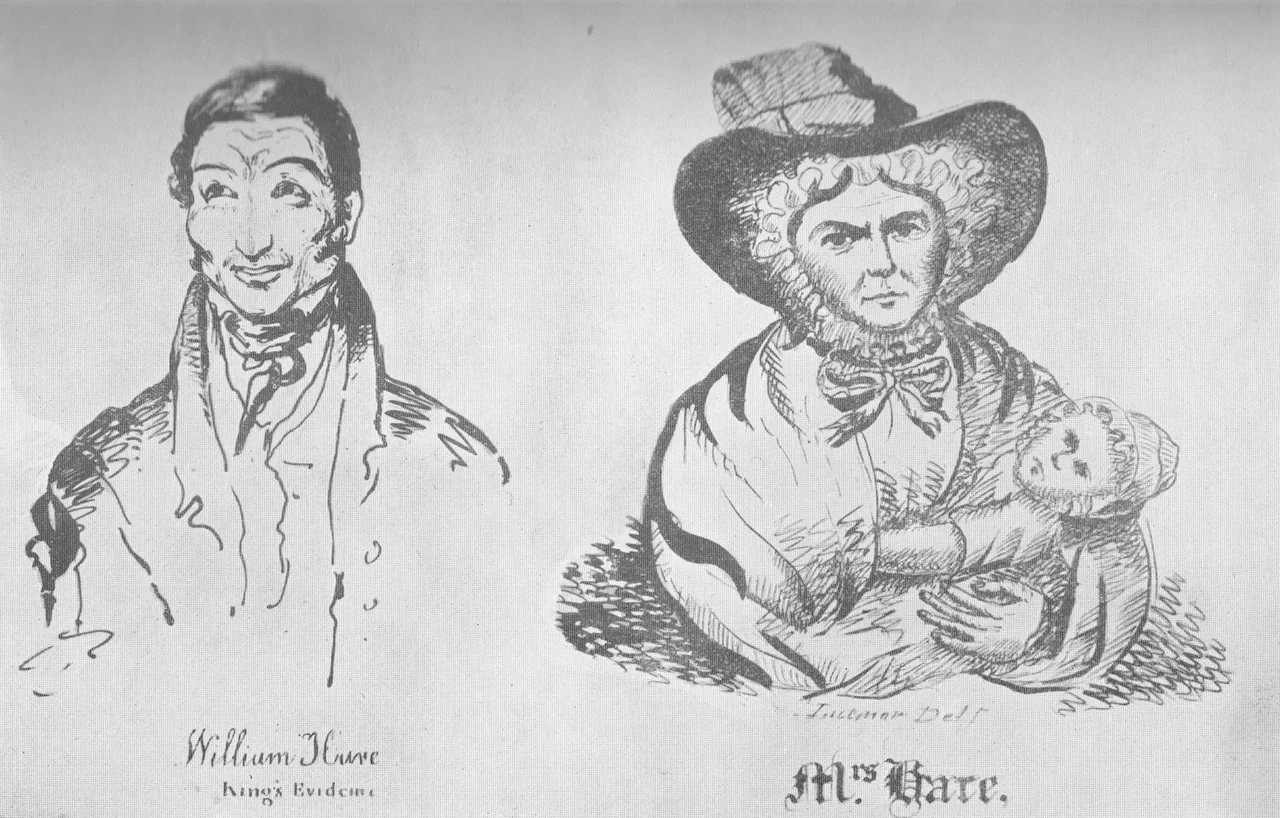

Burke and Hare murders
Margaret Docherty was an Irish woman who had come to Edinburgh in late October 1828 to look for her missing son. She was about sixty years old. On 31 October, William Burke met her in a grocer's shop on the Canongate, persuaded her that they were distant cousins, and invited her to his lodgings for Halloween. She would be the sixteenth and last person to die at the hands of William Burke and William Hare. The story of these killings is often told as a grim curiosity, complete with body-snatchers and anatomy theatres. But the heart of it is sixteen ordinary people who became invisible to the city around them, and the men who learned how to turn that invisibility into money.
The Trade in Bodies
Edinburgh in the 1820s was one of Europe's great centres of medical learning, and its anatomy schools needed cadavers. Scottish law allowed only the bodies of executed criminals, suicides, foundlings, and orphans to be dissected, and the supply fell catastrophically short of demand. "Resurrection men" filled the gap by digging up freshly buried corpses and selling them to surgeons, while wealthier families protected their dead with iron cages called mortsafes. Robert Knox, the popular anatomy lecturer who taught hundreds of students each year, was always in the market. Burke and Hare were not resurrection men. They started, in late 1827, with the body of a lodger who died in Hare's house owing rent. They sold him to Knox's assistants for £7 10s, a windfall for two labourers, and learned a lesson the city would not have wanted them to learn.
Sixteen People
Over the following ten months they killed at least fifteen more. The pattern was simple and terrible. The victims were people Edinburgh's respectable society had already half-forgotten: lodgers in cheap rooms, women working as prostitutes, an elderly Irish woman named Mary Paterson, a relative of Hare's wife, an eighteen-year-old street performer known as "Daft Jamie" Wilson whose mother went looking for him afterward and could not find him. Burke and Hare would invite them to drink whisky, wait for them to grow drowsy, and suffocate them. The method left almost no marks, which is part of why "burking" entered the English dictionary as a word for murder by smothering. The victims were carried to Knox's anatomy theatre, where some of the students recognised faces but said nothing.
Margaret Docherty
Other lodgers in Burke's house found Margaret Docherty's body hidden under straw on All Saints' Day and went to the police. A forensic examination suggested suffocation but could not prove it. The case threatened to collapse for lack of evidence until prosecutors offered Hare immunity if he turned king's evidence. He took it, named every victim he could remember, and walked free. Burke was tried alone, convicted of one murder, and hanged on 28 January 1829 before a crowd estimated at 25,000. His body was dissected in public at the Edinburgh Medical School, and his skeleton remains on display there, a permanent reminder. A small pocketbook made from his skin is held at Surgeons' Hall Museum. Hare disappeared, possibly to England. The case against Burke's wife Helen was found "not proven," a peculiarly Scottish verdict.
What the Murders Changed
Robert Knox was never charged. Public anger followed him for the rest of his life, but no court ever found him criminally responsible for what his students received in their dissection rooms. The deeper outcome was the Anatomy Act of 1832, which broadened the legal supply of cadavers by permitting unclaimed bodies from workhouses to be used for dissection. The new law solved the supply problem and ended the era of body-snatching. It also, in its quieter way, repeated the central injustice of the murders: that those without families to claim them were still the ones whose bodies the medical schools received. The story has echoed through fiction ever since, from Robert Louis Stevenson's 1884 tale "The Body Snatcher" onward. The harder fact, beneath all the retellings, is that sixteen people died because the city had already stopped seeing them.
From the Air
Located at 55.9533°N, 3.1892°W in central Edinburgh, in the West Port area just south of the Grassmarket and west of Edinburgh Castle. The murders took place in Hare's lodging house off Tanner's Close, a tenement long since demolished. Surgeons' Hall Museum, where Burke's skeleton and the pocketbook of his skin remain, lies about 0.5 nautical miles east. Edinburgh Airport (EGPH) is roughly 6 nautical miles west. Best viewed from 2,000-3,000 feet AGL in clear weather, with Arthur's Seat rising to the east.
Nearby Stories
- Ardoch Roman Fort 2.2 km away
- Craignethan Castle 3.1 km away
- Haddington 3.8 km away
- Balvaird Castle 4.3 km away
- Battle of Kilsyth 9.4 km away
- Siege of St Andrews Castle 9.9 km away
- Neidpath Castle 11 km away
- Melrose Abbey 15 km away