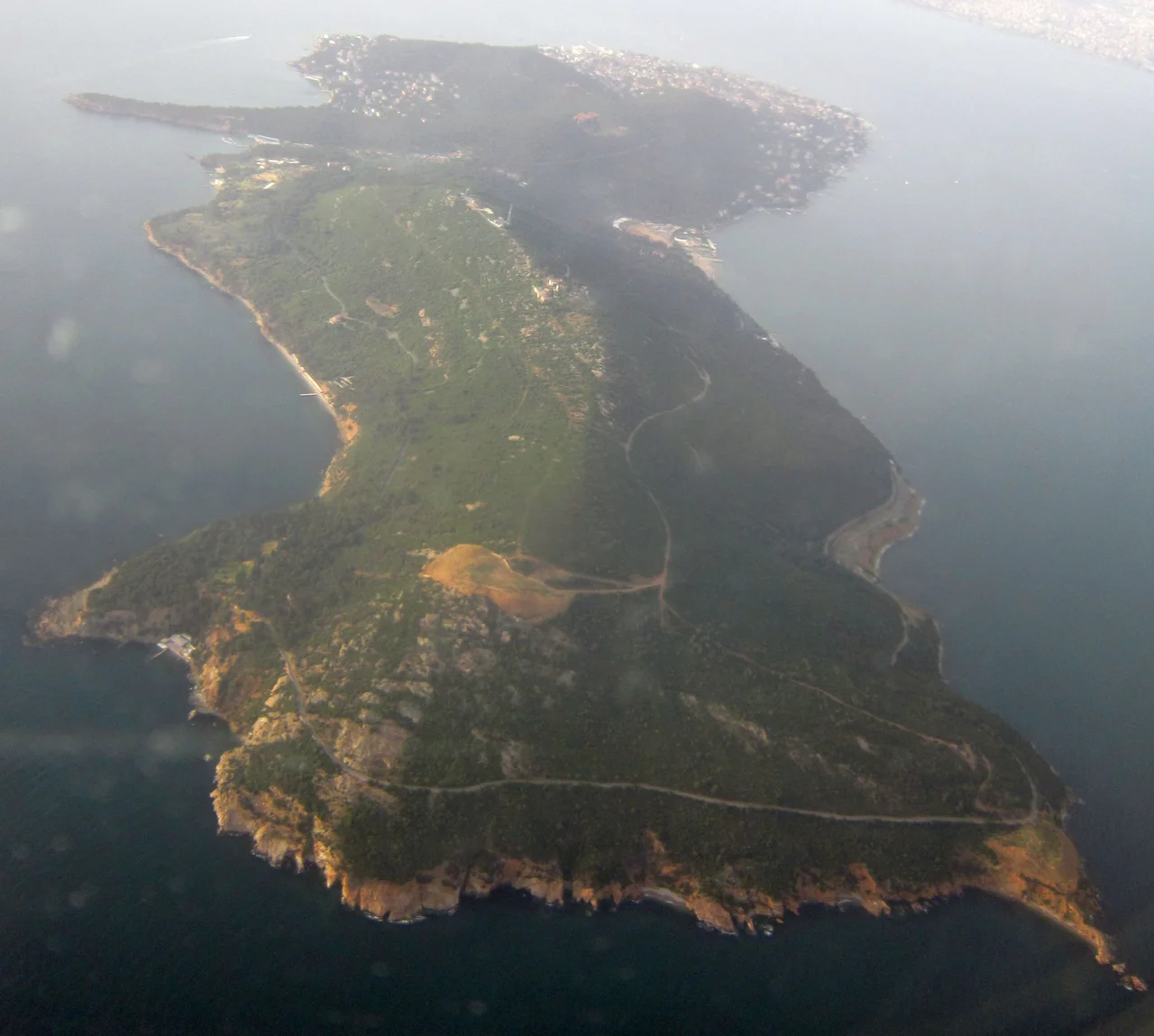

Büyükada
Leon Trotsky wrote some of his most important work here, in a crumbling villa above a sea dotted with fishing boats, while the Soviet state he helped build was hunting him. That particular irony — one of the 20th century's most violent revolutionaries finding shelter on a car-free island where Byzantine empresses once paced the same cliffs in their own exile — is precisely the kind of layered, impossible history that Büyükada seems to generate effortlessly. The island is only about two square miles, a short ferry ride from one of the world's largest cities. But it has always stood apart, literally and spiritually, from the Istanbul roaring on the mainland horizon.
An Island That Has Always Been a Destination for the Unwanted
Long before tourists arrived, Büyükada — then called Prinkipo, the Greek name it still carries in many languages — served the Byzantine Empire as a convenient place to make inconvenient people disappear. Empress Irene was exiled here, as were Euphrosyne, Theophano, Zoe, and Anna Dalassena. The roster reads like the roll call of a Byzantine soap opera, queens and mothers-in-law deposited on this rocky shore when Constantinople needed them gone. The Ottomans were slower to seize Prinkipo than the rest of the islands, but once they did, the island drifted into quiet obscurity until 1846, when the first ferry connection transformed it overnight into something new: a summer destination for the prosperous Greek and Armenian families of Istanbul who could finally reach it in an afternoon. The 19th century left the island its most visible legacy — rows of ornate wooden mansions, some still standing along Çankaya Caddesi in defiant beauty, others slowly losing their battle with time.
Trotsky, the Pope, and the Art of Waiting
In February 1929, Leon Trotsky arrived at what was then Prinkipo after deportation from the Soviet Union, and settled in for four years of writing, corresponding, and plotting from this most improbable of addresses. The island gave him time if not safety; GPU agents watched the mail, and the makeshift fishing trips he took with Turkish guards were as much surveillance as recreation. The man who had organized the Red Army was reduced to asking the island's fishermen for tips. Less than a year after Trotsky left, Angelo Giuseppe Roncalli — the future Pope John XXIII — arrived as papal nuncio and lived on Büyükada through 1934, taking his own long walks on the same paths. Whether these two men ever crossed paths or simply breathed the same salt air in different years, the island had managed to host, in rapid succession, a revolutionary and a future saint.
The Bell and the Bell Tower: Sacred Architecture of the Hills
The most-visited site on Büyükada requires a climb. High on Yücetepe hill stands the Greek Orthodox monastery of Hagios Georgios Koudonas — St George of the Bells — probably founded in the 10th century, though the buildings visitors see today date from the mid-18th and 19th centuries. The name comes from a 17th-century legend: a shepherd boy heard bells ringing underground, dug down, and found an icon of St George that local Christians had buried to protect it from the Fourth Crusaders in 1204. Every April on St George's Day, Christians and Muslims alike wind thread along the path to the monastery in rituals that predate the current religious geography of the island by centuries. The panoramic view from the top — the Sea of Marmara shimmering below, Istanbul's minarets faint on the horizon — is, as the guidebooks correctly observe, worth the hike regardless of one's faith. A second monastery, dedicated to Christ the Saviour, crowns the adjacent İsa Tepesi.
The Great Wooden Ruin
Also on İsa Tepesi stands what the source article calls "what should be the pride and joy of the island but is instead on its very last legs": the colossal Greek Orthodox Orphanage, built in 1898 by the Levantine architect Alexander Vallaury for a French company that intended it as a casino. Sultan Abdülhamid II refused to sanction gambling, so it was sold, donated to the Ecumenical Patriarchate, and converted into an orphanage that operated until 1964. It is believed to be the largest wooden building in Europe and the second largest in the world. Decades of neglect followed the state's return of the building to the Patriarchate in 2010. Plans for restoration were announced in 2021, but for now the building remains off-limits, visible from below as a haunting silhouette: enormous, ornate, and quietly collapsing into the hillside.
The End of the Horses, the Beginning of Something Else
Until 2020, Büyükada was the rare place in the world where the dominant sound of transportation was hoofbeats. Horse-drawn phaetons — fayton — were the only form of wheeled transport permitted on the island, a tradition that made the Princes' Islands genuinely singular in Turkey and gave Büyükada a character unlike anywhere else in the metropolitan area. Animal rights activists pushed for decades to end what they argued was an unsustainable and often cruel industry; the explosion of tourism put the horses under impossible strain. When electric vehicles replaced the phaetons in 2020, many residents protested — not out of indifference to animal welfare, but out of concern that electric buses would erode the pedestrianized tranquility that made the island worth visiting in the first place. The debate continues. The silence, for better or worse, has changed.
From the Air
Büyükada lies at approximately 40.86°N, 29.12°E in the Sea of Marmara, about 15 km southeast of central Istanbul. From the air, it is the most prominent of the Princes' Islands cluster — roughly oval, densely wooded on its two hills, with the white domes of the Splendid Palace Hotel visible near the ferry terminal on the northern waterfront. A recommended viewing altitude is 2,000–4,000 feet, which gives a clear sense of the island's compact scale relative to the sea around it and the Istanbul skyline to the northwest. The nearest airport is LTFJ (Sabiha Gökçen International, on the Asian side of Istanbul, approximately 25 km north). The major hub is LTFM (Istanbul Airport, on the European side). In clear weather, the island's two peaks — Yücetepe and İsa Tepesi — are visible from cruising altitude, with the hulking outline of the Greek Orthodox Orphanage distinguishable on the southern hill.
Nearby Stories
- Second Battle of Çatalca 1.5 km away
- Tarabya 4.1 km away
- Şile 7.9 km away
- Hereke Carpet 12 km away
- Battle of Melantias 19 km away
- Bursa 47 km away
- Bandırma 51 km away
- 2025 Kartalkaya Hotel Fire 192 km away