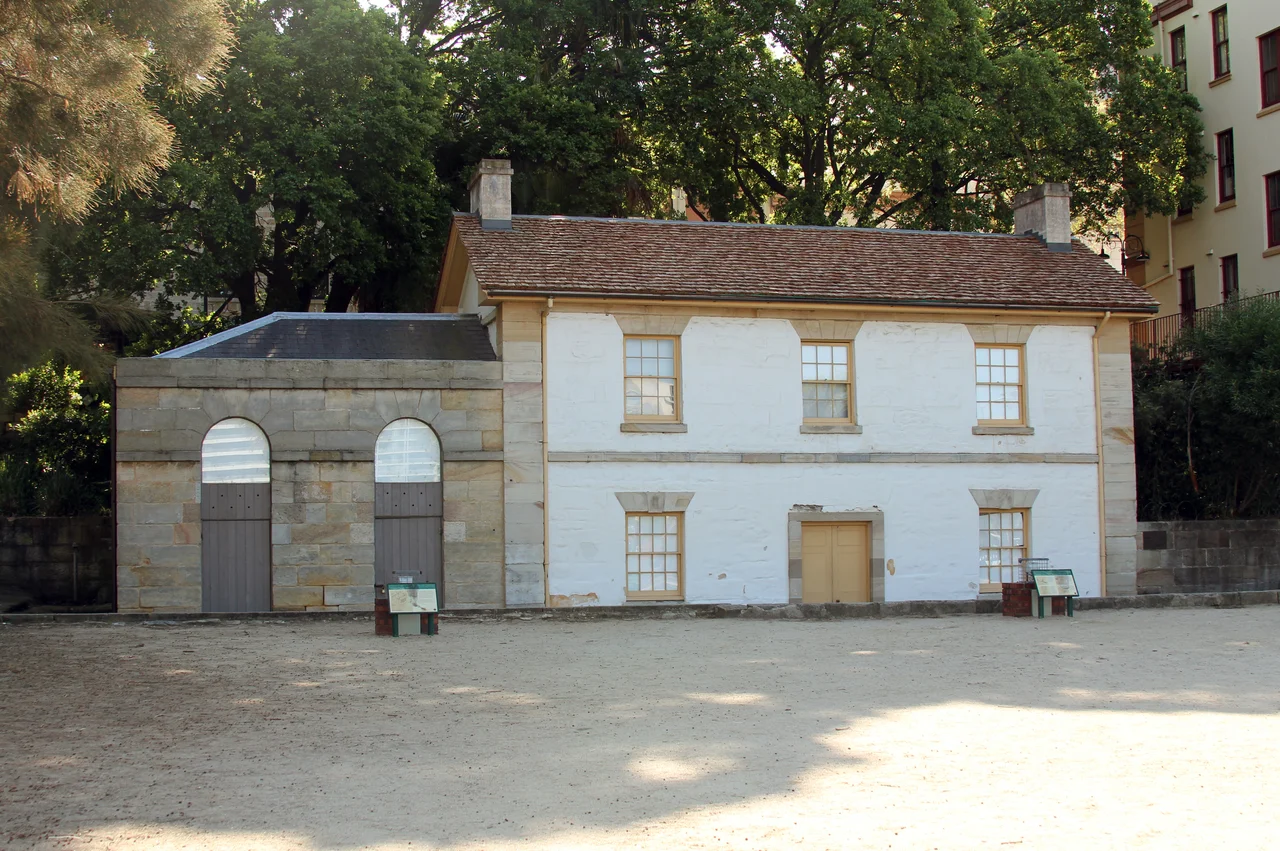

Cadmans Cottage
When this little sandstone cottage was built in 1816, the harbour lapped almost at its doorstep. At high tide the water came within eight feet of the walls, and boats could be hauled up on the rocks just outside. Two centuries later, Cadmans Cottage stands marooned roughly a hundred metres from the waterline, the sea pushed back by the relentless reclamation that built Circular Quay. The cottage did not move. Sydney did. It is the second-oldest surviving residential building in the city and the first ever built on the shoreline of The Rocks, a survivor that has outlasted the dockyard that surrounded it, the harbour that defined it, and very nearly the wrecking ball that came for so much of old Sydney.
A House for the Boat Crews
The cottage was never grand, and it was never meant to be. It was built to house the four government coxswains and their crews, the men who rowed officials and supplies around the young colony's harbour, and they lived here from 1816 until 1845. The building takes its name from John Cadman, a coxswain who occupied it in the 1840s, though by then it had already served a generation of boat crews before him. Its form is plain and honest: a rectangular sandstone block with classical Georgian touches, a plinth and pilasters that hint at architectural ambition above its humble purpose. There are no surviving plans, no record of who designed it or what it cost to build, which has tempted historians to credit the colony's celebrated convict architect Francis Greenway. The evidence is thin. The cottage keeps its own counsel about its origins, as old buildings often do.
Police, Sailors, and Decline
Few small buildings have worn so many lives. After the coxswains came the Sydney Water Police, who made the cottage their headquarters from 1845 to 1864, patrolling a harbour thick with shipping and the trouble that follows it. Then it became a Sailor's Home, from 1865 to 1970, a refuge of sorts for the mariners who passed through one of the busiest ports in the southern hemisphere. Around it, the world it had been built to serve was disappearing. In the 1880s the wharves of Circular Quay expanded; the docks and foreshore were filled and built over, severing the cottage's old connection to the water. By 1962 it stood vacant and failing, and in 1964 the Overseas Passenger Terminal rose nearby and blotted out its view of the harbour entirely. A building that had begun at the edge of the sea was now hemmed in by the modern city, forgotten and falling down.
Saved, and Read Like a Book
Cadmans Cottage was rescued in the nick of time. In 1970 the Sydney Cove Redevelopment Authority took control of The Rocks, and two years later the cottage was proclaimed a historic site under the National Parks and Wildlife Act, beginning a restoration that arrested decades of decay. In 1988, as Sydney prepared to mark the bicentennial of European settlement, archaeologists dug into the ground around the cottage and into the building itself. What they found mattered precisely because so little had been written down. The reclaimed land out front preserved traces of the Sailor's Home era that exist nowhere in the documents. Inside, old drainage and the scars on the western and northern walls recorded how people had used these rooms across more than a century and a half. For a building with almost no paper trail, the fabric itself became the archive, every layer of stone and sediment a sentence in a story no one had bothered to record.
Standing Still While Sydney Moved
There is something quietly remarkable about a structure this small surviving in a place this valuable. The Rocks sits on some of the most coveted real estate in Australia, and for most of the twentieth century old buildings here were demolished without ceremony to make way for the new. Cadmans Cottage endured, and today it serves as a gateway into the harbour's history, having housed the Sydney Harbour National Park information centre and welcomed visitors curious about the city's beginnings. To stand before it is to perform a small act of imagination: to subtract the towers and the cruise terminal and the hundred metres of made land, and to picture the water sliding up to the threshold while a coxswain readied his boat. The cottage was added to the New South Wales State Heritage Register in 1999. It earned the place the slow way, by simply refusing to fall.
From the Air
Cadmans Cottage stands at 110 George Street in The Rocks at 33.859°S, 151.209°E, on the western shore of Sydney Cove just south of the Harbour Bridge approach. From the air it is a tiny feature, best located by reference to its famous neighbours: the Sydney Harbour Bridge directly north, the Overseas Passenger Terminal on the cove's edge, and Circular Quay's ferry wharves immediately east. View on a low harbour circuit at 1,200 to 2,000 feet, with the Opera House across the cove to the southeast. Sydney Airport (YSSY / Kingsford Smith) lies roughly 9 km south; Bankstown (YSBK) serves general aviation to the southwest. Harbour airspace is controlled and heavily trafficked by scenic flights and seaplanes, so coordinate with ATC; mornings give the clearest light on The Rocks' sandstone.
Nearby Stories
- Royal National Park 28 km away
- Jervis Bay 107 km away
- Hive shipwreck 149 km away
- Apsley Falls 283 km away
- Smoky Cape Lighthouse 316 km away
- South West Rocks Pilot Station Complex 346 km away
- Roxy Theatre and Peters Greek Cafe Complex 413 km away
- 2003 Fiordland Earthquake 1774 km away