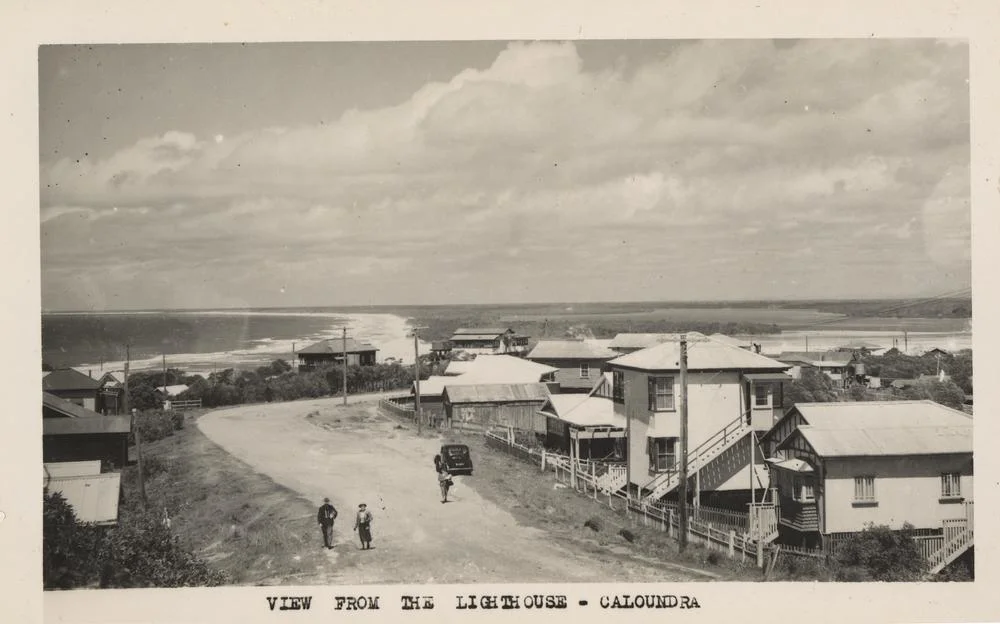

Caloundra Lighthouses
On 22 March 1999, a crane lifted Caloundra's old lighthouse onto the back of a truck, and the building came apart. The timber frame -- more than a century old, clad in corrugated iron -- gave way under the strain of being moved. For the people who had spent years lobbying to bring the town's oldest structure home, it was a sickening moment. The little tower had already survived being shipped off the hill three decades earlier and left to rot beside a boat club. Now, on the verge of rescue, it had nearly destroyed itself. They repaired it, tried again, and on 11 June 1999 the 1896 Caloundra Head Lighthouse finally stood once more on the exact patch of ground where it was built.
A Light for the Channel
When Queensland separated from New South Wales in 1859, the young colony had a single lighthouse to its name and a coastline that demanded many more. Caloundra Head got its light because of a discovery made in 1879, when the colony's portmaster sounded a new deep-water route -- the North West Channel -- running from Caloundra down the eastern shore of Bribie Island into Moreton Bay. It proved the safest, most reliable entrance to the Port of Brisbane, and in 1896 a lighthouse rose on the headland to mark its mouth. The tower was a distinctly Queensland design: a conical hardwood frame sheathed in corrugated iron, cheap to build with local timber, fitted with a fine optical apparatus imported from Chance Brothers near Birmingham. Fewer than a dozen of its kind were ever built.
The Keeper on the Hill
The first keeper arrived when the light was lit in September 1896, and his cottage quickly became the hub of a settlement. One room served as the local post and telegraph office; the steady traffic of residents collecting their mail wore a track along the ridge that eventually became Canberra Terrace, the town's main road. Because the keeper had a large family, the first Caloundra school was held for a time in his cottage. By 1910 a new incandescent vapour light -- the first of its kind in Queensland -- shone 22 miles out to sea, and many mariners reckoned it the finest on the coast. Lighthouse Hill became the place visitors were taken to admire the view, and the tower's silhouette spread onto postcards, brochures, and the local school crest, whose motto read simply: Giving Light.
Two Towers, Side by Side
By the 1960s, container ships were growing and the old light was ageing. In 1968 a second lighthouse went up beside the first -- a square reinforced-concrete tower carrying a glassed observation room, looking for all the world like an airport control tower. It combined lighthouse, signal station, and radar in one structure, one of only two of its design ever built in Australia and now the only survivor. For a while the two towers stood together, Victorian timber beside Space-Age concrete, a seventy-year leap in engineering compressed into a few metres of grass. It is a rare thing to see a craft and its successor preserved cheek by jowl, and the contrast is the whole point of the place.
Outliving Their Purpose
Neither light lasted as long as its builders hoped. The 1968 tower had a short working life: high-rise apartments soon rose along the coast and blocked its beam from the sea, and by 1978 a new light at Point Cartwright had taken over the channel. The signal station was de-staffed in 1992, its functions handed to an automatic unit on a nearby rooftop. The 1896 tower, meanwhile, had been hauled away in 1970 and nearly lost to decades of neglect before its dramatic return in 1999. Today both stand together again in a small hilltop park behind Kings Beach, looking out over Caloundra, Moreton Island, and the blue line of the Glass House Mountains. They no longer guide a single ship -- but the town that grew up around the old light has refused, twice over, to let it go.
From the Air
The Caloundra Lighthouses stand at approximately 26.80S, 153.14E, on the highest point of Caloundra behind Kings Beach, at the northern tip of the Pumicestone Passage about 80km north-east of Brisbane. The two towers sit side by side in a small hilltop park amid suburban and medium-rise development -- the white 1896 corrugated-iron cone with its red-domed lantern, and the taller square concrete 1968 signal-station tower resembling an airport control tower. The headland gives commanding views over Moreton Bay, Moreton Island to the south-east, the long sand sliver of Bribie Island, and the Glass House Mountains inland to the west. Nearest airports: Caloundra (YCDR) approximately 3nm west, Sunshine Coast (YBSU, Maroochydore) approximately 12nm north, Caboolture (YCAB) approximately 20nm south-west, Brisbane (YBBN) approximately 50nm south. Coastal sea breezes and summer afternoon cloud are common.
Nearby Stories
- Abbey Museum of Art and Archaeology 8.2 km away
- Noosa National Park 18 km away
- Cressbrook Homestead 33 km away
- 2010-2011 Queensland Floods 68 km away
- Childers Palace Backpackers Hostel fire 148 km away
- Cape Byron 174 km away
- Cape Byron Light 204 km away
- HMS Porpoise (1799) 514 km away