
Calton Hill
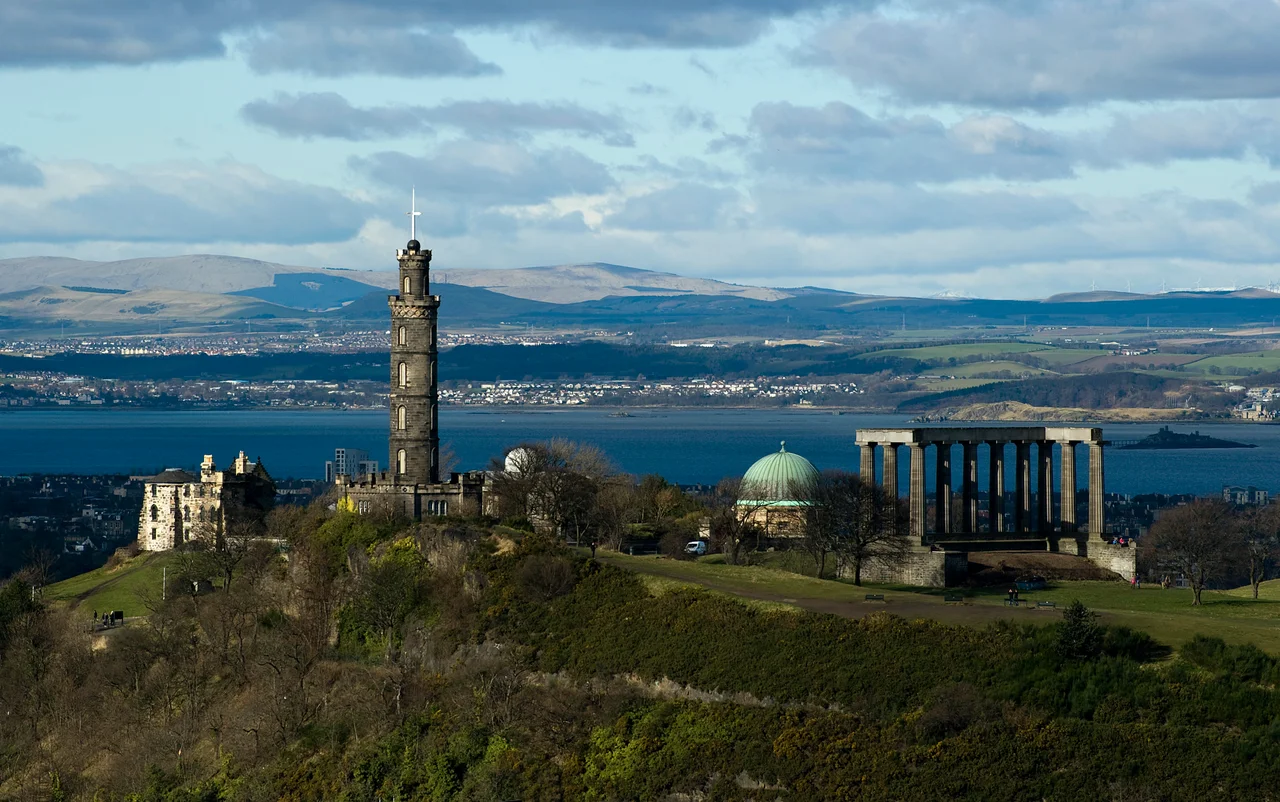
Climb Calton Hill at sunset and the city arranges itself for you. To the south, Arthur's Seat rises like a sleeping animal. To the west, the Castle floats on its rock above Princes Street. To the north, the Firth of Forth catches the last light. At your feet stand columns of a Greek temple that was never finished, a Greek tower commemorating a naval admiral, and an observatory shaped like an antique villa. The whole arrangement is so deliberately theatrical that it earned Edinburgh the nickname "Athens of the North," a comparison the city took seriously enough to start building the Parthenon. Then, in 1829, the money ran out.
Crag on the Hill
Calton's earliest recorded name was "Cragingalt," which appears on a 1560 Petworth map of the Siege of Leith. Linguists trace it through Old Welsh and Brittonic roots meaning roughly "crag on the hill" or "place of the small wood." The hill is part of the same volcanic geology that produced Arthur's Seat and Castle Rock, the cooled remains of vents that erupted around 350 million years ago. There may have been a prehistoric hillfort here. In 1456, James II granted the valley below the hill to Edinburgh for tournaments and "warlike deeds." In 1591, a Carmelite monastery on the hill's slopes was converted into a hospital for lepers, with rules so severe that opening the gate between sunset and sunrise was punishable by hanging from a gallows that stood at the entrance. Ten skeletons unearthed during tramway works in 2009 are thought to be patients from that hospital.
The Unfinished Parthenon
The National Monument of Scotland was begun in 1826 as a memorial to Scots who died in the Napoleonic Wars, designed by Charles Robert Cockerell and William Henry Playfair as a faithful copy of the Parthenon in Athens. Construction stopped in 1829 when the subscription fund ran out, leaving twelve columns on a high plinth and a chord of unfinished pediment. Edinburghers nicknamed it "the disgrace of Edinburgh," "Edinburgh's folly," and "the pride and poverty of Scotland." The half-built monument is now beloved precisely for its incompleteness. Nearby, Playfair was also responsible for the Dugald Stewart Monument (1831), a small circular temple commemorating the philosopher; the City Observatory; and Playfair's own astronomer-uncle's monument. The Nelson Monument, shaped like an inverted telescope, was completed in 1816 to honour the admiral who died at Trafalgar.
Fire and Politics
On the night of 30 April every year, Calton Hill transforms. The Beltane Fire Festival, a modern reinvention of an ancient Celtic ceremony marking the start of summer, draws over twelve thousand people to watch fire performers, drummers, and the Green Man and May Queen process around the National Monument. The festival was revived in 1988 by performance artists led by Angus Farquhar, with academic support from the University of Edinburgh's School of Scottish Studies, and has grown into one of the city's signature events. The hill also hosts a Hindu Dussehra festival in early October and the Samhuinn Fire festival at Halloween. The political dimension runs almost as deep as the festive one. For years a permanent vigil for Scottish devolution stood here, and in October 2004 Calton Hill was the venue for the Declaration of Calton Hill, which set out demands for a future Scottish republic. St Andrew's House on the steep southern slope is the headquarters of the Scottish Government, the everyday workplace of the institution the vigil helped bring into being.
The View Down
Robert Louis Stevenson called Calton Hill "the best place from which to see the city," and almost two centuries of photographs prove him right. The Old Town's silhouette unfolds along its ridge, the New Town spreads to the west in Georgian terraces, and beyond it all lies the silver tongue of the Forth. Old Calton Burial Ground on the southwestern slope holds an obelisk to political martyrs, an early monument to American Civil War soldiers from Scotland, and the graves of the philosopher David Hume and the publisher William Blackwood. The hill has appeared in films from Sunshine on Leith to Greyfriars Bobby. Whatever Edinburgh is doing on any given evening, you can usually see most of it from up here, framed between the columns of a temple that was never quite built.
From the Air
Located at 55.9553°N, 3.1822°W in central Edinburgh, immediately east of Princes Street. Calton Hill rises to 103 metres (338 feet) above sea level. From the air, look for the distinctive cluster of monuments on its flat summit: the unfinished Parthenon columns of the National Monument, the round Dugald Stewart temple, and the slim Nelson Monument tower. The Firth of Forth lies to the north, Arthur's Seat to the southeast, and Edinburgh Castle to the west. Edinburgh Airport (EGPH) is about 6 nautical miles west. Best viewed from 2,000-3,000 feet AGL in clear weather.
Nearby Stories
- Ardoch Roman Fort 2.2 km away
- Craignethan Castle 3.1 km away
- Haddington 3.8 km away
- Balvaird Castle 4.3 km away
- Battle of Kilsyth 9.4 km away
- Siege of St Andrews Castle 9.9 km away
- Neidpath Castle 11 km away
- Melrose Abbey 15 km away