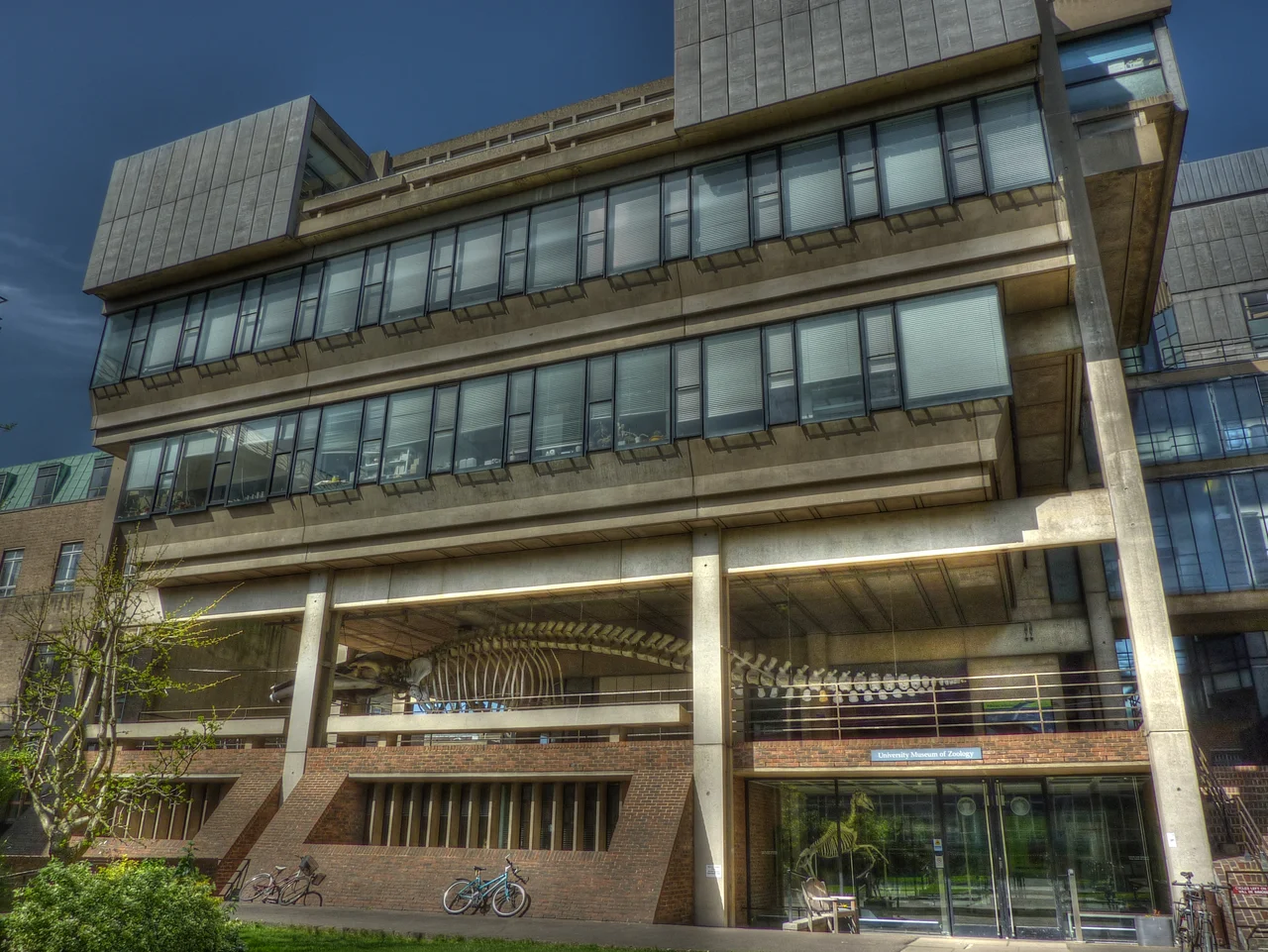

Cambridge University Museum of Zoology
Bobby the fin whale is 21.3 metres long, or roughly 70 feet. During the museum's renovation, finished in 2018, Bobby was dismantled, cleaned bone by bone, and then reassembled in the new entrance hall. Standing beneath that skeleton — which arches overhead in the building's soaring interior — you get a sense of what the Cambridge University Museum of Zoology is really about: not classification, not taxonomy, but the sheer physical fact of animals. Their scale. Their strangeness. Their presence on Earth and, in many cases, their absence from it.
Darwin's Specimens, Still Here
Much of the museum's collection was assembled during the nineteenth century, when the great collecting expeditions were simultaneously documenting the world's fauna and, in some cases, accelerating its depletion. Charles Darwin contributed specimens to the Cambridge Philosophical Society, which eventually made its way into the museum's holdings. Darwin himself collected insects from around Cambridge, and fish from the voyage of HMS Beagle between 1831 and 1836 are preserved here — still stored in spirit, still awaiting researchers who want to examine species catalogued by the man who would later explain why all species exist. Alfred Russel Wallace, who co-originated the theory of natural selection independently of Darwin, is also represented in the collections. The museum is, among other things, a physical archive of the moment biology became evolutionary science.
The Lost and the Extinct
The bird collection holds skins, eggs, and skeletal material — including remains of the dodo from Mauritius and the Rodrigues solitaire from the island of Rodrigues. These are not replicas. They are actual physical remnants of animals that no longer exist anywhere on Earth except in collections like this one. The museum also holds the skeletal remains of many other extinct species and the preserved skins of animals whose living populations are now critically endangered. This is part of what made the collections significant enough for designation in 1998 by the Museums, Libraries and Archives Council as being of outstanding historical and international importance. The fish specimens stored in spirit, some collected by Darwin himself, remain scientifically active: their DNA can be extracted and compared to modern populations, making them tools for twenty-first-century research even after nearly two centuries.
A Building Transformed
The museum reopened on 23 June 2018 after a major redevelopment, for which it received a grant of £1.8 million from the Heritage Lottery Fund. The renovation aimed to make the building more environmentally sustainable while creating new display spaces, upgraded storage, and expanded learning programmes. Bobby the fin whale, dismantled and cleaned during the works, returned to greet visitors in the transformed entrance hall. The redesigned galleries were conceived to connect people with animal diversity rather than simply to document it — participatory displays rather than cases of pinned specimens. The museum is part of the University of Cambridge Museums consortium and one of the eight Cambridge museums, all of which offer free admission to the public.
A Cast of Scientists
The museum's past superintendents read like a directory of Victorian natural history. William Clark served from 1817 to 1866; his successor John Willis Clark held the position until 1892. Reginald Crundall Punnett, who followed in 1908, is remembered today for his foundational work in genetics — Punnett squares, the grids used to predict inheritance patterns, bear his name. The collection itself preserves the work of dozens of collectors: F.M. Balfour, Professor of Zoology; Hugh Strickland, ornithologist; John Henry Gurney Sr., a banker who devoted his spare hours to birds. These were people who believed that documenting the living world was urgent, necessary work. Given what the century that followed would do to the populations they documented, they were right.
From the Air
The Cambridge University Museum of Zoology is located at 52.2033°N, 0.1204°E in central Cambridge, on the Downing Street site of the University of Cambridge. Cambridge is approximately 80 km north of London. London Stansted Airport (EGSS) is approximately 40 km to the south; Cambridge City Airport (EGSC) is a small general aviation airfield 3 km to the east. From lower altitude, the university's compact city centre — with its distinct collegiate architecture and the River Cam — is identifiable south of the A14.
Nearby Stories
- Kentwell Hall 2.5 km away
- Thetford Hoard 2.8 km away
- King's Ely 6 km away
- Bedford 7.8 km away
- White House Farm murders 13 km away
- Oundle 14 km away
- Hemel Hempstead 14 km away
- North Weald Airfield 15 km away