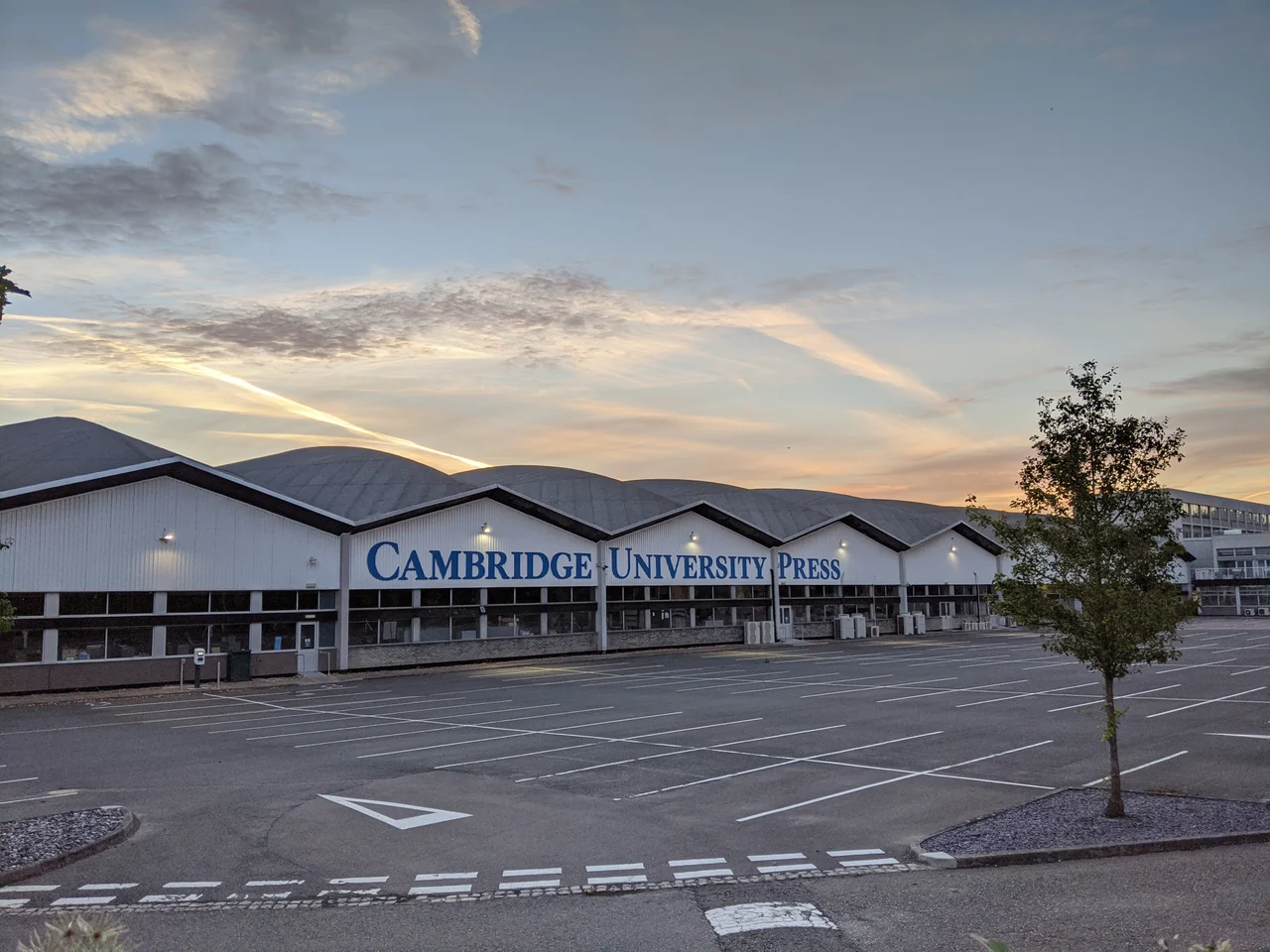

Cambridge University Press
Henry VIII granted Cambridge University the right to print books in 1534. His motivations were probably less about advancing scholarship than about establishing control over what got printed in an England he was remaking by force. But the letters patent issued that year set in motion something that would long outlast the king's intentions. Cambridge University Press has been operating continuously ever since — surviving the English Civil War, the Industrial Revolution, two World Wars, and the digital transformation of publishing — making it the oldest university press in the world.
From Thomas Thomas to Fifty Thousand Titles
University printing in Cambridge began in earnest when Thomas Thomas set up the first printing house in 1584. His first publication was a book called Two Treatises of the Lord His Holie Supper. That book is now nearly 450 years old, and Cambridge University Press has published over 50,000 titles since then, by authors from more than 100 countries, reaching readers in more than 40 countries around the world. The list of authors who have published with Cambridge is a compressed history of Western intellectual life: John Milton, William Harvey, Isaac Newton, Bertrand Russell, Stephen Hawking. The Nobel Prize count is even more striking — the Press has published works by more than 170 Nobel laureates, across physics, chemistry, economics, medicine, and literature. Richard Feynman, Niels Bohr, Samuel Beckett, Ernest Hemingway: the range suggests a press that understood scholarship broadly from the beginning.
The Pitt Building and the King's Printer
The Press's physical home shifted several times across the centuries. In 1833, a handsome new building on Trumpington Street in central Cambridge — the Pitt Building, designed by Edward Blore — became headquarters. It was listed as a heritage structure in 1950. In 1981 the Press moved operational functions to a purpose-built facility on Shaftesbury Road. But the Pitt Building remained, repurposed as a conference venue that still hosts events in Cambridge today. The Press also acquired Eyre and Spottiswoode in 1989, an old Bible and prayer-book publisher, which carried with it an ancient and peculiar title: the Queen's Printer — now the King's Printer. The Press remains one of only two publishers in England with the right to print the Book of Common Prayer and the King James Version of the Bible. The other is Oxford University Press.
A Near-Collapse and a Secret Deal
In November 1975, Cambridge University Press was facing financial collapse. Its chief executive Geoffrey Cass wrote a 60-page letter to the Inland Revenue requesting tax exemption — arguing that the Press's publishing activities were sufficiently aligned with the university's educational mission to qualify as charitable. The Inland Revenue had refused a similar request in 1940. This time, quietly and without public announcement, the exemption was granted. Oxford University Press made a similar request and received the same treatment. The arrangement remained largely hidden until journalists and rival publishers began raising questions in the early 2000s. In 2020, the papers held at the National Archives relating to the original applications were withdrawn from public access for fifty years. The episode remains one of the stranger footnotes in British publishing history.
Into the Digital Era
In 2016, Cambridge University Press replaced its separate online portals with Cambridge Core — a unified platform for accessing its academic publishing. By 2023, more than 50 percent of its research articles were available in open access mode, a significant shift for an institution that spent its first four centuries in the business of controlled print distribution. In 2021, the Press merged with Cambridge Assessment — the organisation that administers GCSE and A-level examinations for millions of students worldwide — to form Cambridge University Press and Assessment. It was the largest restructuring in the Press's history. Henry VIII's letters patent, issued to advance the Tudor state's control over the printed word, had become the foundation of an institution that now actively works to make knowledge freely available to anyone in the world.
From the Air
Cambridge University Press is headquartered at 52.1882°N, 0.1320°E in Cambridge, England, near the Shaftesbury Road campus. The historic Pitt Building stands on Trumpington Street at the heart of the city. Cambridge is served by London Stansted Airport (EGSS), approximately 40 km south. Cambridge City Airport (EGSC) is a small general aviation field immediately east of the city. The university's compact centre with its spires and collegiate courts is visible from lower altitude directly south of the A14.
Nearby Stories
- Kentwell Hall 2.5 km away
- Thetford Hoard 2.8 km away
- King's Ely 6 km away
- Bedford 7.8 km away
- White House Farm murders 13 km away
- Oundle 14 km away
- Hemel Hempstead 14 km away
- North Weald Airfield 15 km away