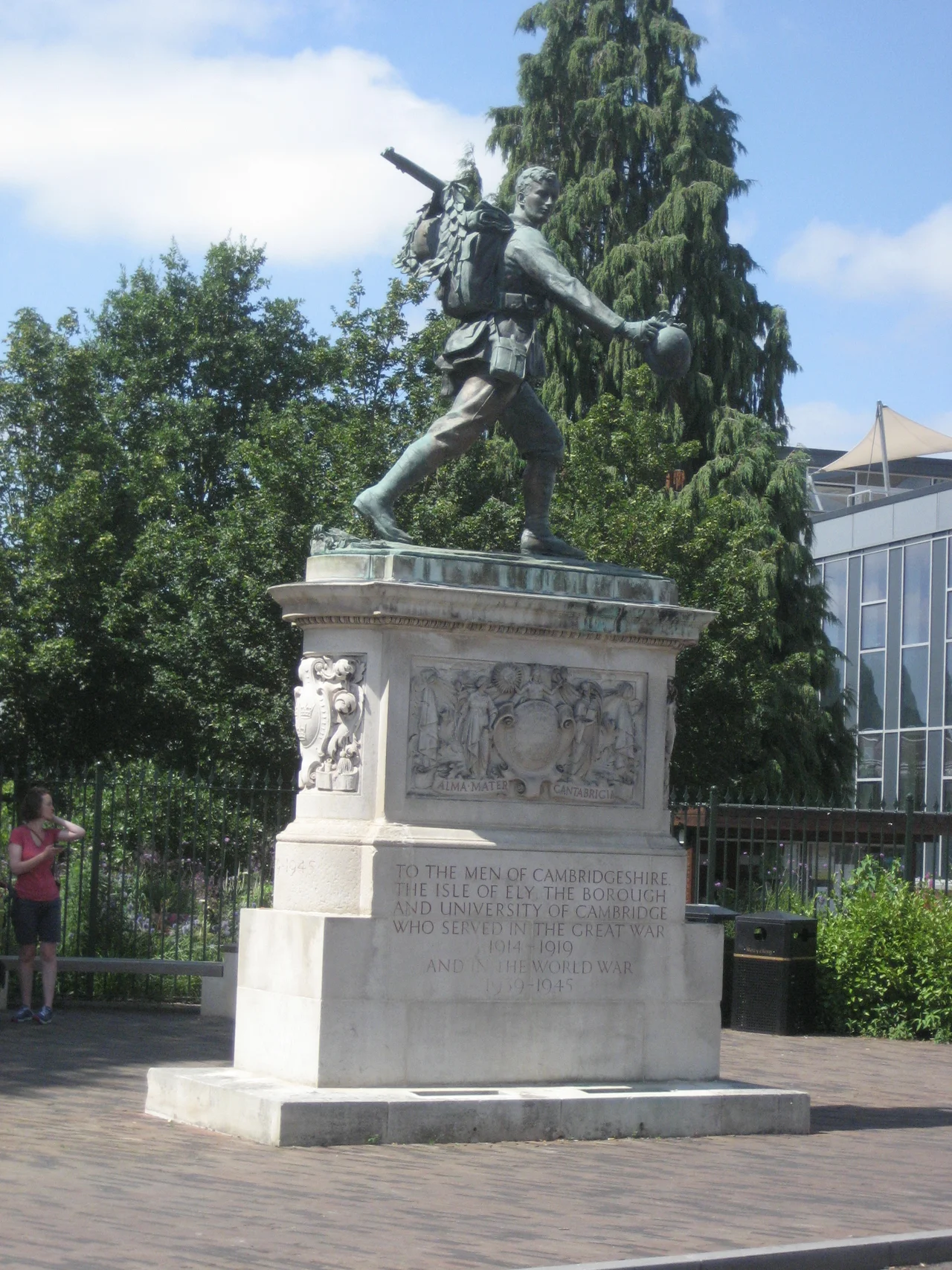

Cambridge War Memorial
He is bareheaded, carrying his helmet in one hand, and in that hand also clasps a rose. Another rose has fallen at his feet. His rifle is shouldered with a laurel wreath hanging from it, and on his backpack sits a captured German helmet — a trophy of the war he survived. He is walking up Hills Road toward the city centre, and he has turned his head back over his right shoulder to glance along Station Road toward the railway station. He is coming home. The Cambridge War Memorial, known as The Homecoming, was unveiled on Hills Road in 1922 by the Duke of York — the future King George VI — and it remains one of the most quietly moving war memorials in England.
The Debate Before the Bronze
After the First World War ended, Cambridge spent years arguing about how to remember it. The debates began in January 1919 when the Lord Lieutenant of Cambridgeshire Charles Adeane convened a memorial committee drawn from county and borough councils and the university. Proposals ranged from a clock tower to cottages for injured soldiers, from improvements at Addenbrooke's Hospital to a simple public amenity. The estimated cost of the eventual plans was £30,000, of which two-thirds was earmarked for Addenbrooke's. Fundraising was slow. By December 1919, only £12,000 had been raised. The colleges of the university contributed little — most were raising funds independently to commemorate their own war dead in their own chapels. By October 1920, the committee had approved plans for two memorials: oak panels at Ely Cathedral and a large monument in Cambridge itself.
A Canadian Sculptor's Vision
The Vice-Chancellor of the University of Cambridge, Arthur Shipley, recommended a Canadian sculptor named Robert Tait McKenzie to design the figure. McKenzie created a soldier wearing the uniform of the Cambridgeshire Regiment, slightly larger than life at 7 feet tall — reduced from the originally proposed 8 feet to save money. He modelled the soldier's face on Kenneth Hamilton, an undergraduate at Christ's College, Cambridge. The sculptor's choice — a soldier in motion, turning back toward what he has left behind — captures something that purely static monuments miss: the idea of return, the moment between the war and the rest of a life. The bronze was not ready in time for the official unveiling on 3 July 1922, and a gilded plaster cast stood in its place. The bronze was installed the following year, dedicated in a ceremony on 3 July 1923.
A Memorial That Keeps Moving
The plinth is built of brick faced with limestone, rounded at the ends like a sarcophagus, with high-relief carvings of armorial bearings and an inscription in red-painted lettering: 'TO THE MEN OF CAMBRIDGESHIRE / AND THE ISLE OF ELY, THE BOROUGH / AND UNIVERSITY OF CAMBRIDGE / WHO SERVED IN THE GREAT WAR / 1914–1919.' A second inscription was added after the Second World War. The memorial was moved in 1952 from its original position nearer the railway station to a traffic island in the middle of Hills Road, where it became a landmark — and sometimes an obstruction — for decades. In 2012 it was relocated again, this time to the south side of Hills Road, near Cambridge University Botanic Garden, as part of a development project. It became a Grade II listed building in 1996. The soldier, through all his moves, is still walking toward the city centre.
6,000 Names in Ely
The Cambridge War Memorial was not the only work the 1920 memorial committee approved. In St George's Chapel at Ely Cathedral, a series of oak panels was installed listing the 6,000 casualties from Cambridgeshire and the Isle of Ely who died in the First World War. The names are arranged alphabetically by town and parish, without distinction of rank — a democratic choice in an era when rank defined nearly everything. The panels were dedicated on 11 May 1922, with an address by General Lord Horne, commander of Eastern Command. Cost: £3,500. The memorial in Cambridge cost £4,500. Together they absorbed virtually all the money that years of local fundraising had produced. The rest of the proposed memorial programme — the improvements at Addenbrooke's, the war-related projects that were meant to improve the city for the living — faded quietly away, forgotten by the time the hospital moved from its old site in 1976.
From the Air
The Cambridge War Memorial stands at 52.1951°N, 0.1310°E on Hills Road in Cambridge, on the south side near Cambridge University Botanic Garden. Cambridge is approximately 80 km north of London. London Stansted Airport (EGSS) is 40 km to the south. Cambridge City Airport (EGSC) is a small general aviation field approximately 3 km east of the city centre. Hills Road runs south from the railway station into the heart of the city; the memorial can be spotted near the junction with Station Road from lower altitude on approach to the area.
Nearby Stories
- Kentwell Hall 2.5 km away
- Thetford Hoard 2.8 km away
- King's Ely 6 km away
- Bedford 7.8 km away
- White House Farm murders 13 km away
- Oundle 14 km away
- Hemel Hempstead 14 km away
- North Weald Airfield 15 km away