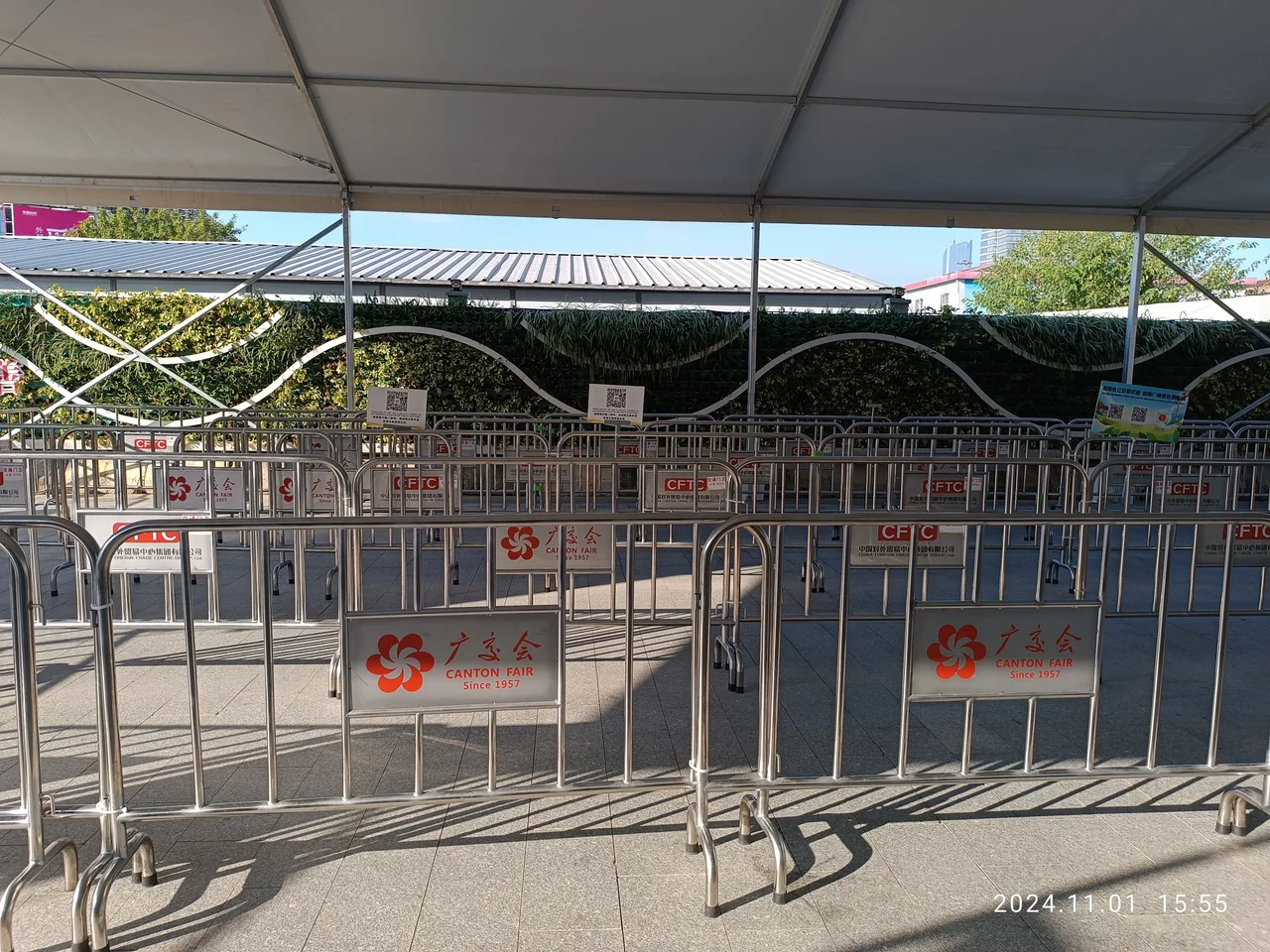

Canton Fair
Twice a year, Guangzhou absorbs the world. Buyers arrive from every continent with notebooks and business cards and the practical urgency of people who need to source products, negotiate prices, and close deals. The Canton Fair — formally the China Import and Export Fair — has been running every spring and autumn since 1957, making it not just the oldest trade fair in China but one of the oldest continuously operating trade exhibitions in the world. More than 24,000 Chinese enterprises set up in 51 exhibition sections. The sheer scale makes it less like a trade fair and more like a city within a city, assembled twice a year for the purpose of commerce.
Seven Decades of Buying and Selling
The Canton Fair opened for the first time in the spring of 1957, just eight years after the founding of the People's Republic of China. At that time, China's foreign trade was tightly controlled by the state, and the fair served as one of the few sanctioned windows through which Chinese goods could reach international buyers. It was called the Chinese Export Commodities Fair — a name that made its purpose explicit.
Over the following decades, the fair survived political turbulence and economic transformation. It continued through the Cultural Revolution, through China's opening-up period in the late 1970s, through the explosion of manufacturing that turned the Pearl River Delta into the workshop of the world. In 2007, the name changed to the China Import and Export Fair, acknowledging that trade now moved in both directions. The fair is co-hosted by China's Ministry of Commerce and the provincial government of Guangdong Province, organized by the China Foreign Trade Centre.
Inside the Exhibition Halls
The Canton Fair Complex on Pazhou Island in Haizhu District is immense — one of the largest exhibition venues in the world by floor area. The National Pavilion's export section is sorted into 16 product categories, spread across 51 exhibition sections. Electronics, textiles, hardware, ceramics, furniture, machinery, medical equipment — the range of goods on display spans almost every category of manufactured product.
The participants are equally diverse. Private enterprises, state-owned factories, scientific research institutions, wholly foreign-owned enterprises, and foreign trade companies all take booths. For many smaller Chinese manufacturers, the fair represents their primary channel to international buyers. For importers and procurement managers from around the world, it is a place where years' worth of sourcing work can be compressed into a week of floor-walking. Beyond buying and selling, the fair hosts activities including commodity inspection, insurance services, transportation logistics, and trade consultation — effectively serving as a complete commercial ecosystem.
The City That Trade Built
The Canton Fair does not exist in isolation. It is the most visible expression of something older and more fundamental about Guangzhou: this city has been a trading hub for more than two millennia. Merchants from the Arab world, India, and Southeast Asia were doing business at Canton's port centuries before European ships arrived. The Canton System that regulated foreign trade during the Qing dynasty funneled all Western commerce through this single port.
The Pearl River Delta that surrounds Guangzhou became, in the late twentieth century, one of the most productive manufacturing regions on the planet. Shenzhen, Dongguan, Foshan, Zhongshan — the cities of the delta turned the global supply chain inside out. The Canton Fair, meeting in this context twice a year, functions as something like a clearinghouse for all of that production capacity, connecting what the delta makes with what the world wants to buy.
Spring and Autumn Rhythms
The fair runs on a strict seasonal schedule: spring sessions in April and May, autumn sessions in October and November. For buyers who attend regularly, these seasons structure the year. Airlines add flights to Guangzhou. Hotel prices spike. The metro lines to Pazhou Island run crowded with visitors carrying sample bags and rolling luggage.
The city adapts. Restaurants near the fair complex extend their hours. Interpreters advertise their services in English, Arabic, Spanish, and Russian. Printing shops run overnight jobs for product catalogs. For the duration of each session, Guangzhou becomes, in a very concrete sense, the commercial center of the world — not by ambition or branding, but simply because so many transactions happen here, repeatedly, reliably, season after season, as they have since 1957.
From the Air
The Canton Fair Complex is located at approximately 23.10°N, 113.36°E on Pazhou Island in the Pearl River, in the Haizhu District of Guangzhou. From the air, the massive exhibition halls are visible as large rectangular structures along the river's south bank. The nearest major airport is ZGGG (Guangzhou Baiyun International), approximately 25 km to the north-northwest. The Pearl River and Pazhou Island are easy visual references when approaching Guangzhou from the south or east.
Nearby Stories
- Shunde 12 km away
- 2015 Shenzhen Landslide 15 km away
- Mount Luofu 23 km away
- Qingyuan Maglev Tourist Line 32 km away
- Kaiping 56 km away
- Heyuan 90 km away
- Chikan, Kaiping 92 km away
- Erlitou Site Museum of the Xia Capital 1257 km away